




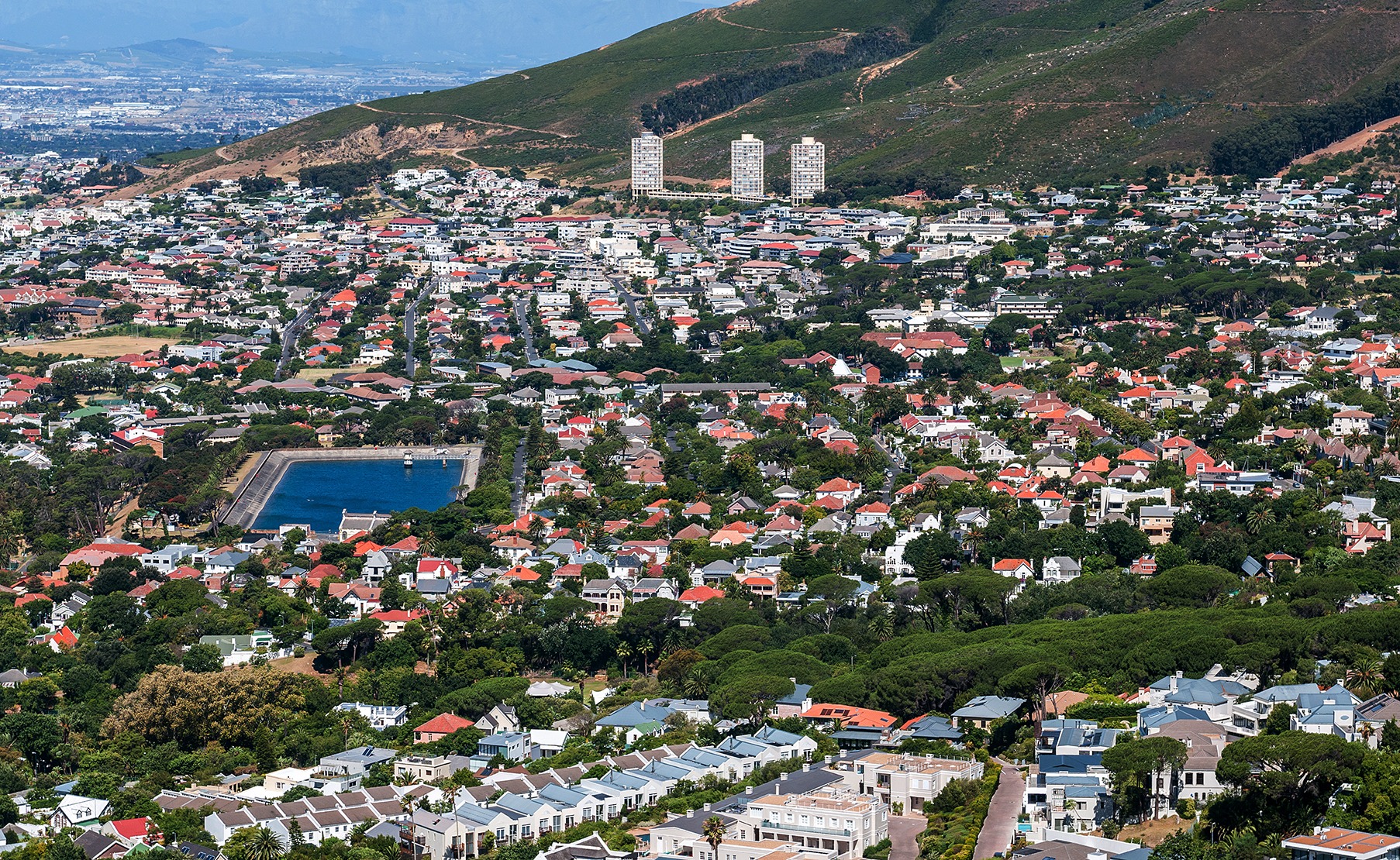
 Gardens and Vredehoek, Cape Town. (Photo: iStock)
 Amid rising outrage about Cape Town’s spiralling property prices, Mayor Geordin Hill-Lewis wrote a GroundUp op-ed in December 2025 designed to correct some popular misconceptions.
“Foreign buyers are not the villains in Cape Town’s story,” Hill-Lewis wrote.
He acknowledged that foreign property ownership in Cape Town had risen since Covid, from 2.5% to 4.3% of purchases between 2020 and 2024.
But these buyers, Hill-Lewis argued, “overwhelmingly cluster along the Atlantic Seaboard and pockets of the Helderberg region. These are luxury neighbourhoods on mountainsides and coastlines”.
Foreign demand pushed up prices “at the very top end” of the market, the mayor wrote.
“Blaming foreigners is comforting, but it is not serious analysis.”
/file/attachments/orphans/iStock-2196098414_381633.jpg "Sea Point, Cape Town. (Photo: iStock)")
Yet the perception that foreign money is at least partly to blame for distorting the Cape Town property market continues to endure.
“Note that in addition to having different earning potential to us (ie, earning in euros or dollars), I’ve also heard stories about foreigners who already own property in their local country taking funds from their access bonds to purchase homes cash in the Cape. Meaning that they can benefit from the substantially lower interest rates in their home countries (eg, Netherlands interest rate sits consistently below 5%). So triple advantage,” one frustrated resident wrote on Reddit.
Daily Maverick asked Hill-Lewis for the data substantiating his claim, but the mayor’s office had not responded to this or other questions by the time of publication.
Where the data runs out
It is difficult to obtain data on this issue, because South Africa does not keep a public register of property sorted by owner nationality.
The Deeds Office can be searched, but only one title deed at a time.
Lightstone, a commercial property analytics firm, does aggregate the numbers, but in extremely broad strokes, representing simply the percentage of total sales.
What we wanted to know was whether the mayor was correct in his assertion that foreign nationals are essentially buying only top-end properties in touristy suburbs – or whether there was evidence to suggest that locals might be competing with foreign buyers for more modest homes.
So, on the suggestion of a reader, Daily Maverick turned to Airbnb.
Inside Airbnb, an independent project that scrapes and republishes the platform’s listings, records each host’s self-reported location.
We pulled the full Cape Town dataset: 26,877 listings tied to 14,135 hosts. About 820 of those hosts, 8.1% of the ones who disclose a location at all, say they are based outside South Africa. Between them, they run roughly 1,089 listings.
/file/attachments/orphans/new3_765833.jpg "(Image: Generated by Claude)")
Advertising a property for short-term rentals does not automatically equate to owning the property, so we went to work on refining the data.
We stripped out commercial operators, the agencies and management companies that hold property on other people’s behalf: among them the London villa firm Oliver’s Travels, which alone lists 16 Cape Town units.
We also removed hosts who described themselves as South Africans living temporarily abroad.
What was left was 755 individuals, overseas-based, running 993 Cape Town listings.
/file/attachments/orphans/new1_950418.jpg "(Image: Generated by Claude)")
Many are not letting a single spare flat: 62 of these hosts run three or more listings each, and the top 10 hold 73 properties between them.
We are not publishing these host’s names or listings to protect their identities in the current climate.
/file/attachments/orphans/new2_379160.jpg "(Image: Generated by Claude)")
What the properties are actually worth
To test the mayor’s “luxury” framing, we took a sample of the units these overseas hosts rent out and asked a Cape Town estate agent to put a price on them.
Anita Momberg of Rock Properties worked from Lightstone valuation reports and current comparable listings on Property24.
She valued a 32m² one-bedroom on Kloof Street at R1.5-million to R1.65-million, a 47m² Gardens flat on the corner of Kloof and Camp at about R2-million, and a 40m² Oranjezicht studio at about R2.2-million.
A small two-bedroom near the CTICC, she put at around R2.5-million.
None of these sits on the Atlantic Seaboard, and none comes near the prices the mayor depicts.
The properties we studied were predominantly located in Gardens, Oranjezicht, Lagoon Beach, Blouberg, and in one case, the slopes above Hangberg, the traditionally coloured fishing community in Hout Bay.
The host of that last property describes herself in her own listing as a German surgeon who owns “two beautiful houses” in Cape Town.
Guests, she explains, reach her apartments by driving “through this vibrant neighbourhood where many local fishermen and their families live”.
It is a long way from a Clifton bungalow.
Beyond the Atlantic Seaboard
The aggregated data from Lightstone does give the mayor part of his argument.
Lightstone reported in April 2025 that foreigners without South African residency paid an average of R2.7-million for property in 2024, more than double the R1.2-million average for local buyers, and that the Western Cape drew about 40% of all purchases above R10-million.
But the same analysis simultaneously shows foreign buyers reaching well down the price ladder. They accounted for roughly 15% of sales in the R3-million to R5-million band.
The average foreign purchase price of R2.7-million speaks for itself, situating these properties inside Cape Town’s mid-market, not at the very highest end.
/file/attachments/orphans/iStock-615793406_454056.jpg "Scarborough on the Cape Peninsula (Photo: iStock)")
The geographic spread shows up elsewhere, too. A 2025 report by the property firm REI recorded international buyers spending R600-million in February and a record R700-million in April, and named demand well beyond the Atlantic Seaboard: Muizenberg, Kommetjie, Scarborough, Blouberg and Hout Bay.
EWN reported in November 2025 that foreign buyers accounted for over half of all sales in Scarborough in 2024.
As the emigration advisory concern Finglobal noted in 2023, there are very few barriers to entering the local property market as a foreign buyer.
Non-residents need no visa, can buy remotely without setting foot in the country, and pay the same transfer fees and costs as any local.
The local economy argument
Airbnb has claimed that it contributed R23.5-billion to the South African economy in 2022 alone.
“Amid increasing living costs, local hosts and their communities are also benefiting,” the company said in a press release at the time.
The word “local” seems important to highlight there, because some analysts dispute the notion that foreign-owned Airbnbs being rented out largely to other foreigners provide a significant amount of value to the South African economy.
“A non-resident who owns a property and Airbnbs it out for part of the year and then also gets to come to South Africa on holiday at no additional cost is certainly not expanding or growing our economy, not creating any jobs, etc, in the way that is envisaged under the international tax treaty position,” tax expert Lance Collop told Daily Maverick
Then there is the question of VAT collection.
“For every million rands that a high-end property in Camps Bay is let out for a week, we should be receiving R150,000 in VAT,” Collop said. “I don’t believe that we do.”
Collop is one of many who believe that there should be some additional form of taxation on foreign property purchases in a city with a limited housing stock like Cape Town.
He points abroad for templates: Canada’s ban on non-resident purchases, Australia’s bar on foreigners buying existing homes, the UK’s stamp-duty surcharge, and Singapore’s 60% levy on foreign buyers.
These measures are among those explicitly dismissed by Mayor Hill-Lewis in his December op-ed.
“What will not deliver affordability are the familiar political distractions such as rent caps, foreign-buyer restrictions, or attempts to regulate prices downwards,” he wrote.
None of this proves the mayor wrong that foreign buyers are over-represented at the very top, as evidenced by the Lightstone finding that they account for 40% of sales above R10-million.
But the average foreign purchase price tells the other half of the story, sitting squarely in the market that locals compete for, and many of the overseas hosts’ properties in our sample reflect that.
On the available evidence, foreign demand reaches further into the ordinary market than the Mayor of Cape Town’s account supports. DM
Comments
Scroll down to load comments...