




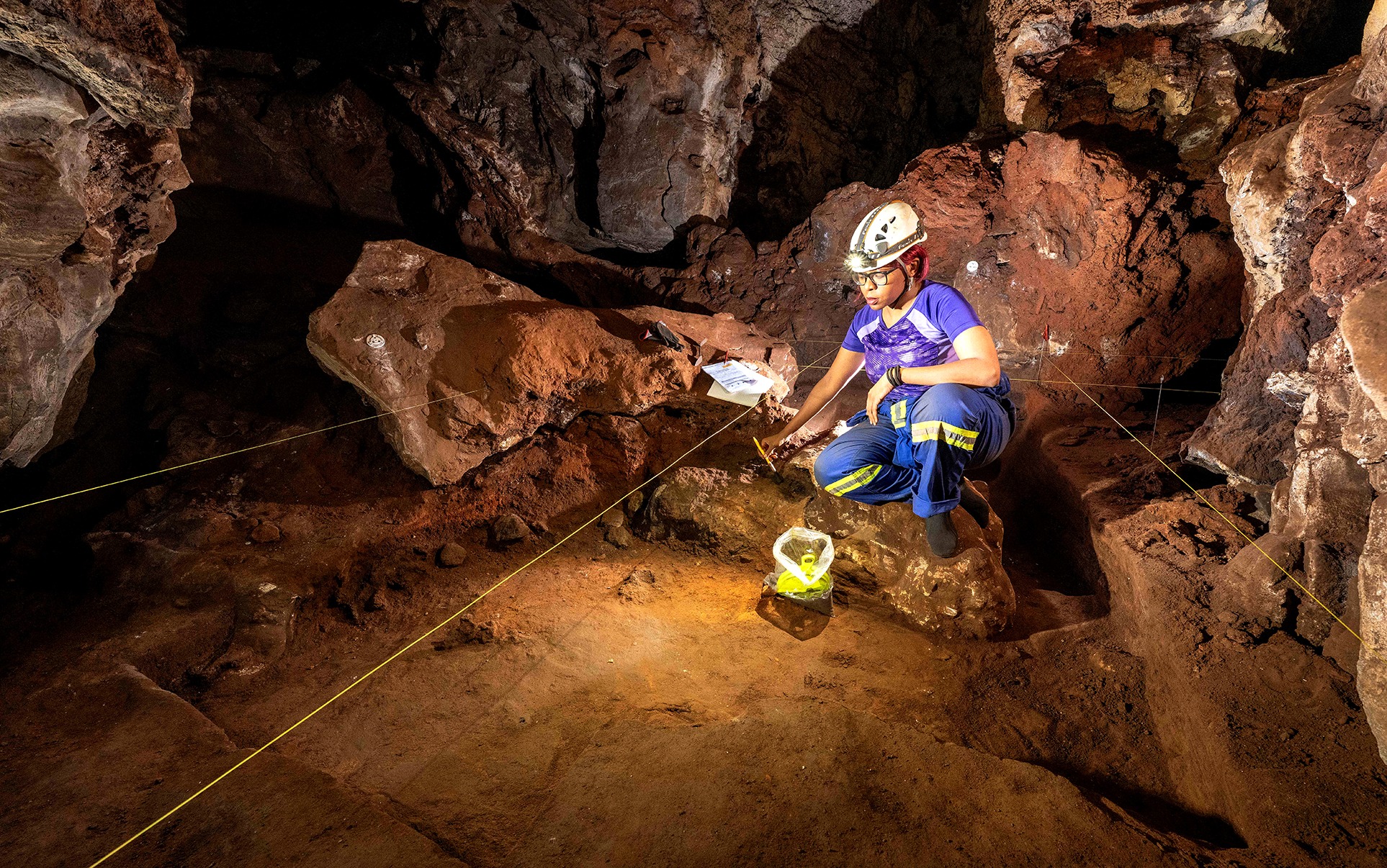
 National Geographic Explorer and biological anthropologist Keneiloe Molopyane studies an excavation pit. Molopyane was one of the members of the all-female ‘underground astronauts’ who helped excavate Homo naledi fossils. (Photo: Robbie Shone / National Geographic)
An international team of researchers successfully extracted and analysed the first-ever protein fragments from 23 fossil teeth of Homo naledi, found in the Cradle of Humankind World Heritage Site in South Africa.
The teeth tested were from all the individuals found to date in the Rising Star cave system and represent fossils “from infants to older ages, including those whose teeth were significantly worn. Our interpretation is that they had some kind of cultural practice,” said Professor John Hawks, a co-author of the paper and member of the Rising Star team.
/file/attachments/orphans/20_NGS2025EXPLOR_LeeBerger_CR_RobbieShone_051325_0139_982244.jpg "National Geographic Explorer-in-Residence and paleoanthropologist Lee Berger, from the University of the Witwatersrand, leads team member Mathabela Tsikoane up a tight and awkward climb on the main thoroughfare through Rising Star Cave in South Africa. This part of the cave is quite typical of some of the passageways within the cave system. (Photo: Robbie Shone / National Geographic)")
Professor Lee Berger, National Geographic Explorer-in-Residence and corresponding author of the study, who is still an Honorary Professor at Wits University, said: “The chance of having sampled 20 individuals and they are all from one sex, is quite literally one in a million.”
First described by Berger and colleagues from the Dinaledi Chamber of the Rising Star cave system, Homo naledi is an extinct hominin species with a combination of human-like and pre-human-like features that lived between 335,000 and 241,000 years ago.
The study was published in the journal Cell, by scientists from the University of Copenhagen, the University of the Witwatersrand, the National Geographic Society’s Rising Star project and 13 collaborating global institutions.
To determine the biological sex of each individual, researchers looked for Amelogenin-Y – a protein that is uniquely coded onto the male Y chromosome – within the tooth enamel.
Thorough examination of ancient proteins from the enamel of 23 Homo naledi teeth revealed a complete absence of the marker, indicating a strong likelihood that each individual discovered in the Rising Star Cave system was biologically female.
Among hominins, as in all other mammals, females typically have two X chromosomes, whereas males have one X and one Y chromosome. Because only males have an Y chromosome, finding Amelogenin-Y tells researchers with certainty that the tooth belonged to a male.
Hawks said they sampled fossils from all the chambers in the cave system and from every individual they had found. “In total, there are 200 teeth, but they don’t belong to 200 individuals, of course.
“We don’t know where the males are, but what we found was super interesting. There is a reason for this,” he said. “There are many past human societies with sex-specific burial practices, but we’ve found very little hard evidence of this from the earliest burial sites of modern humans or Neanderthals.
/file/attachments/orphans/12_NationalGeographic_RisingStar_les1-dh3-frontal-comparison-photo-ghost_135609.jpg "Two female skulls of Homo naledi, the ‘Neo’ skull from the Lesedi Chamber (top left) and the DH3 skull from the Dinaledi Chamber (below right). These represent the largest and smallest known Homo naledi skulls. (Photo: the Rising Star programme)")
“These remains of Homo naledi are older than any known Neanderthal or modern human burial site, and it’s remarkable to see that they may all be female.”
“Unlike those found in other remains like bone fragments, proteins in tooth enamel are preserved because dental enamel – the hardest tissue in the human body – shields proteins from environmental contamination, even for millions of years. This makes them ideal carriers of genetic information from deep time,” said South African-born scientist and lead study author Dr Palesa Madupe.
/file/attachments/orphans/15_PalesaMadupe_CreditPalesaMadupe_981415.jpg "Palesa Madupe, a South African-born scientist and lead author of the study. (Photo: Palesa Madupe)")
Madupe is a molecular scientist who was a postdoctoral researcher at the University of Copenhagen at the time of the study and is currently a researcher at the Max Planck Institute for Evolutionary Anthropology in Germany.
“It is exciting that the team was able to recover genetic information from H. naledi in the form of palaeoproteins, and this opens the door for future analyses during this time period. The methodology used here is particularly important because it is minimally invasive, meaning our precious fossil heritage doesn’t need to be destroyed to obtain that information,” she said.
Why the size variation?
The study helps resolve the long-standing mystery of why Homo naledi lacked significant size variation. Hawks added that the team would revisit their comparison with other species with this new knowledge, with regard to biology and female development.
When the Wits University team first discovered and excavated the Homo naledi remains in 2013, they noticed something puzzling – the adult fossils found in the Dinaledi Chamber were all very similar.
/file/attachments/orphans/10_NationalGeographic_RisingStar_nalediexcavation_creditMathewBerger_363851.jpg "A fossil mandible of Homo naledi photographed during palaeoanthropological research in the Cradle of Humankind. The specimen forms part of ongoing studies into the anatomy and evolution of the extinct hominin species. (Photo: Mathew Berger)")
/file/attachments/orphans/06_NationalGeographic_RisingStar_nalediexcavationMathabelaTsikoane_728415.jpg "An excavator’s hand carefully removes sediment during a 2019 excavation inside the Rising Star Cave. (Photo: Mathabela Tsikoane / National Geographic Rising Star Project)")
The adult fossils had very little variation in size, shape, and other physical traits. Typically, some variation is expected among hominins, especially among males and females, otherwise known as sexual dimorphism.
“In some other ancient hominins, there is a bias in the preservation of male individuals. Naledi now gives us a huge opportunity to understand the biology of female hominins,” said Hawks.
Extracting the ancient proteins
To investigate this anomaly, researchers applied a minimally destructive acid etching technique to carefully extract fragments of ancient proteins – called peptides – from the remains.
The peptide samples were then analysed with a mass spectrometer to identify all of the proteins present in the remains, including amelogenin – a process called paleoproteomic analysis.
“It appears that the most likely explanation for the observed absence of an Amelogenin-Y marker in these individuals is that we are seeing a sex-bias in mortuary practice — a practice until now only observed in contemporary human cultures,” said Berger.
/file/attachments/orphans/22_EnricoCappellinipreparingancientsamples_creditMeaghanMackie_971025.jpg "Enrico Cappellini, Professor of Paleoproteomics at the Globe Institute, University of Copenhagen (Denmark), senior and corresponding author of the study. (Photo: Enrico Cappellini)")
He told Daily Maverick that, from his “perspective (and I believe others on this work), the most likely explanation for this separation by sex in death is some sort of complex cultural practice by Homo naledi that segregates the sexes after death for cultural purposes.
“Our numbers are large enough that chance can be removed, of course, and natural taphonomic processes or processes like patriarchal or matriarchal cultural systems would be unlikely to remove baby boys from such an assemblage.
“Yes, we can see this in the skeletons, and in hindsight, perhaps we could have suggested this originally, given the very low sexual dimorphism we reported, lack of strong muscular markings on bones, the gracile nature of the individuals and overall lack of male markers in the skeletons.
“We even published that the variation in the teeth was so low that it could be subsumed into a single sex sample of humans, but given the prevailing attitude in the field against contemporary human levels of culture, innate small-brained hominin, we just didn’t allow ourselves to go there!” said Berger.
Still, the research team acknowledges in this work that there could be another reason for the absence of male markers in the tested Homo Naledi remains: the Amelogenin-Y gene may have mutated or been deleted over time.
“While the deletion of the entire Amely gene has already been observed in extant male humans and even in the DNA of a Neanderthal male, it’s very unlikely that this would be the case among even half of the 20 individuals we studied or for an entire population,” explained Enrico Cappellini, Professor of Paleoproteomics at the Globe Institute, University of Copenhagen, where the analytical work took place, and senior and corresponding author of the study.
“Either scenario, namely the absence of H. naledi males in the Rising Star cave system or a systematic deletion of their Amely gene, is fascinating and would have deep implications for a better understanding of the biology and evolution of this species.”
This finding is particularly significant because Homo naledi is anatomically distinct from modern humans, possessing a brain size only slightly larger than that of a chimpanzee, the authors said. Despite this smaller cranial capacity, a growing body of research suggests that the species engaged in practices once considered uniquely human.
According to Professor Rebecca Ackermann, Dr Palesa Madupe, the lead author, is a young black South African scientist and a real “rising star” in the field, once again confirming how South Africans can rise given opportunities and resources.
“It will be interesting to do further studies of H. Naledi to determine whether we are indeed sampling all females, as it appears, or whether H. Naledi has a rare mutation/deletion of the Amely gene in some or all males, making them undetectable with this method,” she added.
Many questions remain: Where are the males? And as Berger said: “With these and other discoveries across the planet, it is becoming increasingly evident that we have grossly underestimated the cultural capacity and complexity of ancient human relatives, even the very small-brained ones.” DM


Comments
Scroll down to load comments...