



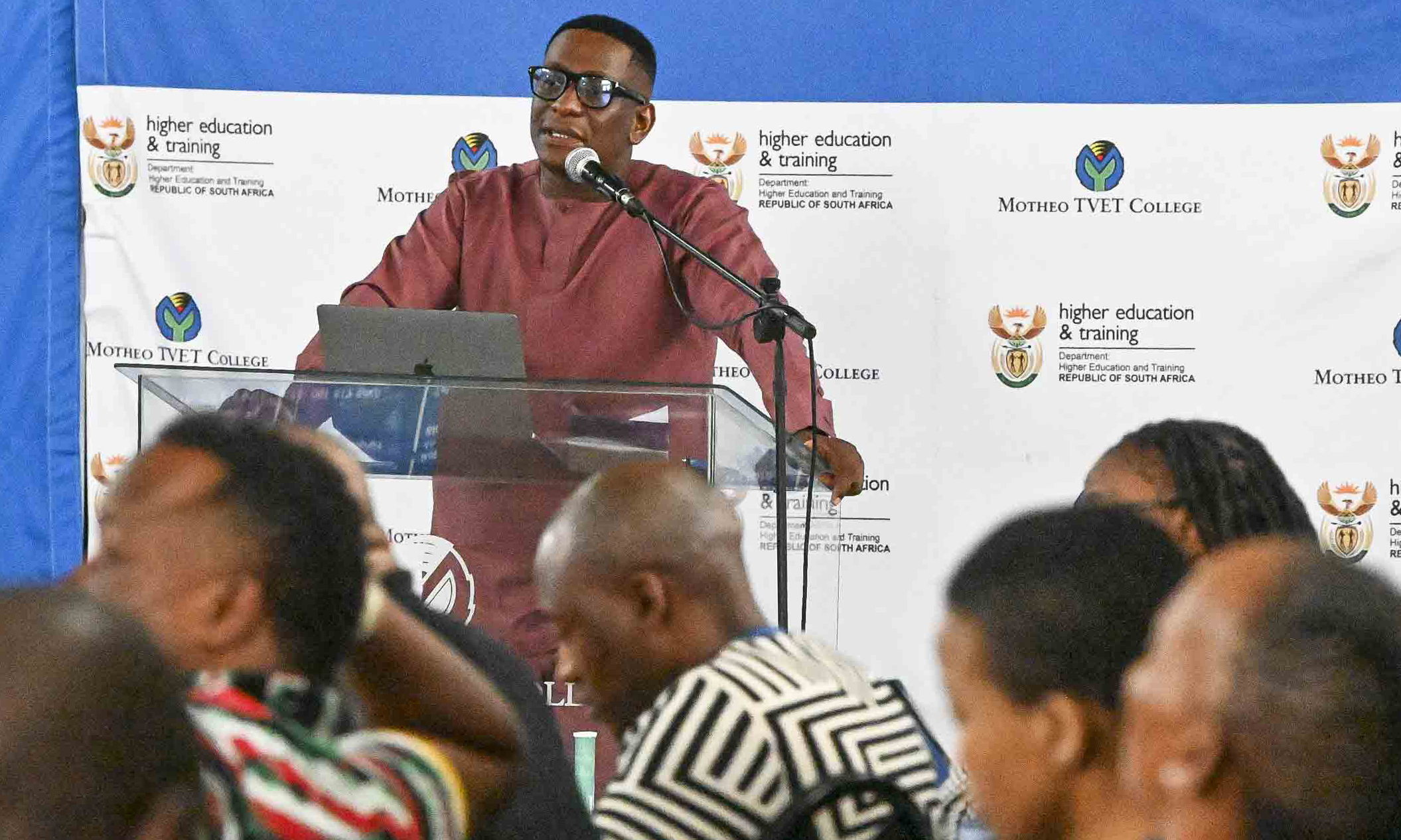
 Chairperson of the parliamentary committee on higher education Tebogo Letsie addresses committee members. (Photo: Gallo Images / Volksblad / Mlungisi Louw)
Members of Parliament serving on the parliamentary committee on higher education have called for universities to provide evidence that no suitably qualified South African could fill academic posts before appointing foreign nationals.
The demand emerged during a committee meeting on 24 June 2026, where the Department of Higher Education and Training (DHET) presented updated figures on the employment of foreign academics in the post-school education and training sector.
According to the department, 6,739 foreign academic staff members were employed at South African universities in 2024, based on audited data. Zimbabwean nationals accounted for 27% of the total, while Nigerians made up 14%, making them the two largest groups of foreign academics in the sector.
However, the department acknowledged significant shortcomings in the data available to it, including uncertainty over how many foreign academics are permanent residents, naturalised citizens or holders of critical skills visas.
The issue has come under increased scrutiny since several universities, including the University of Cape Town (UCT) and Stellenbosch University, appeared before the committee to account for their employment practices.
/file/attachments/orphans/ED_587038_743944.jpg "University of Cape Town staff and students attend a sit-in protest against gender-based violence on 21 November 2025. (Photo: Gallo Images / Brenton Geach)")
When UCT previously briefed MPs, committee members expressed concern that at the professor level, foreign national academics outnumbered black African, coloured and Indian academics combined. University officials acknowledged the imbalance and described it as unacceptable.
The department told MPs it agreed that South Africans should be prioritised for employment opportunities and that concerns about compliance with labour and immigration laws were being taken seriously.
DHET Deputy Director-General for University Education, Dr Thandi Lewin, said the department lacked sufficient data to determine the extent of any potential irregularities.
“The difficulty that we have is that we have the suspicions, but not good enough data, to really tell us how much of this is … happening. When Stellenbosch [University committee] came, they presented the data openly, in a way that we want all institutions to do. In just four slides, they provided a very clear picture of the situation. Who are permanent, who are naturalised, and who have critical skills visas and in which areas… Unfortunately, we did collect additional data at the request of the committee working with Universities South Africa, but … it is not a great data set,” said Lewin.
She said information relating to critical skills visa holders remained incomplete and still needed to be provided by institutions.
Opening the meeting, Higher Education Minister Buti Manamela reminded universities that employing foreign nationals without valid documentation was unlawful.
He said the Immigration Act made it a criminal offence to employ a person who did not possess a valid work visa and stressed that South Africans and permanent residents should be prioritised, with foreign nationals appointed only where the required skills were demonstrably unavailable locally.
Manamela said that any institution that breached these requirements was “not exercising academic freedom. It is breaking the law, and it will be treated accordingly.”
MPs challenge department’s interpretation
Patriotic Alliance MP Ashley Sauls disagreed with the minister’s interpretation that permanent residents should enjoy the same priority status as South Africans by birth in employment matters.
“It is my position that I disagree with the interpretation of the minister around naturalised citizens having the same priority status as South Africans by birth when it comes to employment and transformation aspects... My position is that the Department of Higher Education [is] intentionally using the law to give foreign nationals jobs that South Africans are able to do, and qualified to do,” said Sauls.
Lewin rejected the suggestion that universities were deliberately favouring foreign nationals.
“I don’t think that there’s any evidence that universities are intentionally using the law to give foreign nationals jobs.” She said the department was not doing enough in many aspects, “but we do have a number of programmes in the department that are looking at specifically developing academics in our own universities.”
The debate also touched on the Employment Equity Act. While permanent residents are legally entitled to work in South Africa and enjoy protection under labour legislation, affirmative action measures under the Act are directed at designated groups as defined in the legislation.
Sauls argued that the South African Constitution stated that “every citizen has the right to choose their trade, occupation or profession freely”, adding that the right did not automatically extend to foreign nationals or permanent residents. This meant the state could pass laws regulating or restricting certain jobs to citizens only.
Committee chairperson Tebogo Letsie cautioned that legal advice would be required to settle the differing interpretations raised.
Oversight concerns
African National Congress MP Gaolatlhe Kgabo criticised the department’s inability to effectively monitor universities’ employment practices and questioned how the department ensured that institutions complied with labour and immigration laws.
He asked what action would be taken if a university council failed to follow the law. “We would be able to intervene, and we would be able to do an investigation, and we would be able to take action against the council of that university, because the Higher Education Act empowers us to do that,” said Lewin.
She acknowledged, however, that the department did not exercise direct oversight over every senior appointment made by universities.
“In the case of universities, it’s not our responsibility, and I’m not saying that it shouldn’t be, but I’m saying that at the moment the university branch does not exercise authority over all senior appointments at all universities, and I’m not saying that we shouldn’t, but we do not currently do that. Should we be requested to do that … we would probably need to rethink how our branch is structured and what kind of capacity we need,” said Lewin.
Letsie stressed that committee members were not opposed to the employment of foreign nationals, but wanted an assurance that universities were complying with South African law when making appointments.
Responding to Daily Maverick questions on illegal foreign nationals amid tensions over the March and the March protests, Kopanang Africa Against Xenophobia’s Dale McKinley said, “Our percentage of academic staff that is foreign-born is very low relative to many other countries, particularly developed countries where many academics from the global South are situated.
“Imagine if the United States or the UK decided that South African academics and others foreign-born would have to leave, or shouldn’t be going. You would have tens of thousands of academics having to be taken away, and that is simply not feasible nor is it desirable,” said McKinley.
The DHET said it would continue to work with universities and Universities South Africa to improve the quality of data available on foreign academic appointments and immigration status. DM
Comments
Scroll down to load comments...