




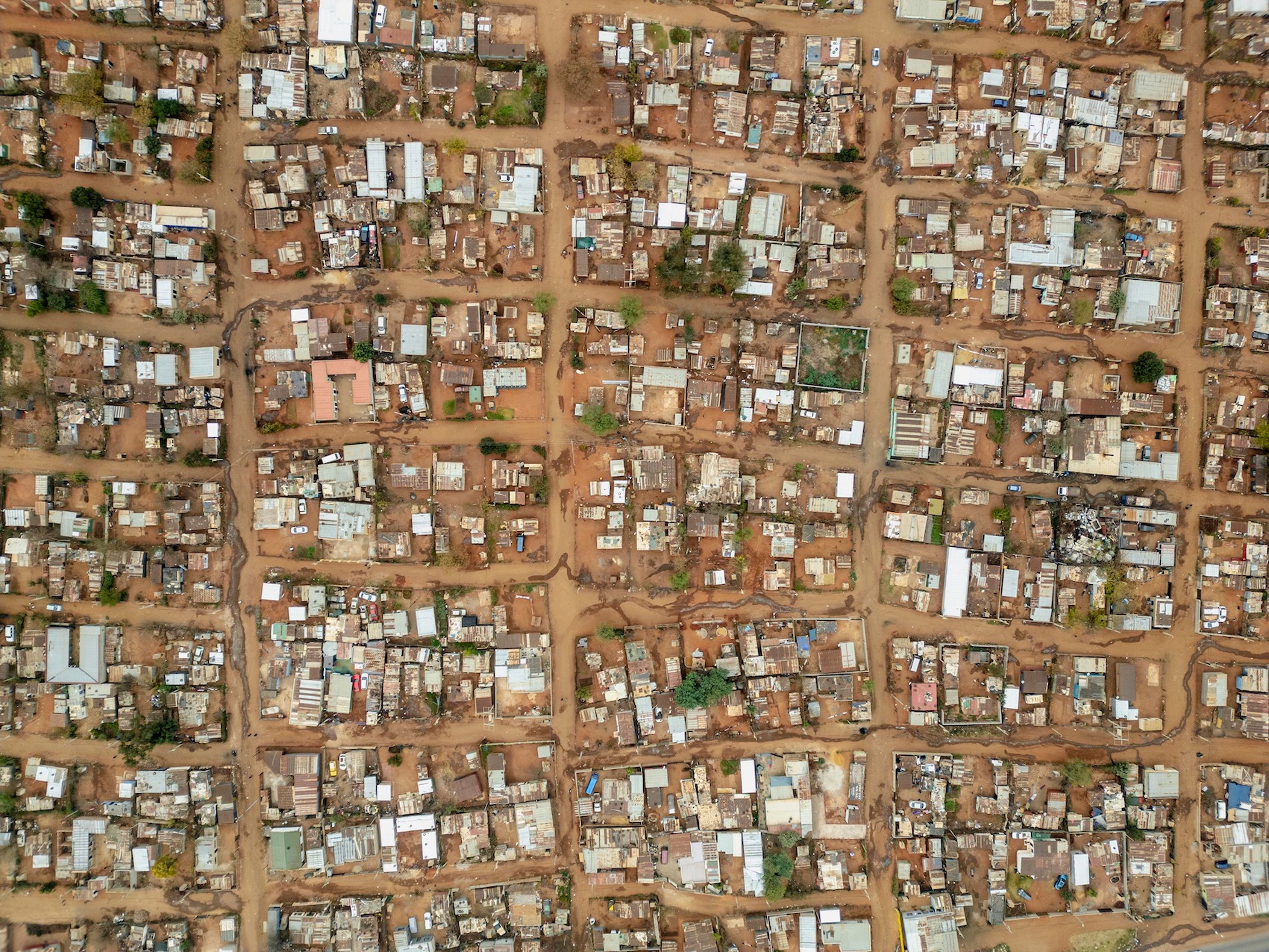
 Aerial photo of Thembelihle township. (Photo: Ihsaan Haffejee)
“Every day, I wait till the early hours of the morning hoping that water will come,” says Simphiwe Zwane, a mother and community activist. She has lived in Thembelihle for 30 years.
Thembelihle is an informal settlement southwest of Johannesburg near Lenasia. It is home to roughly 20,000 people.
The township has communal taps that were installed under apartheid. No new pipes have been installed since democracy. Because of the lack of communal taps, many houses have installed taps that are unlawfully connected to the water system. The need for water in the township far exceeds what two nearby reservoirs, Lenasia Hospital Hill and High Level, can provide. Water stops flowing through the taps most days.
/file/attachments/2994/GroundUp-Jhb-nowaterinset1_424475.jpeg "Community activist Simphiwe Zwane demonstrates that no water comes out of her tap during the day, as her granddaughter, Ntomnehle, watches. (Photo: Ihsaan Haffejee)")
/file/attachments/2994/GroundUp-Jhb-nowaterinset2_457868.jpeg "Simphiwe Zwane inside her kitchen next to the buckets that she uses to collect water for her family’s daily needs. (Photo: Ihsaan Haffejee)")
Across the road from Thembelihle is a Johannesburg Water tank-filling point for region G, which includes Lenasia, Ennerdale and Eldorado Park. About two dozen tankers are filled with water here daily. They deliver to more than 50 rain tanks nearby. But, ironically, the trucks drive past Thembelihle, delivering nothing here.
“If it was not for the help from churches and residents nearby, we’d be dead,” says Zwane.
This sentiment was echoed by all the residents we spoke to.
Pensioner Lindiwe Mthethwa, who has also lived in Thembelihle for more than 30 years, said she has “never seen a water tanker in the area”.
“It is like they don’t view us as human,” said Mzwanele, a resident who works for the City of Johannesburg, but did not give his last name.
Thembelihle means “Place of Hope”. Yet, says Zwane, the community has faced a decades-long struggle for permanent tenure, basic services and dignity.
/file/attachments/2994/GroundUp-Jhb-nowaterinset3_979352.jpeg "Workers fill up water trucks at the filling point opposite Thembelihle. (Photo: Ihsaan Haffejee)")
Johannesburg Water spokesperson Nombuso Shabalala confirmed that Thembelihle does not receive water tanker deliveries. She said that many informal settlements in the area have illegal water connections, and this means “demand for water is much higher than the system can give”.
But it’s unclear that demand for water in the township would be that much lower without the illegal connections. The connections provide convenience, but all the residents still need water daily. It’s also unclear why the illegal connections are a reason not to deliver water to the township.
Residents, including Zwane and Mzwanele, say the illegal connections, which are decades old, are also not what they want. The connections were made, they say, because there were too few communal taps installed in the early 1990s.
“We had no choice,” says Zwane. She says the state “had denied people constitutional rights”.
Section 27 of the Constitution says that everyone has the right to sufficient water, and the state must take steps to realise this right. But there is no evidence that the state is making much effort to realise the right to water for the people of Thembelihle.
Zwane and her 16-year-old daughter have to make many trips to nearby neighbourhoods or churches to collect water. That can take hours.
The 10- to 20-litre buckets they use to carry water are heavy, and Zwane does not have a wheelbarrow to carry them.
/file/attachments/2994/GroundUp-Jhb-nowaterinset4_884090.jpeg "Lindiwe Mthetwa (72) does her laundry using a bucket outside her home in Thembelihle. (Photo: Ihsaan Haffejee)")
The City of Johannesburg has spent more than R650-million on water tankers over the past five years, but the specifics of this are shrouded in secrecy.
The water tankers are mainly provided by contractors who tender to supply residents mostly living in informal settlements, municipal manager Floyd Brink told the South African Human Rights Commission’s inquiry into the Gauteng water crisis in May. DM
/file/attachments/2994/GroundUp-Jhb-nowaterinset5_458254.jpeg "A burst water pipe flooded this yard in Thembelihle. (Photo: Ihsaan Haffejee)")
/file/attachments/2994/GroundUp-Jhb-nowaterinset6_683305.jpeg "Damaged Joburg Water infrastructure near Thembelihle. (Photo: Ihsaan Haffejee)")
The four-decade service delivery fight
Thembelihle’s struggle for services stretches back decades.
The settlement was founded in the mid-1980s, largely by employees of a local brick manufacturing company
In 1992, the area briefly allowed for numbered stands and the installation of limited communal taps. But that same year, the municipality commissioned a geotechnical survey that would become the central justification for state neglect.
Much of the settlement is located on dolomitic (a type of rock) land. Building on dolomite is risky because the rock dissolves in water. When these collapse or water washes away the overlying soil, it can cause sudden and severe sinkholes.
In 2002, the municipality announced plans to move the community to Vlakfontein, about 8km south of Thembelihle.
Some residents viewed these efforts as forced removals and argued that they should receive services where they were living.
“Residents questioned the accuracy of the information… Lack of consultation as required by law was also a matter of concern, amongst other issues, [and] a stand-off emerged,” wrote Siphiwe Segodi for Planact.
In 2003, the City deployed “Red Ants” security personnel to demolish dwellings and relocate more than 600 households, leading to violent clashes with residents.
The City sought an eviction order in 2003, but residents, with pro bono (free) legal help, challenged it.
A report by public interest law organisation SERI suggested that upgrading was possible where Thembelihle is located, without removing or relocating people, if water management precautions were taken. This led to the municipality dropping the case in 2004.
In 2006, a party called the Operation Khanyisa Movement (OKM) tried to get community-backed councillors who lived in Thembelihle elected.
OKM won a single council seat in both the 2006 and 2011 municipal elections.
Zwane, who was an OKM councillor, says that “when we entered politics, that’s when things got ever uglier with us… it was dirty and it followed us”.
In September 2011, a large, week-long protest erupted over continued delays in the provision of water, electricity and sanitation.
In 2016, former president Jacob Zuma unveiled the electrification of several thousand homes in Thembelihle at a cost of more than R90-million.
But hopes that the electrification would be followed by water and sanitation to homes have been dashed.
The settlement relies on more than 4,000 outdoor toilets , which residents say are more than a decade old. While Shabalala says contractors periodically desludge the toilets, some residents claim they have not been emptied for months.
Shabalala attributed delays to overcrowding, misuse of the facilities and unauthorised conversions to flush systems. Some residents say they cannot use their toilets anymore, and have to go up and down the street to find an outdoor toilet that is not blocked.
Zwane said that these problems are because of a failure to recognise Thembelihle as a permanent community despite its long history and thousands of households.
First published by GroundUp.
Comments
Scroll down to load comments...