




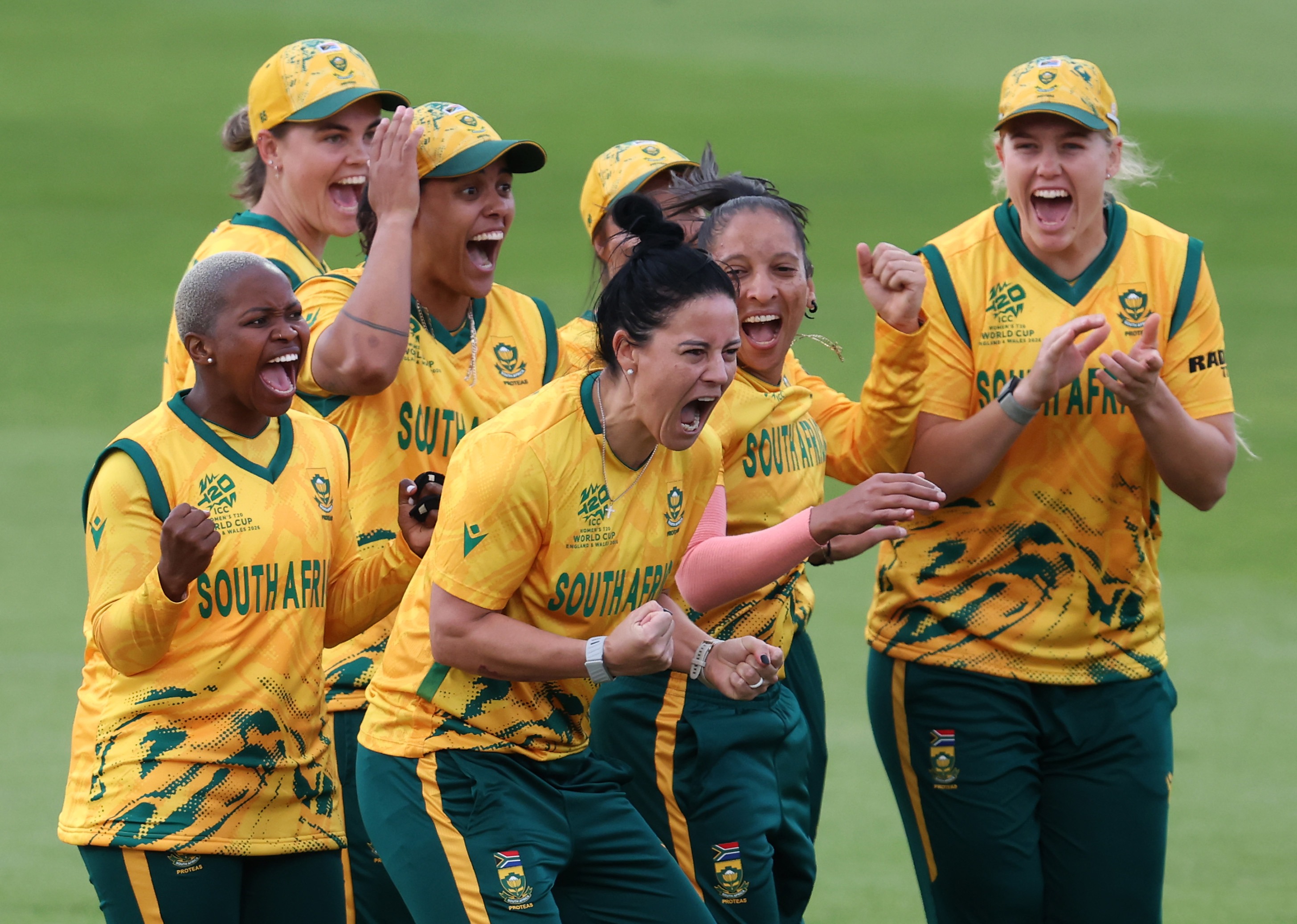
 Marizanne Kapp of South Africa celebrates with teammates after taking the wicket of Pakistan’s Muneeba Ali in the very first ball of the game on 17 June. Kapp went on to take two more wickets, helping to restrict Pakistan and secure a win for South Africa. (Photo: David Rogers / Getty Images)
In their third game of the group stage in the women’s T20 World Cup against India on 21 June, South Africa found themselves in a familiar position of losing the toss and having no choice but to bowl first, chase later.
The previous two outings, against Australia and Pakistan, had shown SA struggling in this position, especially on slower wickets and a batting line-up noticeably adrift against spin.
However, while all SA’s opponents have opted to open the bowling with spin, the Proteas have entrusted the new ball to the pace and accuracy of Marizanne Kapp.
Not only has she delivered with the ball, all-rounder Kapp has also starred with the bat, once again proving herself as a clutch player for the big occasion.
/file/attachments/orphans/2282634087_777751.jpg "All-rounder Marizanne Kapp steered her team to crucial victory in their T20 World Cup match against India on 21 June with her unbeaten 45-ball 81, and very first T20 World Cup half-century. (Photo: George Wood / Getty Images)")
In the game against India, Kapp helped limit their dangerous batting line-up by claiming two wickets for 27 runs before producing the innings of the match with an unbeaten 45-ball 81 to guide the Proteas to a narrow victory.
Despite having played in nine previous T20 World Cups, this was only Kapp’s first half-century at the tournament.
“Probably my best T20 innings that I’ve played, especially against the quality Indian attack on this specific wicket, that probably suits them a bit more,” she said after the match.
Her experience as an all-rounder came to the fore in a performance that helped SA secure a crucial victory against India and strengthened their semifinal hopes after having endured two underwhelming performances.
Impact despite illness
In the game against India, Kapp behaved differently.
When she claimed wickets in the first over against Australia and Pakistan, Kapp would ball her fists and roar in celebration, all while staring down her fallen opponent – if looks could kill.
In those opening overs with the new ball, Kapp conceded only one run against Australia and three runs against Pakistan. Against India, however, she conceded nine, including a boundary.
When she claimed the all-important wicket of Smriti Mandhana in the third over after allowing another boundary two balls earlier, Kapp glared into the pitch, accepted a few low-fives and seemed more annoyed than celebratory. She knew she still had work to do.
“People always say I’m so angry when I play cricket, but show me a bowler who’s going to smile when someone hits you for a six or a four,” said Kapp after the game. “I actually get annoyed when bowlers smile when they bowl wide or get hit for fours and sixes.”
The subdued reaction was also due to the fact that Kapp had not been feeling well, a fact pointed out by skipper Laura Wolvaardt only after the game and later elaborated on by Kapp in the post-match press conference.
“I was actually a little bit ill in the warm-up,” said Kapp. “Didn’t feel well at all, and at one point I went into the change-room and cried a bit.”
Despite her illness, Kapp kept going. As the rest of the bowling attack were getting plundered in the Powerplay, Kapp kept her lines tight, conceding only three boundaries to Chloe Tryon’s and Shabnim Ismail’s combined seven.
When Kapp removed Mandhana, India lost their momentum and SA’s bowling attack improved, ensuring India could never relaunch their innings. By the time Kapp returned to bowl the final over, a projected score that had been set for 180 had been pulled back to under 160. She made sure that it was.
But her job was not finished.
With the Proteas losing both Wolvaardt, who is still searching for fluency in this World Cup, and Annerie Dercksen in quick succession, Kapp walked to the crease at the end of the Powerplay with the Proteas at a troubling 25 for two.
She joined a less aggressive Tazmin Brits, and understandably so given that it was her first game of the tournament after replacing Suné Luus as opener. Brits contributed a valuable 40 and featured in a 97-run stand from 63 balls with Kapp, which ultimately proved the difference between winning and losing.
Kapp understood that the priority was not quick runs, but a partnership.
“The biggest thing at that stage was just getting a bit of a partnership,” she said. “It’s sometimes so difficult batting in those periods of a T20 game, because you almost can’t go too hard because you can’t afford to lose another wicket. We had to stabilise and build a bit of a partnership. And we knew if we got ourselves in, we could catch up at the back-end.
“So it was just, at first, building that partnership. Then, we got to a stage where I just said, ‘Okay, now we’re going to have to start going after it,’ and that seemed to work for us. As soon as we started being a bit more positive, more balls went into the gaps and into the boundaries.”
Through her leadership, experience and firepower, even when battling illness, the all-rounder has shown time and time again, especially in pressure situations, that she can be leaned on – that she may be the key to getting SA over the line.
Central to her team’s fortunes
Since her debut against Australia way back in 2009, Kapp has become one of the most decorated all-rounders in the game, currently ranked fifth in the world in women’s bowling and fourth among the all-rounders.
So far in this T20 World Cup, Kapp sits sixth on the wicket-taking charts with six wickets, while her unbeaten 81 is the third-highest score in an innings of the tournament. She also currently boasts the sixth-best batting strike rate of 174.57.
Granted, Kapp was also part of SA’s struggles against Australia and Pakistan, falling for 12 and 10 with the bat.
/file/attachments/orphans/2282076365_815949.jpg "In South Africa's game against Pakistan on 17 June, Marizanne Kapp claimed three wickets in her first two overs while conceding only nine runs. (Photo: David Rogers / Getty Images)")
Nevertheless, while all eyes were on Wolvaardt, Kapp has emerged as the standout player for SA.
“It seems like whenever there’s something on the line, or we’re playing a World Cup, [Kapp] finds a way to bring out her best cricket,” said Wolvaardt. “She’s two players in one.
“The way that she bowled in the previous game, and now to play a knock like this is incredible. She just has that competitive nature, and it just brings out the best in her.” DM
Comments
Scroll down to load comments...