



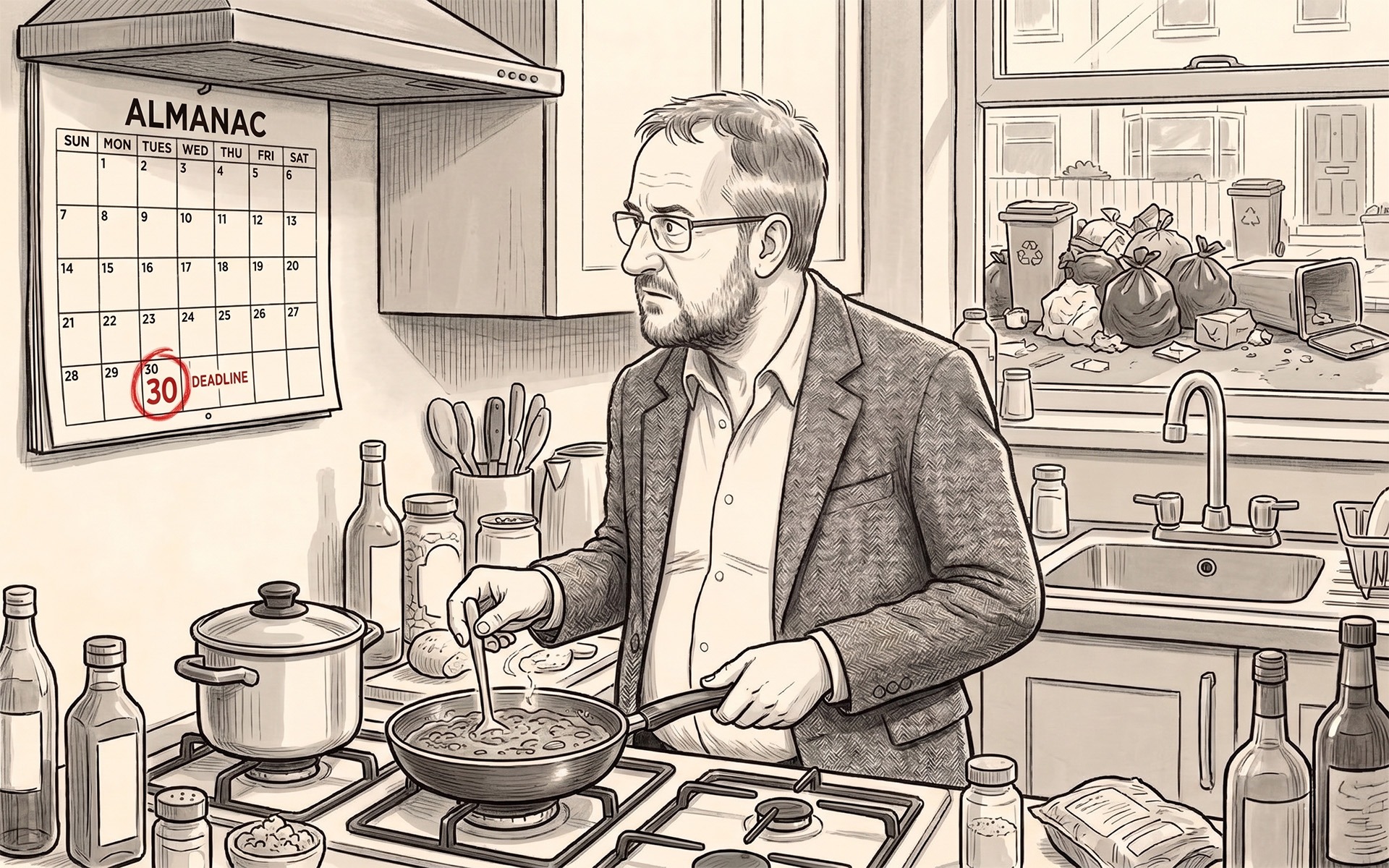
 Exxaro faces production bottlenecks due to Transnet’s inability to transport coal efficiently, highlighting broader issues of state infrastructure failure. (Generated with Google Gemini Flash Image 2.5)
I often wonder how the days of our CEOs really start. I don’t mean the stupid “diaries” they sometimes publish, or the habits they claim to have. I’m much more interested in the coffee they drink, who makes it, is their house really as big as I imagine or is it actually really normal.
Sometimes certain facts about their days appear in public view. We now know, thanks to Vodacom’s results, that they’re spending a fair amount of money on security for their CEO, Shameel Joosub.
/file/dailymaverick/wp-content/uploads/2021/11/BM-Ray-Vodacom-option-3.jpg "File photo: Shameel Joosub, chief executive officer of Vodacom Group Ltd., speaks during a news conference at the headquarters of Vodacom Group Ltd. in Johannesburg, South Africa, on Monday, May 18, 2015. (Photo: Dean Hutton/Bloomberg via Getty Images)")
/file/dailymaverick/wp-content/uploads/2025/03/DSC4210_2.jpg "Ben Magara, CEO of Exxaro. (Photo: Supplied)")
I suspect Exxaro CEO Ben Magara’s day doesn’t start in quite that way.
And it doesn’t even start where you would think it would start, with a look at Monday’s coal production figures, but rather with a look at that day’s railway figures from Transnet.
Exxaro had a capital markets day on Monday, one of those shindigs where a company’s top brass tells people what they are doing and then answers questions about it.
These shindigs sound like a lot of fun ... for everyone who is not answering questions.
Among the facts that emerged from this was that Exxaro can produce about 3.9 million tonnes of coal at its mine in the Waterberg, Limpopo. But at the moment Transnet can only actually move about two million tonnes of that to the Richards Bay Coal Terminal every year.
If you have spent much time driving on our national roads lately you will know what that means; there is an unbelievable number of trucks filling the gap.
Now, I don’t think Exxaro would automatically double their production if Transnet doubled their trains. They might keep some coal back for higher prices, and they might well gear their mine in all sorts of ways.
But still, the fact that you have the capacity to double your production while the state is preventing you from doing that must really keep you awake at night. If I were Magara I would probably need Joosub’s security detail to protect myself from me!
Magara and Exxaro are, of course, not alone.
/file/dailymaverick/wp-content/uploads/2024/01/GettyImages-1720068609.jpg "A Transnet SOC freight train stands idle with wagons loaded with coal in a rural area on 2 October 2023, south of Leeu Gamka, South Africa. (Photo: Per-Anders Pettersson/Getty Images)")
Company after company has a story about how state failure has affected them.
Last week the food producer Libstar said it had had to close an entire sauce factory in Joburg after it went for 25 entire shifts without water.
I’ve never tried to make a sauce without water before, but I imagine that I would give up long before 25 shifts.
/file/dailymaverick/wp-content/uploads/2025/05/ATB-grootes-municipalities-copy.jpg "Illustrative image | Astral Foods. (Photo: Astral) | Chickens at Astral Foods. (Photo: Guitar_Tawatchai/Freepik)")
For years Astral has had to supply its own water to its massive facility in Lekwa, where the municipality has just completely failed to do what it is supposed to do.
The list is endless – companies end up paying for all sorts of things that should really be taken care of through their rates and taxes. Instead, like so many of us in the middling classes, we end up paying for everything twice.
While you could possibly work out a formula to determine how money you are paying for the cost of state failure, the real price we pay is so much higher than that.
At the moment one of the big national discussions is, once again, about illegal immigrants.
And while some of its leaders may be driven really by prejudice (one of the group’s main leaders is Ngizwe Mchunu – he is not just prejudiced against foreign people, but also gay and lesbian people. In short, if you are not exactly like him, he doesn’t like you) the real power of their claims is that so many people don’t have a formal job.
While the real reasons for our high unemployment rate are important, they are also complex and difficult to point to.
It’s much easier to point to someone who is not like you and just say, “that’s the one who is responsible”.
It doesn’t matter how untrue that is, having someone not like me to blame is always incredibly attractive.
The result is that hundreds of thousands of people now fear for their lives, while our acting police minister, Firoz Cachalia, says they’re spending R600-million preparing for the “deadline” of 30 June.
It is a strange thing, this state failure. We talk about it all the time, it has a direct impact on all of our lives, we argue about who is responsible and we talk about the local elections.
But we never really appreciate the true damage it does.
To the lives of you and I and the futures of our children.
What is so frustrating is that running sewers and water systems and rubbish collection and electricity and coal-carrying trains are all things humans know how to do. And to do efficiently and well.
Instead of just doing that, we humans fight and argue. With results you can see here and in other places where infrastructure is failing.
Hopefully, when I wake up tomorrow morning and sip the coffee I made myself, there will be happier thoughts to ponder. DM
Comments
Scroll down to load comments...