




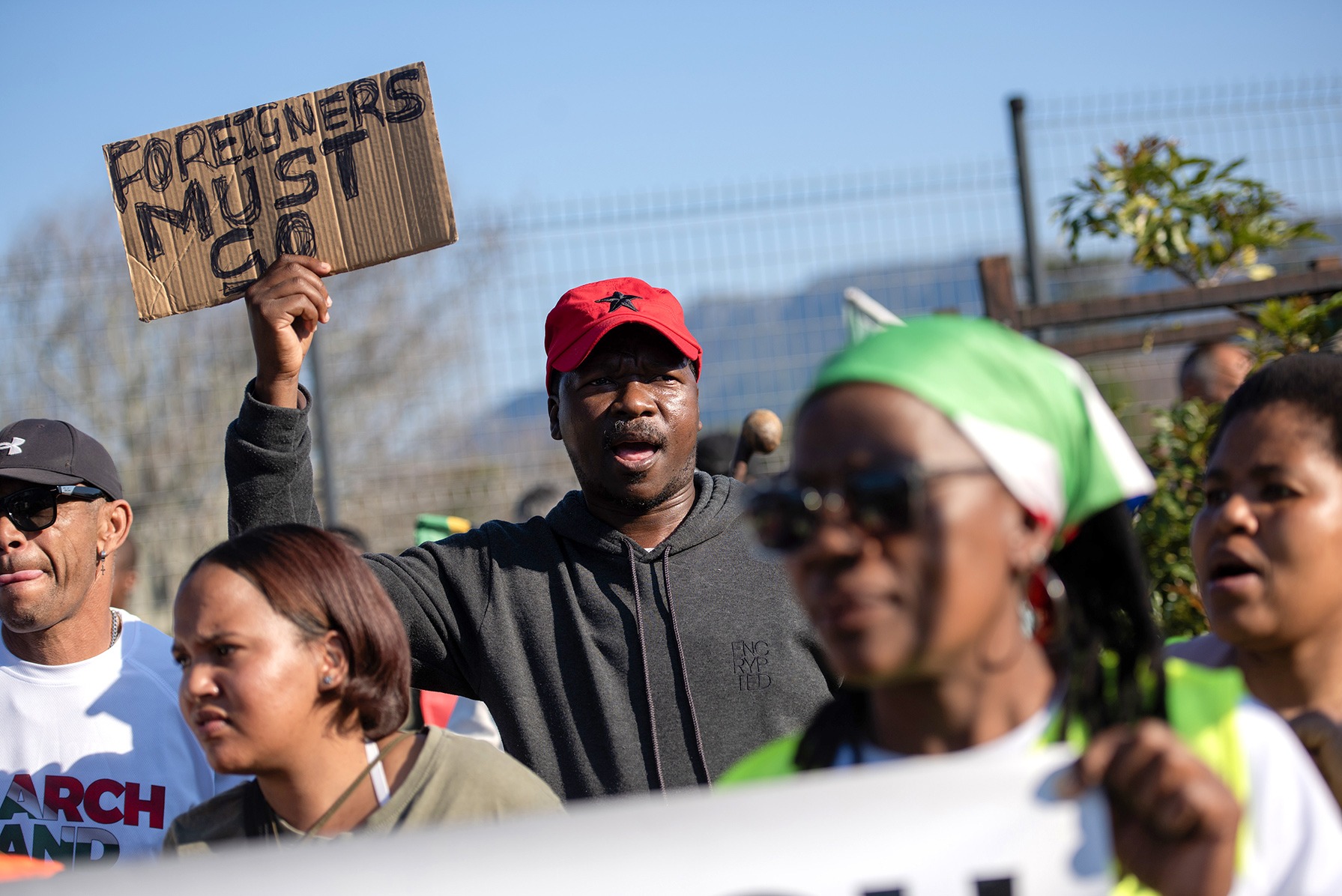
 A man holds up a sign at a small March and March protest in Wynberg, Cape Town, on 20 June 2026. (Photo: David Harrison)
For decades, South Africa carried the mantle of the “Rainbow Nation”, a beacon of reconciliation post-apartheid, positioning itself as one of the continent’s moral anchors and an economic powerhouse. From its active role in the African Union to its status as a destination for the continent’s brightest minds, South Africa was a natural home for pan-Africanism. But as of June 2026, that vision is fracturing under the weight of exclusionary politics that are becoming increasingly violent.
The recent waves of xenophobic intimidation and vigilante-led violence across the country have not only blighted our communities; they have pushed South Africa into a profound reckoning. The “Rainbow Nation” is being eclipsed by a dark, inward-looking populism that threatens to isolate the country from the continent.
The economics of scapegoating
The current situation is not a spontaneous combustion of public anger, but a systemic failure of political leadership. With unemployment hovering at 32% (and, specifically, youth unemployment running at about 60%) and structural inequality continuing to define the landscape of post-apartheid life, the temptation for political opportunists to find a convenient scapegoat is high.
The rise of groups such as March and March and Operation Dudula demonstrates a dangerous trend of the outsourcing of state failure onto the most vulnerable. By framing foreign nationals (documented or not) as the most visible culprits for South Africa’s economic stagnation, failing service delivery and crime, these movements have effectively diverted public rage away from a government that has struggled to deliver on the promises of 1994.
Data from the Human Sciences Research Council confirms this drift. In 2025, about 42% of South Africans expressed outright hostility towards immigrants, up from 28% in 2020. When despair meets demagoguery, social cohesion is the first casualty.
The amnesia of solidarity
Perhaps the most stinging indictment of this current xenophobic intensity is the profound historical amnesia it reveals. South Africa’s freedom was not won in a vacuum; it was forged in the halls of Dar es Salaam, in the camps of Lusaka, and through the diplomatic and financial sacrifice of almost the entire continent. For decades, the “Frontline States” (including Angola, Botswana, Mozambique, Tanzania, Zambia and Zimbabwe) bore the brunt of the apartheid regime’s military aggression. They provided safe harbour to ANC exiles, training grounds for uMkhonto weSizwe, and diplomatic legitimacy when the world looked away. Nigeria, though geographically distant from South Africa, made significant financial contributions, with Nigerian public servants paying a compulsory “Mandela tax” from their salaries to support the liberation struggle.
To witness South Africans, in 2026, hunting down the very people whose forebears sacrificed their sovereignty, safety and prosperity to secure our liberation is not merely a policy failure. It is a betrayal of the pan-African solidarity that made democratic South Africa possible – and we must name it as such.
Beyond vigilantism: Restoring the rule of law
Crucially, the anger towards undocumented migration must not be treated as a licence for mob justice. While every sovereign state has the right and duty to regulate its borders and manage its immigration processes, this responsibility belongs to the state, and not to street-corner tribunals.
The current wave of vigilante behaviour thrives in the vacuum left by a decaying Department of Home Affairs, which has been plagued for years by systemic corruption, massive documentation backlogs and an inability to process asylum seekers efficiently. When the state abdicates its administrative duty, it cedes the monopoly on order to populists.
Dealing with illegal immigration effectively requires a functional, transparent and humane legal framework, not the intimidation of shopkeepers or the torching of homes. True enforcement of the law would be digitised, efficient processing centres, robust diplomatic cooperation with neighbouring states to manage migration flows, and accountability for the corrupt officials who keep borders porous. Resorting to violence against individuals, who are often victims of regional instability themselves, does nothing to fix the administrative failures at Home Affairs. It only deepens the cycle of lawlessness, suggesting that in South Africa one’s security is dependent on the size of the mob rather than the strength of the Constitution.
Pretoria has not been entirely mute. In late May, the government condemned the violence while defending its own enforcement record, and Foreign Minister Ronald Lamola publicly rejected the notion that migrants are to blame for the country’s economic woes. But the reflex has been denial before introspection: meeting Kenya’s President William Ruto, President Cyril Ramaphosa insisted that “South Africans are not xenophobic”, a claim he repeated days later in a televised address on 7 June. Ramaphosa acknowledged the failures, corruption and gaps in migration management. He insisted that the enforcement of immigration law “rests with the state and the state alone” and unveiled a five-point action plan. However, Professor Alan Hirsch noted that many of the actions mentioned in this plan had previously been announced by the government and that the key issue has been the “painfully slow” implementation of such initiatives.
Moreover, every measure in the plan answers the marchers’ grievances rather than the violence committed in their name. The President has still not condemned March and March or Operation Dudula by name, no prosecutions of vigilante ringleaders have been announced, and in November 2025 the Johannesburg High Court (in Kopanang Africa Against Xenophobia v Operation Dudula) found that the state’s prolonged failure to implement the court-ordered National Action Plan to Combat Racism and Xenophobia was unconstitutional. The South African Human Rights Commission has supported this position. In effect, the state has told the mob to stand down while declining to confront its organisers – a silence that lets the intimidation continue and leaves migrants with little protection.
The diplomatic cost of this trajectory is already being paid. This past Africa Day (25 May), a poignant and telling silence descended on Pretoria. Several African ambassadors, signalling their deep displeasure at the state’s tepid response to xenophobic violence, chose to boycott the official celebrations. Moreover, when nations like Nigeria and Ghana, traditional allies and key players in the continent’s economy, publicly summon South African envoys to account for the safety of their citizens, the dream of an integrated, prosperous Africa begins to disintegrate. Ghana has gone further, formally requesting that a debate on the attacks take place at this month’s AU summit in Cairo – a request Pretoria has met with a defensive rebuttal rather than contrition. Ghana, Nigeria, Malawi and Mozambique have begun repatriating citizens caught up in the unrest. Mozambique has confirmed that five of its citizens have been killed.
From an African integration standpoint, this matters enormously. South Africa’s credibility as a champion of the African Continental Free Trade Area, having signed on to the free movement of goods, services and, eventually, people across the continent, is incompatible with domestic politics that treat African mobility as inherently suspect. The structural ambition of continental integration requires a population that can imagine fellow Africans as partners and not threats. That imagination is not formed by policy alone; it is formed, or deformed, by the stories a nation tells itself about who belongs. Right now, South Africa is telling the wrong story. And the continent is listening.
The unequal right to belong
What the current moment demands, beyond the well-catalogued policy prescriptions, is a harder confrontation with the moral architecture that sustains anti-immigrant sentiment. Xenophobia in South Africa does not simply erupt as raw prejudice; it operates through the respectable vocabularies of legality, order and scarce resources. This is precisely why it evades accountability so effectively, and why Ramaphosa’s June address, for all its administrative detail, fell short: it answered the mob’s demands while refusing to call out its lexicon.
At the centre of that lexicon is what Anye-Nkwenti Nyamnjoh termed the “unequal right to belong imperfectly”. South African citizens may offend, fail or transgress, yet they still remain part of the national “we”. Citizenship functions as a kind of moral insulation: it does not prevent punishment, but it protects the durability of belonging. Foreign nationals, particularly poor African migrants, informal traders and the undocumented, are accorded no such elasticity. Their presence is treated as probationary and revocable. And crucially, their wrongdoing, however individual, is made to stand for an entire category of people, confirming retroactively that they should never have been here at all. This is not incidental to xenophobia, it is its operating logic.
It is a logic that legal distinction alone cannot repair. The Kopanang judgment matters because it draws the critical boundary between immigration governance and vigilante punishment. But courts cannot interdict conduct and they cannot dissolve the moral hierarchy that makes that conduct permissible and, for many, righteous. What is needed is a political counter-language: one that insists that the question of documentation is a separate and secondary matter from the question of human dignity, and that the economic despair driving anti-immigrant sentiment is the product of state failures that predate any significant migrant presence in South Africa and vastly exceed any call that migrants may make on South Africa’s social services and economy.
A choice for the future
The local government elections in November 2026 loom large. There is a palpable fear that political parties, desperate for electoral survival, will double down on anti-immigrant rhetoric, further inflaming the tinderbox of community tension.
South Africa stands at a crossroads. It can choose to descend into a cycle of insular nationalism, where the “foreigner” is forever the enemy, or it can engage in a difficult but necessary national dialogue about its own systemic failures. True pan-African leadership requires the courage to face internal economic grievances without sacrificing the humanity of our fellow Africans.
The “reckoning” here is not just for the politicians who have allowed the discourse of hate to fester, but for the South African public. We must decide whether the “Rainbow Nation” was a genuine aspiration or merely a transient chapter in our history that is now moving in a more exclusionary and ultimately self-destructive direction.
If South Africa continues to alienate the peoples of this continent, it will eventually find itself alone, no longer a leader of Africa, but an island of insecurity, because our African neighbours will, justifiably, seriously reconsider their political and economic relations with the country. The time for performative condemnation from government podiums (and for enforcement packages that answer the mob’s demands while ignoring its victims) has passed. The time for tangible, protective and inclusive governance is now, before the bridges we’ve built across the continent are burnt entirely. DM
Mandira Bagwandeen is an affiliate researcher at the New South Institute, a public policy think-tank focused on building democracy and public institutions. Aaliyah Vayez is a political and security analyst based in South Africa.
Comments
Scroll down to load comments...