




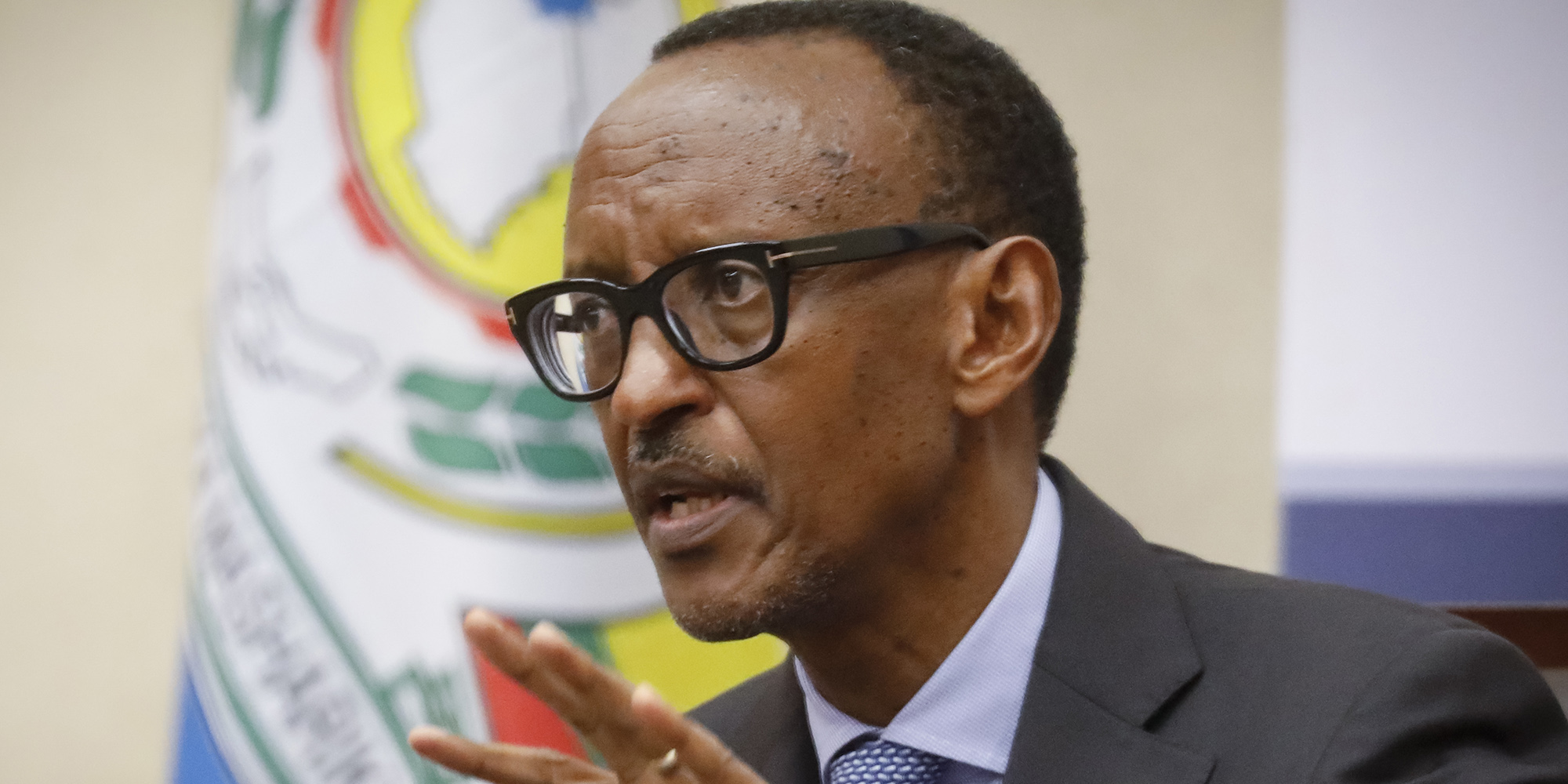
 The president of Rwanda, Paul Kagame, speaks during a news conference in Kigali, Rwanda, on 8 April 2019, a day after the country marked the 25th anniversary of the 1994 genocide. (Photo: Dai Kurokawa / EPA-EFE)
“No one truly knows a nation until one has been inside its jails. A nation should not be judged by how it treats its highest citizens, but its lowest ones,” Nelson Mandela wrote in his autobiography, Long Walk to Freedom.
That critical principle of fair treatment for all, including those found guilty of the worst crimes, is at play in the plight of 21 Rwandan prisoners serving long sentences in jails in Benin and Senegal and four others who were acquitted but are nonetheless stuck in a safe house in Niamey, Niger.
More than 32 years after the genocide in Rwanda, these 25 persons, who were prosecuted for complicity in that mass murder, are resisting moves to send them back to their home country, where they fear retribution.
/file/dailymaverick/wp-content/uploads/2023/09/Bridget-Beautiful-Rwanda-9.jpg "The Flame of Remembrance atop the Kigali Genocide Memorial in Rwanda. (Photo: Bridget Hilton-Barber)")
Seven men and one woman are still serving out their sentences in a prison in Senegal, and 13 men in Benin. Four men who were prosecuted for genocide-related crimes but acquitted are living under effective house arrest in a safe house in Niamey, Niger. They are living in limbo as Niger wants them out, and no one wants to take them in — except Rwanda.
Senegal and Benin also want to divest themselves of their convicts, but no other nation is willing to accept them — except, once again, Rwanda. While Kigali has declared its readiness to take all 25 individuals, they are fiercely resisting the move, fearing they will not be safe there.
The UN Security Council could decide their fate this week in a crucial vote scheduled for 25 June.
The International Criminal Tribunal for Rwanda (ICTR), a dedicated UN court, tried, convicted and sentenced the 21 in Senegal and Benin for complicity in the genocide perpetrated in 1994 by the predominantly ethnic-Hutu government and its allies, mainly against the minority ethnic-Tutsis, though some moderate Hutus were also killed.
The four in Niger were part of a group of eight who were acquitted of such crimes or were convicted and had served their time. They were transferred to Niger in 2021, where four have since died, one earlier this month.
The ICTR closed in 2015 and was succeeded by the International Residual Mechanism for Criminal Tribunals (IRMCT) with a mandate to complete the work of the ICTR and of an equivalent tribunal trying atrocities committed in the former Yugoslavia in the 1990s.
The detainees in Senegal and Benin were moved there in batches from the headquarters of the ICTR in Arusha, Tanzania, starting in 2009. Stand for our Parents, an organisation representing relatives of the detainees, believes that Senegal and Benin now want them out and have begun preparations to transfer them to Rwanda. They told Daily Maverick that officials of both countries have visited Rwanda’s Mpanga International Prison, which already holds some detainees who were convicted and sentenced by the UN-backed Residual Special Court for Sierra Leone for crimes against humanity in the civil war there.
Stateless limbo
The four in Niger are living in a kind of stateless limbo. They were originally in a safe house in Arusha where they could move around freely. Stand for our Parents says, however, that the four are effectively under house arrest in Niger as their papers have been taken from them and they are under constant police guard. “Even if you want to go to buy medication you have to ask permission,” said one member of the organisation.
According to the organisation, the previous Nigerien government under Mohamed Bazoum had openly sought their expulsion, but the men successfully resisted deportation to Rwanda. Following the July 2023 military coup that toppled Bazoum, relatives believe the current junta is too preoccupied to address the men’s situation directly. However, they suspect the military rulers would gladly hand them over to Rwanda if given the chance.
And the IRMCT — which was always intended to be temporary — is also winding down its operations, which has significant and unsettling implications for the 25 people in Niger, Benin and Senegal; in large part because the relatives believe the UN is eager to cut costs.
In a report to the UN Security Council last December, about how to phase out the IRMCT, UN Secretary-General António Guterres noted that the UN was paying Senegal and Benin about $500,000 a year to keep housing the 21 convicts in their jails. The UN is also paying Niger.
He noted that Rwanda had indicated that it was ready to take the men but that if the Security Council agreed to this, further discussions would be necessary about the high costs and administrative support which the IRMCT would need to continue providing.
/file/dailymaverick/wp-content/uploads/2025/10/GettyImages-2215078945.jpg "UN Secretary-General António Guterres. (Photo: Nadja Wohlleben / Getty Images)")
“But most likely I think Rwanda will make all efforts to have them transferred to Rwanda because it’s really what Rwanda most wishes,”said a member of Stand for our Parents.
“So I think when it comes to costs, it may not be an issue for them because …they say that they’ve already built prisons for them.”
During a hearing in the Security Council on 13 June, Rwanda’s justice minister, Emmanuel Ugirashebuja, reiterated that Rwanda was ready to receive persons convicted by the ICTR for the enforcement of their sentences. It was also ready to receive its nationals who had been acquitted or who had completed their sentences “and continue to await durable solutions.”
This offer clearly encompassed the convicts still serving time as well as the four men living in the safe house in Niamey, Niger.
The justice minister said Rwanda’s correctional facilities were up to international standards and that it also had extensive experience in receiving and reintegrating former genocide convicts.
At the same UN hearing, the IRMCT president, Judge Graciela Gatti Santana, said Rwanda’s proposal was being considered, adding it would “require confirmation that all necessary guarantees for the protection of the fundamental rights of the convicted persons are in place.”
Judicial independence
However, she agreed with Guterres’ report that the IRMCT must retain certain functions. Specifically, judicial independence is essential for supervising convicts’ rights, particularly when adjudicating critical decisions regarding potential early release on humanitarian or other grounds. Santana noted that the average age of the prisoners was 72, and even those sentenced to life imprisonment might become eligible for early release.
During the hearing, there was also discussion about where to transfer the IRMCT’s huge archives as part of phasing out the court. Ugirashebuja said Rwanda was also ready to house and care for the archives. However, Santana agreed with Guterres that the archives should instead be transferred to the UN Secretariat as they contained much sensitive and confidential information which needed to be carefully managed.
/file/attachments/orphans/President-Graciela-Gatti-Santana_819102.jpg "IRMCT judge president Graciela Gatti Santana. (Photo: United Nations / Wikipedia)")
The 25 persons in the three countries are vehemently opposing their transfer to Rwanda. Stand for our Parents wrote to Secretary-General Guterres on 8 May, opposing the transfer on legal and moral grounds.
These included an allegation that Rwanda had already initiated parallel legal proceedings against persons already tried by the ICTR, which would violate the fundamental “non bis in idem” principle that none should be tried twice for the same crime.
They noted that in 2018, Rwanda had introduced the crime of genocide ideology, which was not in the statute of the ICTR and so could be a way to indict the 25.
Transferring the detainees to Rwanda would also violate the international principle of “non-refoulement” which “prohibits an international organisation from transferring a person to a territory where he or she would be exposed to a real risk of inhuman or degrading treatment, torture, or serious infringement of human dignity”.
The letter from the relatives said reports published by recognised international organisations, including Amnesty International (2024) and Human Rights Watch (July 2025), “document systematic violations of the rights of persons deprived of their liberty in Rwanda, making such risk concrete and established”.
On 8 May, Human Rights Watch demanded an “effective, independent and transparent” investigation into the death in custody of prominent academic and government critic Aimable Karasira on the day he was due to be released.
/file/attachments/2994/2026-06-23_13-34-52_647540.png "Aimable Karasira. (Photo: karasira.org)")
‘Nelson Mandela Rules’
And the letter from the relatives noted that the United Nations Standard Minimum Rules for the Treatment of Prisoners — “the Nelson Mandela Rules” — stipulate that “prisoners shall be allocated, to the extent possible, to prisons close to their homes or places of social rehabilitation”.
The families emphasised that they had spent years establishing the practical means to stay in contact with their relatives in Benin, Senegal and Niger — connections that would be severed if the men were moved to Rwanda, where visits would be impossible. Furthermore, they pointed out that standard IRMCT practice requires detainees to consent to their relocation. They noted that UN Security Council Resolution 2740 (2024) explicitly extends this consent requirement to acquitted and released individuals as well.
A spokesperson for the group told Daily Maverick that transferring the prisoners would jeopardise their rights to family contact, medical care, legal communication, protection from ill-treatment — and also, importantly, early release review.
The spokesperson stated that the detainees and their families also oppose transferring the archives to Rwanda. They fear the country could weaponise the files against them, as the archives contain confidential tribunal records, witness testimonies, and sensitive information.
They have also said that the ICTR was not impartial as it succumbed to pressure from Rwanda not to prosecute Rwandan President Paul Kagame’s Rwanda Patriotic Front (RPF) for murders of ethnic Hutus it has been widely accused of as its army marched across Rwanda in 1994 to rout the government.
Carla del Ponte, the ICTR prosecutor from 1999 to 2003, disclosed in her memoirs how she informed Kagame in 2000 that she had opened an investigation against him for alleged war crimes committed by the RPF against Hutus in 1994.
However, the ICTR never indicted him or other RPF leaders because of RPF pressure and witnesses being prevented from travelling to the ICTR court in Arusha, Tanzania. It is widely believed that Rwandan political pressure led to the UN Security Council removing Del Ponte from her job in 2003. DM
Comments
Scroll down to load comments...