




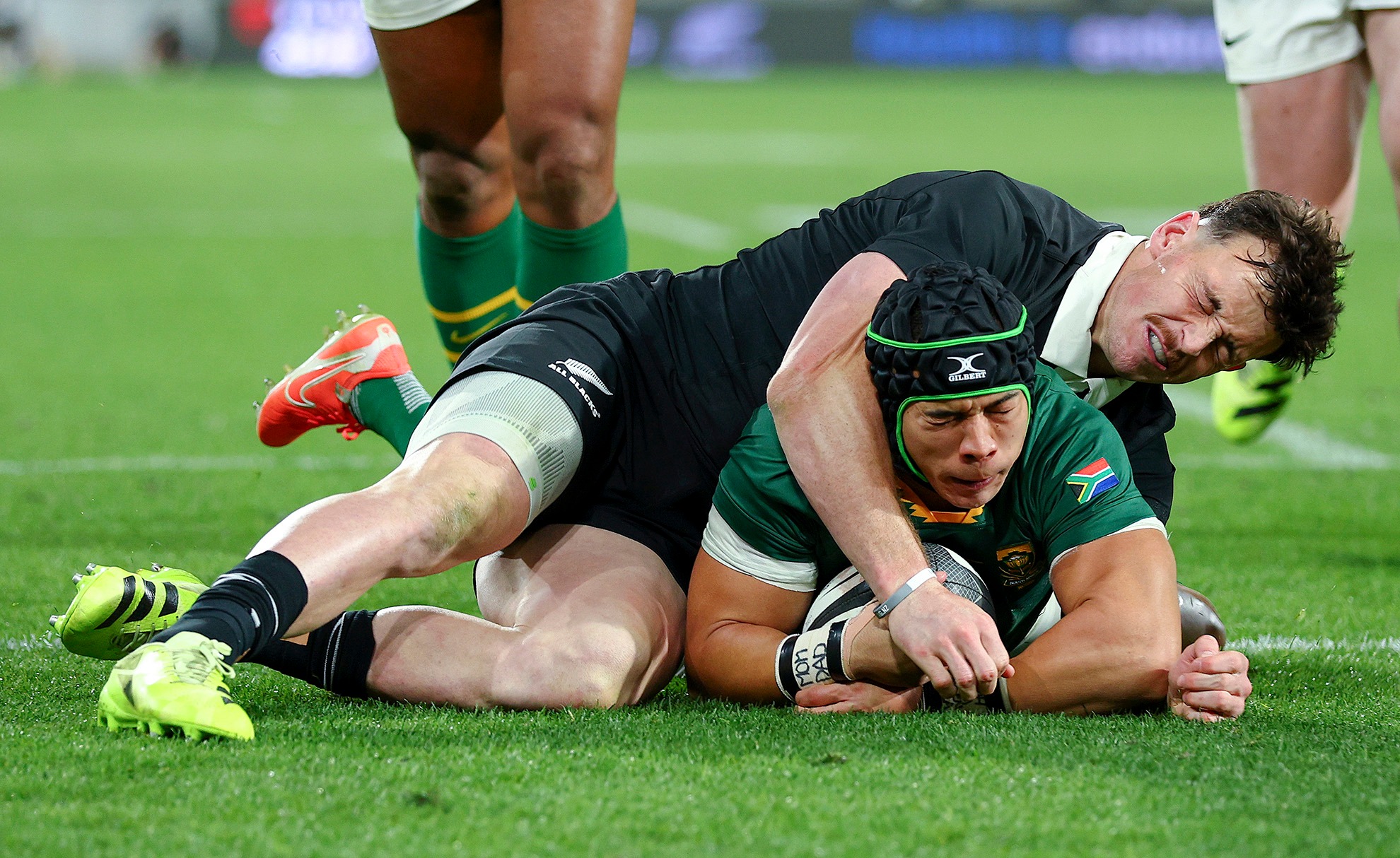
 Bok wing Cheslin Kolbe scores against the All Blacks. The Springboks won’t be chasing bonus points in the Nations Championship. (Photo: Hagen Hopkins / Getty Images)
Test match rugby has always been about the result. Wins and losses are recorded in the history books and echo through time. How many tries were scored doing it, is for the statisticians.
Scoring five tries and losing a Test is far worse than scoring no tries but winning it.
Obviously, there is a third option – winning and scoring lots of tries. But chasing tries for the sake of it and putting victory at risk is not the Springbok way. And it won’t change now, even if the structure of the new Nations Championship encourages try-scoring.
The cross-hemisphere competition, which starts on 4 July, has been designed by the Six Nations and South Africa, New Zealand, Australia and Argentina Rugby (Sanzaar) as a way of adding more edge to the traditional July and November Test windows.
Sanzaar sides, plus Fiji and Japan, are in one pool, against the Six Nations teams of England, Ireland, France, Italy, Scotland and Wales. They each play each other once, with a mini log deciding the top two teams in each pool who will contest the “final” at Twickenham in November.
There will be bonus points for scoring four tries or more, or one bonus point for losing by fewer than seven points.
/file/attachments/orphans/2233953255_285712.jpg "Winning Tests is the main priority - not try-scoring bonus points – so goalkickers such as flyhalf Handrè Pollard will have a big role to play. (Photo: Fiona Goodall / Getty Images)")
Naturally, in tournaments structured this way, bonus points are likely to play a key role in deciding the final standings.
Given that organisations such as Sanzaar and Six Nations often point out that they are in the entertainment business, they will hope that teams chase the four-try bonus point.
According to marketing people, more tries means better rugby.
The Springboks scored 12 tries in an 80-31 romp against the Barbarians last week and it became tedious. There was just no edge to the contest.
It was rugby-basketball. Fun for a while, but was it better viewing than a tight, low-scoring Test with thunderous collisions and nail-biting tension?
Boks only want to win
Springbok coach Rassie Erasmus was dismissive of the idea of chasing the bonus point when Daily Maverick asked if the Boks would factor it into their thinking and approach during the Nations Championship.
New Zealand are traditionally a team that scores plenty of tries, especially at home, so they will almost certainly rack up some bonus points.
But the Boks have been impressive in both winning and scoring tries in recent years. Last year they scored a record 81 tries in 14 Tests, so if that average holds, bonus points should be a natural by-product.
/file/attachments/orphans/TL_2580680_269326.jpg "Rassie Erasmus is only chasing wins. (Photo: Richard Huggard / Gallo Images)")
“We’ve never played a competition with the Springboks apart from maybe the World Cup where you get log points for Test match rugby,” Erasmus said, seeming to forget that bonus points are part of the annual Rugby Championship rules as well.
“It’s almost just been about world-ranking points. To be honest with you, we just want to try and win every match and obviously build squad depth, character and a playing style.
“That’s so that everybody’s used to the system and when we get to the World Cup, there are a lot of players who can play our style. We’re doing things how we want to, in Springbok rugby.”
Despite the “competition” element to these traditional July and November Test windows, the Boks clearly aren’t placing a priority on winning the Nations Championship as a standalone competition.
In theory...
The Boks could theoretically win all six Nations Championship Pool matches and not qualify for the final if, say, the All Blacks also win six and secure more try-scoring bonus points.
In a year where the Boks have four Tests against the All Blacks in the first full tour against their old rivals in 30 years, there is only one priority for the world champions – and it’s not winning the Nations Championship.
“We don’t really see this [Nations Championship] as a competition. We see this as a next Test match and then the next, and the next,” Erasmus said.
“We want to beat England, then beat Scotland, and beat Wales. And I’m sure they want to do the same with us. Going for bonus points… I don’t know if that’s really Test match rugby.
“So no, we just want to win every single Test even if it’s by one point. We want to play the type of rugby we plan for and which makes our fans and ourselves proud.”
The making of captain Kolisi
Beating England at Ellis Park is the first objective for the Boks at a venue where the tourists haven’t won since 1972. The Boks aim to keep it that way.
Siya Kolisi made his Bok captaincy debut against England at Ellis Park in 2018, which was Erasmus’s second Test in charge of the Boks. They have both come a long way since that come-from-behind 42-39 win.
In that game the Boks were stunned by an England blitz in the opening 20 minutes and they fell 21-0 down before a brilliant comeback.
/file/attachments/orphans/2281932153_618326.jpg "Bok skipper Siya Kolisi made his Test captaincy debut at Ellis Park against England. The Boks face them at the same venue on 4 July. (Photo: Richard Huggard / Gallo Images)")
Kolisi has always admitted that the occasion got to him and that he needed to lean heavily on experienced men around him at the time. He reiterated how that match provided him with valuable lessons.
“The emotions got to me that day and I struggled to play, but the team rallied. I had so many great leaders around me,” Kolisi reflected this week. “The system that coach put in at the time really helped me a lot. I learnt that just because I was captain that not everything was up to me.
“That game is when I actually learned how to use other people and lean on them. When England went up 21-0, the players looked at me under the posts and I admitted I had no answers. I looked at the guy next to me and asked if he had something to say.
“That day changed my life.” DM
Comments
Scroll down to load comments...