




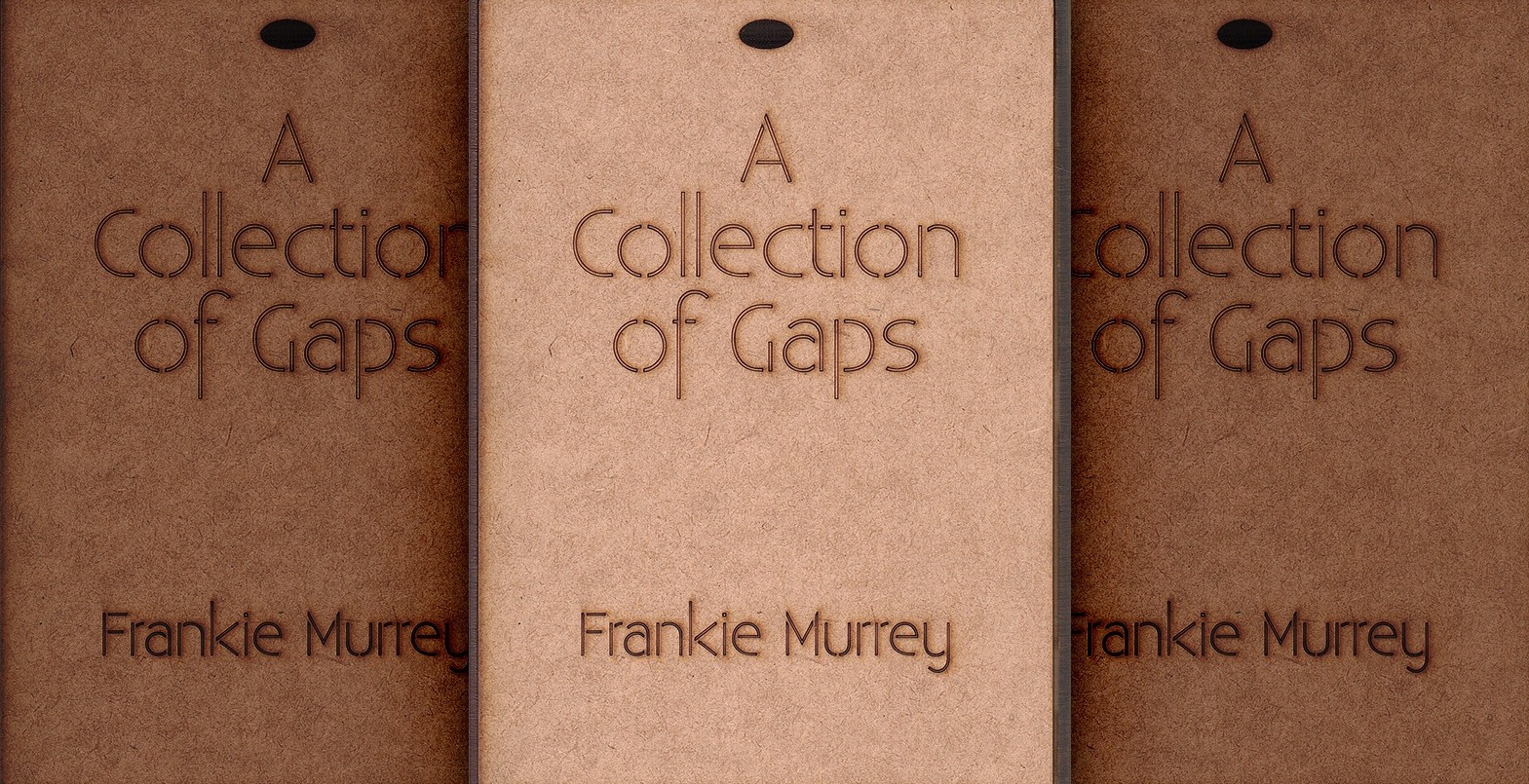
 A Collection of Gaps by Frankie Murrey. (Source: Karavan Press)
Frankie Murrey’s A Collection of Gaps is not quite a book, or not only a book. It is a box filled with separate pieces of writing: reflections, fragments, observations and stories that can be read in any order.
There is no prescribed route through them. Readers can begin wherever they choose, moving through the collection according to mood, chance or curiosity. You can start where you like. You can return to something already read. You can lose something. You can put the pieces back in the wrong order. You can use the box for something else entirely.
Murrey was intentional about this. “The idea was to have a box with things in it, but the nature of having a box means that things can go missing,” she says.
“It becomes this open-ended collection. It could end up empty of everything that it started with and become home to a deck of cards. I really enjoyed the idea of the space just being a container, that what is in it could change.”
As I moved through the collection, pulling out pieces at random and reading them over morning coffee, a theme that resonated for me was the notion of “home”.
Not home in the simple sense of a physical address, but home and homelessness as questions. What makes a place feel like home? What happens when home is unsafe, lost, inaccessible or never fully yours to begin with? What does it mean to move through the world without the certainty of belonging? Can a body become a home? Can a city? Can memory?
Again and again, Murrey’s writing returns to these questions from different angles. Some pieces touch on displacement and belonging. Others explore the privilege of safety and shelter, the vulnerability of those without either, and the uneasy knowledge that for many people home is less a certainty than a longing.
The collection never attempts to answer these questions definitively. Instead, it circles them. Home becomes something fluid and unstable, constantly being made, lost, inherited, imagined and remade. It is this recurring exploration of home and homelessness, both literal and emotional, that forms one of the collection’s strongest anchors.
Yet in Murrey’s work, questions of home are not only confined to houses, neighbourhoods or cities. They frequently spill over into the body.
As our conversation unfolded, I found myself drawn to the recurring references to skin, blood and physical presence that run through the collection. Bodies surface throughout these pieces, sometimes explicitly and sometimes just beneath the text.
Women move through cities. Bodies carry memory. Experiences seem to be written onto the skin itself. When I asked Murrey about this, she linked the idea of home to the experience of inhabiting a body.
“I think that we have to find a way of being at home within ourselves before we can feel fully at home anywhere else,” she said. “And I think that the body is something that’s central to that.”
For Murrey, the body is never neutral terrain. It is where larger questions about safety, vulnerability, ownership and identity become deeply personal. The body carries history. It carries memory. It carries the weight of navigating a world that is not experienced equally by everyone.
One of the things I came to appreciate about reading the collection slowly, pulling out a different piece each morning, was noticing which ones lingered after I had put them back in the box.
A piece dealing with women and inheritance lingered the longest. Not inheritance in the material sense, but the things women pass to one another across generations: stories, warnings, habits, fears, ways of surviving and making sense of the world.
Reading it, I found myself thinking about the women in my own family, the things they taught me, the things they never taught me, and the complicated mixture of love, protection and limitation that can accompany both.
“It starts with things women teach each other that seem ordinary, even nurturing,” says Murrey, “and then gradually reveals how some of that inherited knowledge is rooted in fear, restriction and survival.”
Murrey’s writing is attentive to the compromises women inherit – the lessons designed to keep us safe. The warnings disguised as wisdom. The subtle ways girls learn which parts of themselves must be protected, hidden, restrained or negotiated.
Murrey does not labour these points. She rarely explains more than she needs to. Instead, she places a fragment in front of the reader and trusts them to recognise what lies beneath it. That trust is one of the collection’s strengths. The result is writing that often feels both intimate and universal. The details belong to Murrey’s world, but the emotional terrain belongs to many of us.
It is perhaps inevitable that these reflections eventually return to Cape Town itself, where Murrey lives. The city is everywhere in A Collection of Gaps, though not in any conventional sense.
This is not a collection interested in postcard views or tourist itineraries. Instead, Murrey’s Cape Town is a city of contradictions. A city where extraordinary beauty exists alongside profound inequality. A city of overlapping worlds.
Some people move through the city protected by money, race or circumstance. Others navigate entirely different versions of the same place.
“We live in this city that is so many different bubbles,” she says. “Even though there’s close proximity between the bubbles, how many people are able to just never engage with the complicated city that they live in?”
A Collection of Gaps understands that cities can simultaneously connect and separate us. They can place people side by side while keeping their lives worlds apart. They can allow us to admire beauty while remaining largely untouched by the realities unfolding beyond our own routines.
Murrey’s Cape Town is a city of mountain and sea, but also of taxis, displacement, memory, labour and inequality. It is a city where the meaning of home is often determined by access, circumstance and luck.
And yet, despite the difficult material it contains, A Collection of Gaps is never a bleak collection. This struck me repeatedly while reading. Many of the pieces are haunting. Some touch on displacement, violence, loneliness and grief. Yet they are also very comforting.
The comfort lies in Murrey’s voice itself. Her writing is clean, measured and soothing, creating space for difficult ideas to unfold without demanding certainty or resolution. Perhaps that is why these pieces never feel overwhelmed by their own sadness. They do not deny difficult realities. Instead, they create enough space around them for the reader to sit with them.
Another thread running through the collection is Murrey’s fascination with time. Not time as a straight line, but as something porous and unstable. She describes standing in particular places in Cape Town and feeling as though the boundaries between past and present have thinned.
“There are moments where you think this quality of light, and the way the clouds are, could have been like this 500 years ago.”
She often finds herself imagining earlier versions of the landscape. What did this place look like before roads, buildings and power lines? What would the ground have felt like beneath someone’s feet centuries ago? What remains unchanged?
These reflections are not nostalgic. Rather, they emerge from a desire to place contemporary life within a much longer story. There is something hopeful in that perspective, and perhaps it speaks to the collection as a whole.
A Collection of Gaps is interested in what endures: the stories we inherit, the cities we inhabit, the bodies we carry, the homes we build and lose, and the traces we leave behind. DM
Joy Watson is Book Editor-at-Large at Daily Maverick.
Comments
Scroll down to load comments...