




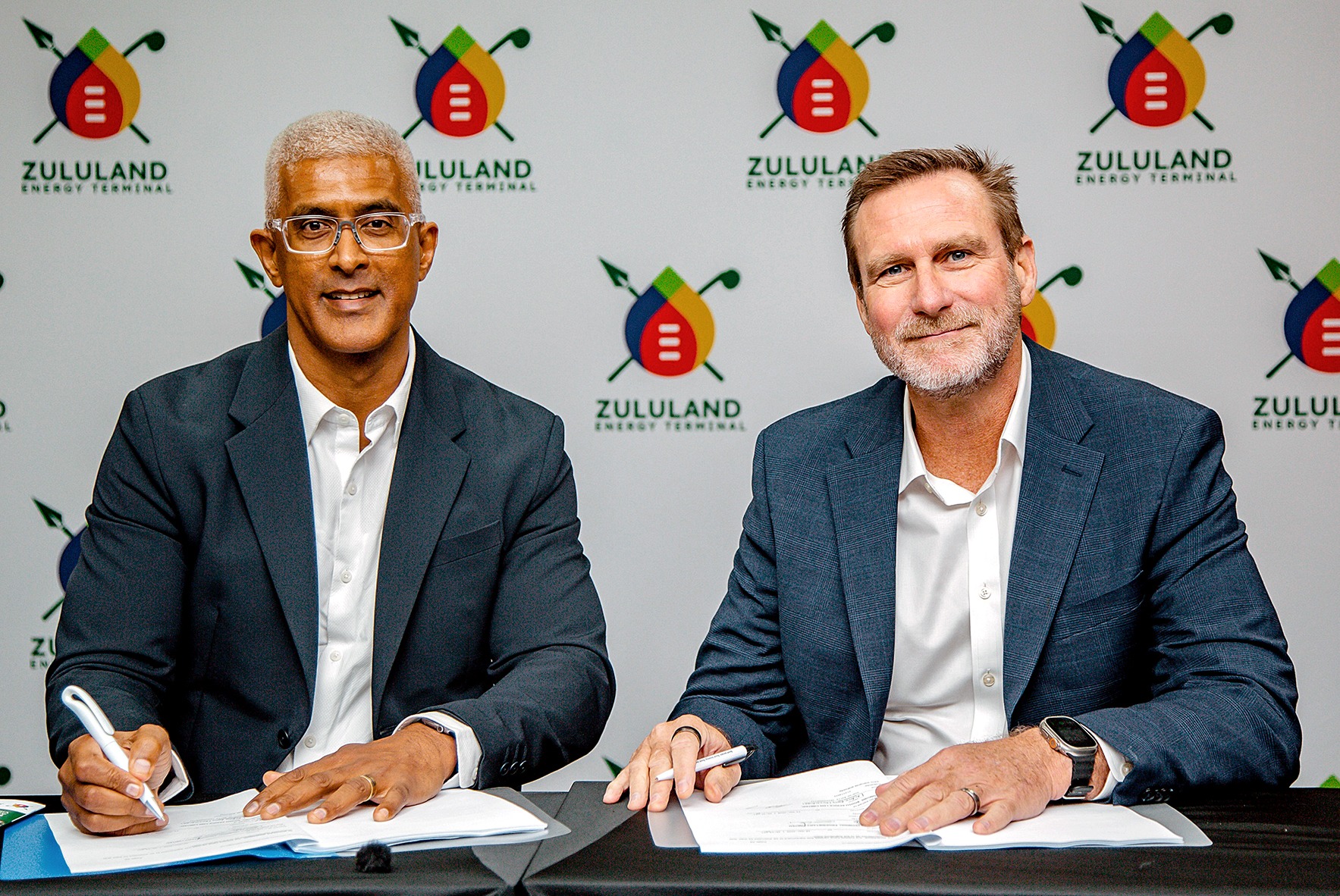
 Oliver Naidu, ZET director (left), and Andrew Barry, chairman, ExxonMobil LNG Market Development. (Photo: Zululand Energy Terminal)
 Minister of Energy and Electricity Kgosientsho Ramokgopa’s IRP 2025 calls for 6GW of gas energy to be part of the mix by 2030. To be fair, this is actually Gwede Mantashe’s grand gas plan he has fanned the flames for since liquid natural gas (LNG) was declared a transition fuel.
At the Africa Energy Indaba 2026 in March, Zululand Energy Terminal (ZET) boss Oliver Naidu was coy about the other party – outside of Eskom – who would make the project bankable and scalable to the necessary capacity.
The cat is out of the bag three months later, after the signing of a heads of agreement (HOA) between the ZET and ExxonMobil South Africa LNG, an affiliate of the global energy giant ExxonMobil.
In an interview with Daily Maverick at the Africa Energy Indaba, Naidu outlined a strict project governance process, saying specifically that after an HOA, ZET would need to complete a Front-End Engineering and Design study to “check if your project is bankable” before making a final investment decision by late 2027 or early 2028. He also explicitly said that “without an anchor customer, I cannot proceed”.
Dragging an anchor to the gas cliff
The ExxonMobil agreement directly satisfies this commercial prerequisite. This partnership, alongside Eskom, formally “strengthens the commercial foundation of the terminal and supports the transition of the project from concept to bankable infrastructure of national importance”.
It also serves as a major signal of international market interest that enables the project to secure necessary funding and transition into reality.
Regarding the perpetual gas cliff that South Africa always stares down because it does not produce its own LNG or equivalents, Naidu was bullish. That critical deadline is 2030, when Sasol gas supplies face a steep decline, but the energy veteran was clear: “I should be ready by the 2030 gas [cliff] even with a bit of commissioning time”.
ExxonMobil’s deal empowers ZET to meet this exact timeline. By 2030, South Africa’s gas supply from Mozambique’s Pande-Temane fields will decline, presenting a major risk to power generation and the economy.
Partnering with a supplier of this scale guarantees the reliable LNG supply needed to establish Richards Bay as a strategic energy hub, directly offsetting the impending shortfall.
/file/attachments/orphans/ZETFuture_525922.jpg "Zululand Energy Terminal, artist’s future projection. (Photo: Zululand Energy Terminal)")
New infrastructure thinking
Okay, at the moment, the ZET is just an LNG storage and transfer facility that Naidu claims will become a “strong foundation” for the country’s energy mix. He discussed expansive plans, including “moving off grid on trucks” to supply customers without pipeline access.
From an Eskom perspective, it is a convenient halfway point in the gas-to-energy strategy.
“Securing ‘foundation customer’ status at the Zululand Energy Terminal provides a critical enabler for our 3,000MW gas programme, with the intention of a long-term contracting approach to minimise volatility and support system reliability while aligning with the IRP 2025 objectives,” said Eskom’s group CEO, Dan Marokane.
The other 3,000MW will be procured under the gas independent power provider programme. The LNG will co-exist with Eskom’s other grid stabilisation energy sources, such as batteries and pumped hydro, and will help reduce diesel usage.
Wait, what is a ZET?
ZET is a joint venture between Vopak Terminal Durban, which is owned by Royal Vopak (a company with its head office in the Netherlands), Reatile Group Proprietary Limited and Transnet Pipelines. It was awarded a concession by the Transnet National Ports Authority to develop, construct, operate and maintain the LNG terminal in Richards Bay Industrial Development Zone in KwaZulu-Natal.
With ExxonMobil’s backing, ZET is positioned to execute a massive, phased infrastructure roll-out.
Phase 1 will include a floating storage unit and onshore regasification capable of about 3Mt per annum.
Phase 2 will scale this to 4.5Mt via an onshore LNG tank.
The deal allows ZET to build a central gas transfer point in the Richards Bay Industrial Development Zone and construct a new 24-inch connection to the Lilly Pipeline, as well as distribute gas broadly to multiple users.
Naidu argues that large-scale infrastructure projects like this are vital for the economy. He framed the terminal as a catalyst for manufacturing and job creation.
The project is officially unlocking a R35-million investment in skills development over its lifespan. Because the commercial foundation is now set, ZET can realistically target its goals of achieving 40% local participation during construction and 60% during operations, specifically focusing on youth, women, and persons with disabilities in the King Cetshwayo District.
Daily Maverick will be watching closely to see if it all plays out as described. DM