




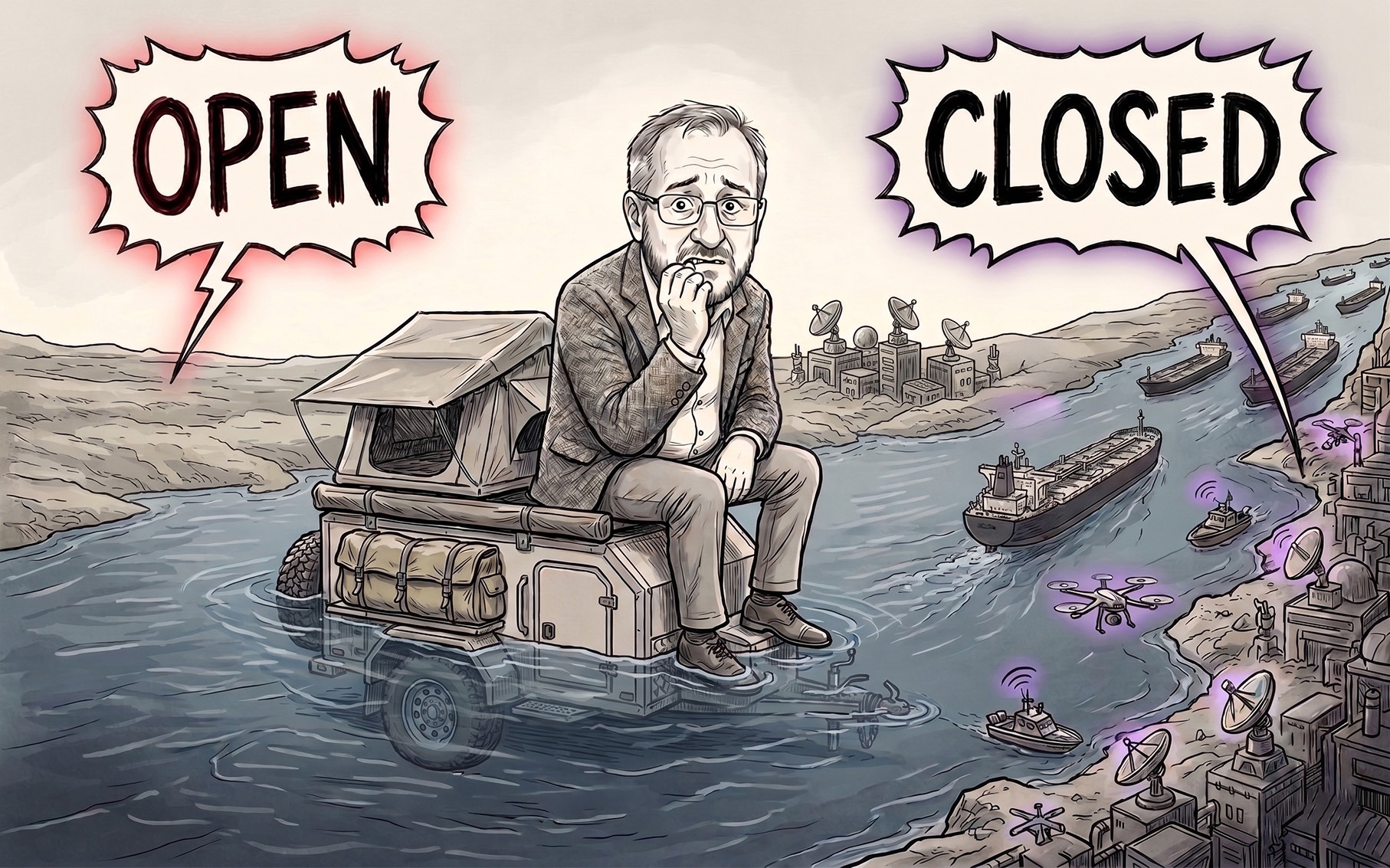
 Illustrative image: Generated with Google Gemini Flash Image 2.5
Some of the most important questions of our time – will our economy really grow this year, what is inflation going to do and, most importantly, having paid very little for that family camping holiday in the Eastern Cape in December, will I be able to afford dragging the trailer with us – seem to revolve around one little patch of water.
Even after having had the pleasure of each other’s company in Switzerland over the weekend, the top people in the US and Iran cannot publicly agree on whether the Strait of Hormuz is open or closed.
Iran says it’s closed, the US says it’s open and Trump is talking his usual nonsense which is generally contradicted by the facts.
So, to work out what on Earth is really going on, and whether or not our camping trip is in jeopardy, one turns to the people who are supposed to know. By which I mean, of course, Reuters and Bloomberg.
And how do they find out? As far as I know, they don’t have people sitting in small dinghies in the strait (imagine pulling that duty as an intern). Neither, I presume, do they have people in the supertankers themselves.
I did wonder if perhaps they have people at either end looking for lights or strange patches of disturbance in the water.
Instead, they turn to a firm called Kpler. If Cartrack helps your company keep track of its vehicle fleet and make sure your drivers are sticking to the speed limit and filling up at the right petrol station, Kpler seems to do the same for people in the shipping business.
Virtually all of their site is hidden, quite understandably, behind a subscription paywall (if you have a subscription and are in a sharing frame of mind, we would confer on you Honorary Insider Status were you to let us have a peek).
But Reuters and Bloomberg report that, actually, while Iran says the strait is closed and the US says it’s open, Kpler says five oil supertankers were able to get through this weekend. If you’re wondering about the size of them, that’s eight million barrels of oil.
From what I can work out, they do it by hugging the coast of Oman and then “going dark”.
Now, I suspect that does not mean they simply switch off all their lights. I think it means switching off their transponder. And probably a lot more than that.
Perhaps, in the 21st century equivalent of submarines hiding from depth charges above them during World War 2 (to get a flavour of that, the movie Das Boot is still unbeaten, they switch off every single device with a SIM card or a wireless connection.
This is surely a movie-in-waiting, something to watch while being distracted by my pets and melting ice?
Should you ever, through an unforeseen chain of events, find yourself at the helm of one of these things in difficult circumstances, they take two miles, about 3km, to stop.
And if, through a slightly more unfortunate chain of events, you find yourself in that tiny dinghy in front of one of these things, they take about half a kilometre to even think about changing direction.
We are talking about something that’s about 10 times the size of my house here. And it’s carrying an unbelievable amount of liquid that has a momentum all of its own.
So, how do they do it? Do they only use a pilot who grew up in Oman? Someone who grew up diving in the area?
Actually, they probably use a combination of navigational toys that do it all automatically.
I’m talking about a system that uses the stars, normal GPS data from satellites, and has a map of the seafloor that helps it steer through the area.
Now, if you, through an even more extraordinary series of events, were a member of the Iranian military and realised one of these ships was doing this, what would you do?
You could probably damage it fundamentally. A World War 2 torpedo that went in a straight line would probably be able to hit it, using an electromechanical firing computer.
And you would probably also succeed in blocking that little channel that hugs the Oman coast at the same time, to stop them sending other ships through.
But if you were to torpedo something like this below the waterline, you would probably be doing the same thing to the talks in Switzerland.
Trump, being Trump, would lose his mind, and who knows what would happen after that.
It is such a strange thing, this shadow world of moving oil in unbelievably massive vessels. So much hinges on whether they get through or not.
If they do, the balance of power moves to the US and Trump, if they don’t, it shifts towards Iran.
And our medium-term futures, of our economy, inflation and the travel trajectory of my camping trailer all hinge on the outcome. DM
Comments
Scroll down to load comments...