




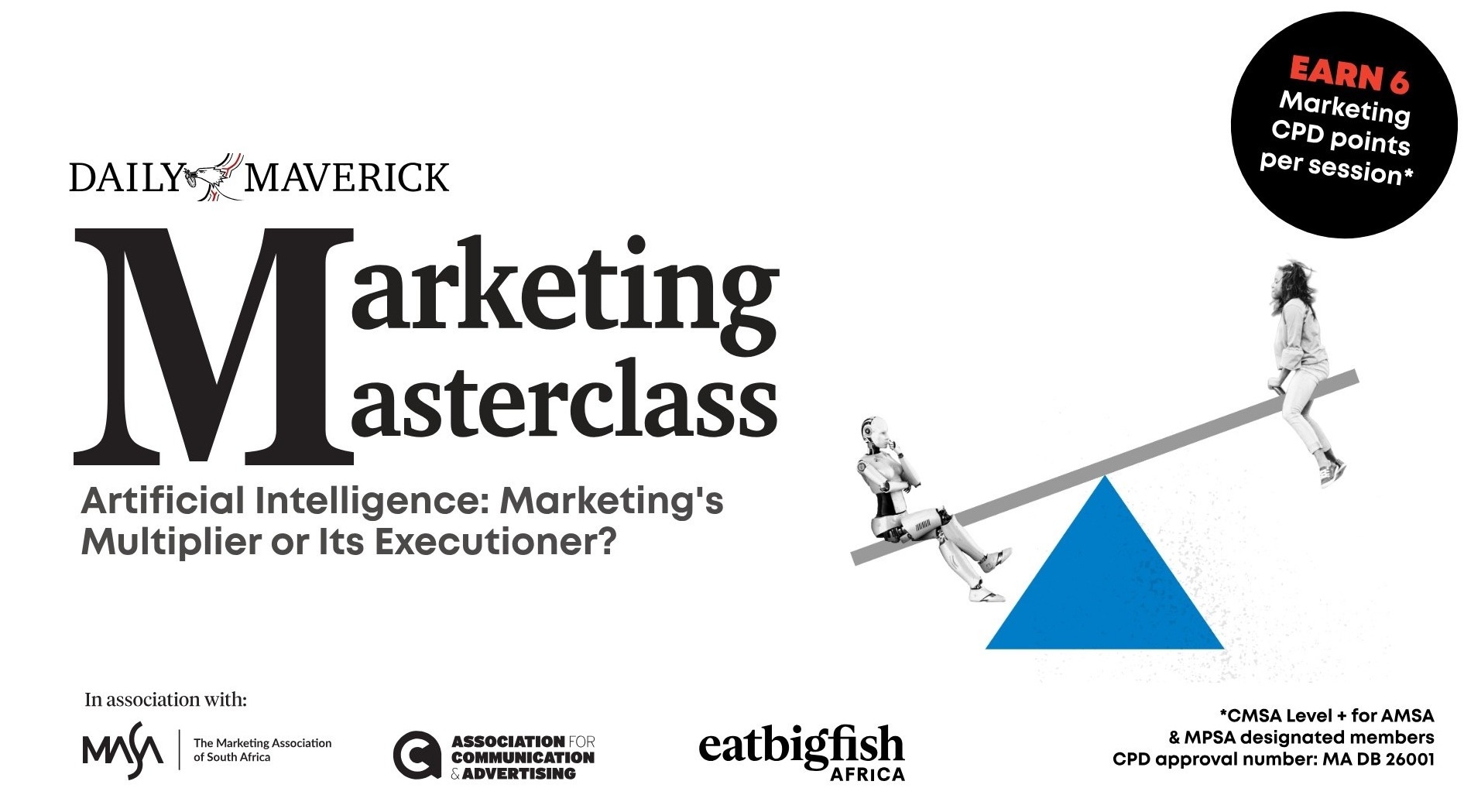
Hosted by David Blyth of eatbigfish Africa (represented by Delta Victor Bravo), in partnership with the Association for Communication & Advertising (ACA) and the Marketing Association of South Africa (MASA), the session put this provocation to two leaders who do not always agree: Jarred Cinman, CEO of VML South Africa, and Musa Kalenga, CEO of The Brave Group.
A rebuild of the industry, not a tweak
Both agreed the current agency and client model is past its time, but Cinman went further than most. “We need to do more than reinvent the commercial model,” he said. “We need to reinvent the entire workflow.” The way creative work moves, from client intent to finished idea, has barely changed in a century. Kalenga put it another way. “We all follow the same workflow to produce differentiated outputs, which means the only thing that differentiates the output is the people in it.”
For most people, AI stops at a soup recipe or a picture of a frog on a bicycle. Cinman’s advice for grasping what is coming was refreshingly practical: go and code something. “Only when you’ve experienced AI coding can you truly understand what these models are capable of,” he said. Coding is where you watch an idea become a finished thing in a fraction of the usual time.
Sameness is a skill problem, not an AI problem
Will everyone using AI simply flood the market with more of the same? Cinman thinks the question is back to front. “It’s a bit like saying, if everyone hires a copywriter, is everyone going to write the best copy in the industry?” The tool does not guarantee the outcome. “There’s a big gap between people who know how to use AI properly and people who are just playing with it.”
Kalenga added a note on pace. “Right now, the world’s collective AI is the dumbest it is ever going to be.” When his team ran the same brief through three teams using the same process and prompts, they never once got an identical result, thanks to the nuance that sits between our ears. “So if you find yourself in a sea of sameness, there’s a bigger problem with the workman using the tool.” The job now is to become better drivers.
From making to judgement
As AI takes on more of the production, the marketer’s job shifts from making to judgement, sifting out what is good across more options than ever. Cinman described who thrives: someone good at defining a problem, with strong taste, happy to get their hands dirty with the tech. “That person is having the best moment of their lives, because they finally have a partner (in AI) that can realise their ideas in a way that has never been possible before.” His worry is for everyone downstream, the people whose job was to arrange the shoot or open Photoshop.
He has already watched clients run agency scripts through ChatGPT to second-guess the work. He refused to let the industry hide behind its showreel. “People say AI will never make the Cannes Grand Prix winner. My response is, how much advertising is a Cannes Grand Prix winner?” Driving around Johannesburg, he sees one forgettable billboard after another. “I’m sorry to tell you, AI can already produce that just as well.”
Bravery, and a case for the juniors
Could AI make marketers braver? Kalenga reached for a Formula One analogy. A great driver throws a car into corners at impossible speed not because he is reckless, but because the machine has become an extension of his body. Bravery is earned on the far side of mastery. But a system that only confirms your biases is not brave. “It’s just a very sophisticated echo chamber.”
On talent, he found his most seasoned people the hardest to move, “like pouring knowledge into a cup full of cement.” So he ran an experiment, the Empty Cup Crew: three unemployed graduates who knew nothing about advertising, taught everything his team knew about AI over four weeks. By the end they were producing work at 80 to 90% of his senior staff, with less drama and at better cost. Cinman drew the parallel to the 1990s, when youngsters walked into established agencies and rewired them because they carried no preconceptions. But he was clear about the duty of leaders in the industry to keep hiring young talent: “Somebody needs to be fighting for the humans here,”
The shape of the team, and how it gets paid
Kalenga sketched the future team around two functions: imagination and execution. On the client side, he warned, brand building has quietly become an admin job, which is a problem when imagination is the only way to relative differentiation. On the agency side, he sees small, sharp “SWAT teams” of two or three people who are brilliant at one thing and can charge a premium for it.
If the point of AI is to compress the time work takes, the billable hour starts to look absurd. Cinman sees a shift to output-based pricing while Kalenga has a more radical idea which is to stop waiting for instruction altogether. “Why are we not the ones driving the demand? Why are you waiting for a brief?” Picture an agency telling a client, unprompted, that it can see their market declining and it already has the solution. That moves the conversation from outputs to value, and away from a race to the bottom on speed and price.
It’s not just about generation
A useful course correction came when Cinman urged everyone to stop fixating on the “generative” in generative AI. “The most interesting parts of it are not generative,” he said. The bigger shifts are operational, in how work is enriched, tested and flighted, and as ever in media: targeting, personalisation, ad testing and optimisation.
Briefing came up as fertile ground. Both guests have built tools to fix quality at the source. Cinman’s approach enriches briefs with the context they may lack, while Kalenga’s scores them, so anything below a threshold does not advance. His warning was blunt. “Human slop translates into AI slop.” Cinman’s was just as sharp. “You actually need AI to evaluate AI,” because we are all wired to be impressed by things that merely look impressive. Otherwise you ship what is, on closer inspection, well-written junk.
The choice ahead
The thread running through the session was that none of this is inevitable. AI will not deliver creative disaster or a golden age on its own. It will amplify the judgement, taste and courage of the people using it, and expose the absence of these qualities just as ruthlessly. Kalenga’s closing line cut to the bone. The biggest obstacle, he said, is a lack of urgency. “You almost have to believe you’re going to die as an industry in order to find the solution.” In an industry long used to waiting for the brief, that may be the most useful provocation of all. DM
About the series
This was the opening session of “We’re Picking Fights”, Season 3 of the Daily Maverick Marketing Masterclass, hosted by eatbigfish Africa in partnership with the Association for Communication & Advertising (ACA) and the Marketing Association of South Africa (MASA). Six fault lines, one platform for tough debate. The series runs as a one-hour webinar every second Thursday from 11 June to 20 August 2026. The next episode asks whether procurement is marketing’s gatekeeper or its growth blocker, and takes place on 25 June. To view the series, visit Daily Maverick Events.