




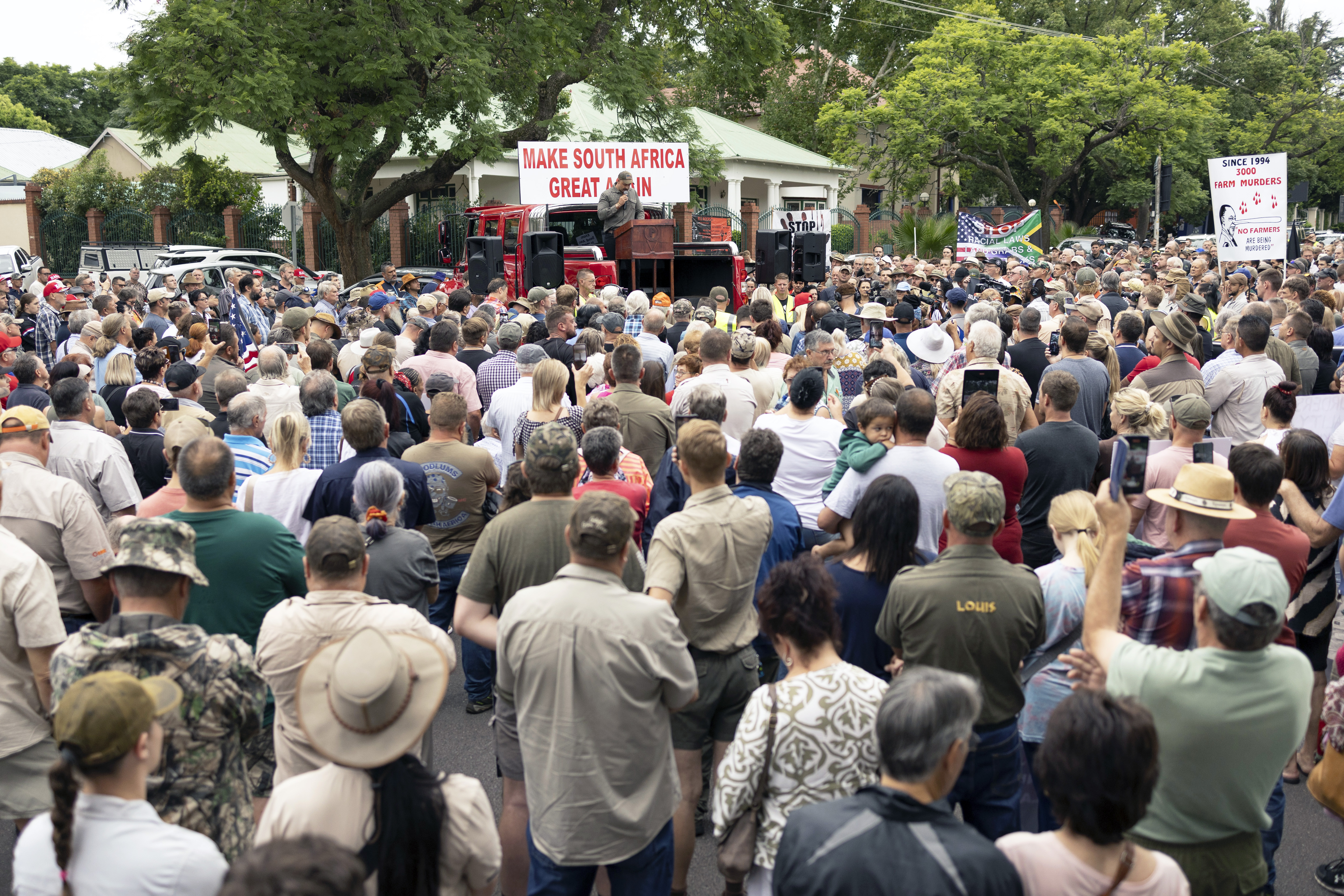
 Afrikaans farmers picket in support of an executive order by US President Donald Trump, granting Afrikaners refugee status in the US, outside the US Embassy in Pretoria, South Africa, 15 February 2025. Trump offered Afrikaners refugee status in the wake of a recently implemented land expropriation bill signed into law by South African President Cyril Ramaphosa that may see land being expropriated from farmers in the country. EPA-EFE/KIM LUDBROOK
A Mississippi farmer who paid higher wages and favoured white South African guest workers has been taken to court by five black American workers alleging a pattern of racial and citizenship-based discrimination and “wage theft”.
US citizens Michael Anthony Nash, Jimmy Shaw, Vinnie Cason, Grant Lewis and Charleston Taurvonta Harris with the support of the Mississippi Centre for Justice (MCJ) and the Southern Migrant Legal Services filed a federal lawsuit in Greenville, Mississippi, in May against Gregory Carr, farm owner and manager of Carr Farms, headquartered in Schlater, a small town in Leflore county and a producer of rice and soybeans.
The MCJ statement and legal papers can be read here.
The MCJ has so far filed seven court actions on behalf of black farmworkers in Mississippi, a state deeply rooted in a history of human enslavement on cotton farms, which then followed years of sharecropping and tenant farming, locking many black families into a cycle of poverty.
The region is internationally known for its troubled racial history, with the Ku Klux Klan (KKK) forming the “White Knights” in 1962 to resist desegregation and violently attack black Americans. In the 1950s/60s, the state was the epicentre of the American Civil Rights movement.
The workers in this court action all live in Sunflower County and were previously employed by Carr, performing seasonal agricultural work between 2018 and 2026.
Sunflower County, founded in 1844, is a cornerstone of the Mississippi Delta and featured as a focal point of the Civil Rights Movement, and also birthed what has become known as the Delta Blues.
/file/attachments/orphans/GettyImages-2214742189_569888.jpg "Newly arrived South Africans, invited by the Trump Administration to come to the United States as refugees, listen to US Deputy Secretary of State Christopher Landau and Homeland Security Deputy Secretary Troy Edgar (right) deliver welcome statements near Washington Dulles International Airport on 12 May 2025 in Dulles, Virginia. (Photo: Chip Somodevilla / Getty Images)")
H-2A visa surge
Latest US State Department figures show that while South Africans made up only 3% of this visa programme, numbers have climbed by 1,300% between 2011 and 2024. US President Donald Trump has offered special refugee status to white Afrikaners who claimed to be facing mass murder on farms.
The first group were given a warm welcome by US Deputy Secretary of State Christopher Landau and Homeland Security Deputy Secretary Troy Edgar at Dulles International Airport in May 2025.
While white South Africans have been working on H-2A visas in the US since the early 1990s, they have been mostly concentrated on the Great Plains, to the west of the Mississippi River and East of the Rocky Mountains. Since then, more young Afrikaans-speaking men have settled in the Delta.
Carr is accused of deliberately misclassifying black US citizens as “independent contractors” to avoid the legal requirement under the H-2A visa programme to pay local workers in “corresponding employment” the same higher wage given to foreign workers.
The court action claims these practices violated the Migrant and Seasonal Agricultural Worker Protection Act and the Civil Rights Act of 1866. The American workers are seeking compensatory and punitive damages for unpaid wages, breach of contract and the emotional distress caused by their unequal treatment.
Carr is alleged to have used various corporate entities, “alter egos”, to bypass labour obligations, allegedly hiring H-2A workers through one entity while paying the US citizens through other companies at the lower rate to avoid paying equal wages and benefits.
An injury to one
Over and above this, the five applicants have highlighted dangerous working conditions on Carr’s farms as well as the lack of proper safety equipment. He has been accused of failing to provide body harnesses with lifelines and boatswain chairs for dangerous work inside grain silos.
A 20-year-old South African farm worker, Eugene Nicholas, suffocated to death in October 2022 when he fell into a soya bean silo without wearing a harness at his place of employment, Bare Bones Farms in Itta Bena, Mississippi. It took five hours for the young man’s body to be retrieved.
US Department of Labor investigators found the farm wilfully violated federal safety standards by not providing harnesses or lifelines to the trapped workers.
In 2023, the owner of the same farm was fined after another young South African, Nantes Lennox, died after also suffocating in a grain bin on the farm.
/file/attachments/2993/Screenshot2026-06-21131057_678680.png "Nantes Lennox, five months before his death after an accident on a farm in Mississippi, US. (Image: Facebook)")
Lennox hailed from Springbok in the Northern Cape. Bare Bones faces a $90,182 penalty for “willful and serious safety violations”.
‘Wage theft’
The five plaintiffs in this instance allege that black US workers’ wages were kept at a constant $10.00 per hour as part of a systematic effort to underpay them in favour of white foreign workers. Ironically, these better-paid white South Africans are subject to some of the same labour abuses their black counterparts have highlighted when it comes to safety and working conditions.
Under the H-2A programme, employers who wish to hire foreign agricultural workers must follow strict rules designed to prioritise and protect US workers.
For example, before hiring foreign workers, an employer must prove to the Department of Labor that there are not enough able, willing, and qualified US citizens available to perform the temporary or seasonal labour. Employers are also required to conduct specific recruitment procedures to find local workers.
Written reports must be submitted by employers to the Department of Labor, detailing efforts, such as contacting former US employees by phone or email to offer them the job at the specified H-2A terms. US workers must be afforded a preference in hiring for the available positions.
One of the most critical protections is the rule regarding corresponding employment is that a US worker performing the same or similar work as an H-2A worker must be treated as if they are part of the H-2A programme.
Wage gap
Papers filed in the lawsuit revealed that the wage gap between the five US citizens and the white South African H-2A workers had “widened significantly” between 2018 and 2025.
While the black US workers were paid a constant rate of $10.00 per hour for all work performed throughout this entire period, the wages for the foreign H-2A workers – which were tied to the Mississippi Adverse Effect Wage Rate – increased annually.
/file/attachments/2993/wage_gap_table_705330.jpg "The progression of the hourly wage gap set out in court papers.")
In addition to the base hourly wage disparity, the financial gap was further exacerbated by other factors, such as Carr allegedly misclassifying black US workers as independent contractors rather than employees.
In so doing, he failed to make the required Social Security and Medicare tax contributions on their behalf, which increased the US workers’ personal tax burdens.
The US workers allege Carr “intentionally sought out white South African workers” to fill his labour force and proceeded to pay them higher rates. Carr, they claim, gave preference in job assignments to white foreign workers and failed to offer at least equal job opportunities to their black workers.
/file/dailymaverick/wp-content/uploads/2025/02/12822803.jpg "People picket outside the US Embassy in Pretoria on 15 February 2025 in support of an executive order by US President Donald Trump, granting Afrikaners refugee status in the US. (Photo: EPA-EFE / Kim Ludbrook)")
Mississippi blues
Writing in the New Yorker in March 2026, Boyce Upholt noted that in 2021, six black farm workers from Sunflower County filed a federal lawsuit against Nelson-King Farms, which had “confirmed suspicions that white South Africans were being better paid”.
According to this lawsuit, Pitts Farms, a corn, cotton and soybean farm, had paid US citizens four dollars and fifty cents an hour less than white H-2A workers, and a few had been pushed out of their jobs entirely.
Upholt quotes Jason Holcomb, an emeritus professor of geography and global studies at Morehead State University, who noted that South African H-2A workers in the US “first found jobs on the Great Plains in the 1990s, working on custom harvesting crews that travelled from farm to farm, to cut crops”.
Historically, said Holcomb, this work had been a rite of passage for high schoolers and college students in the region.
“But in the 1990s, as regulations tightened, local interest waned. Now South Africans represent the fastest-growing source of H-2A farm labor in the US from 2011 to 2024, the number of visa holders has increased by more than 400% and the number of South Africans in the programme has increased 14-fold”. DM
Comments
Scroll down to load comments...