




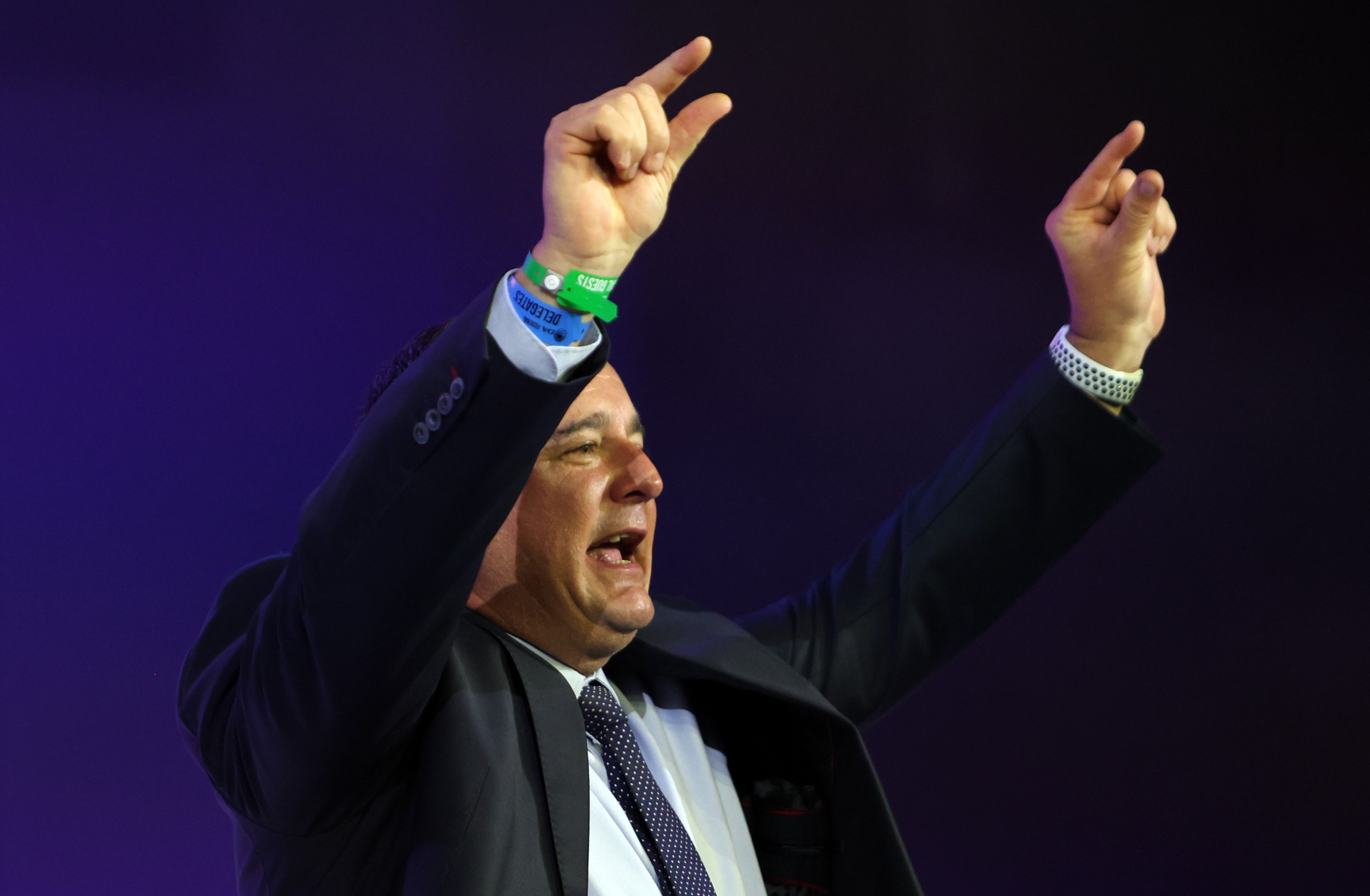
 John Steenhuisen addresses delegates at the Democratic Alliance Federal Congress 2026 at Gallagher Convention Centre. (Photo: Felix Dlangamandla)
 When erstwhile DA leader John Steenhuisen announced in February that he would not be standing for another term, he gave reasons that either had South Africans roaring with laughter or yawning with the boredom of familiarity.
Steenhuisen claimed that he wanted to stop juggling his party leadership role with his demanding agriculture portfolio and also played that tired card of wanting to spend more time with his family.
“For the rest of this term of office, I will focus all my time and energy as minister of agriculture on defeating the most devastating foot-and-mouth disease outbreak our country has ever seen,” he told the media and his loyalists in Durban, where he had begun his political career about 27 years ago.
Nobody believed any of that hogwash. Although Steenhuisen was expected to run unopposed (or only symbolically opposed by a hapless candidate) at the party’s federal congress in May, his term was going to be a tumultuous one. His being unopposed would have owed more to the DA not wanting an ugly contest in an election year than to his overwhelming popularity.
Steenhuisen is widely seen in the DA as the weakest and most uninspiring leader in its history. He was like one of those vegetables that add absolutely nothing to the meal. Maybe a bit of colour, but certainly no flavour. It is just present and inoffensive, so everyone at the dinner table tolerates it, but it does not lift their culinary experience.
The point is that not even his team’s clever adoption of the anthemic 2020 hit John Vuli Gate managed to connect Steenhuisen to the DA’s support base. An uninteresting vegetable is just a bland piece of food and will remain that regardless of any innovation.
When Steenhuisen took over the leadership, he was seen as the most natural successor. The DA had experimented with black leadership when it elected Mmusi Maimane as leader. There was initially great excitement inside the party about the leap. Nobody could now accuse the DA of being a white, racist party.
But when Maimane showed his true colours, or rather his colour, it became uncomfortable. It had to be back to form. Steenhuisen, then the parliamentary chief whip, was the person in place to step in and lead the DA back into the laager and avert incursions from the FF Plus flank.
The DA’s electoral performance under Steenhuisen was, at best, middling. It fared badly in the 2021 local government elections, losing some Western Cape municipalities it had total control of and not doing particularly great elsewhere. It profited more from the ANC’s decline than its own gains. The new kids on the block, ActionSA and the PA, were the energising and energetic forces of that election.
The DA’s temporary capture of the Tshwane and Johannesburg coalition governments was tenuous and therefore easily disrupted by a power-hungry ANC. The DA actually lost 100,000 votes in 2024 compared with 2019, but it could claim improvement because lower voter turnout allowed it to apply cheap lipstick to the decline.
So here is the thing. The ANC’s horrendous outing in that general election handed Steenhuisen a legacy gift. Voters felt revulsed by the ANC and stayed away, but they did not give their votes to anyone else.
The improvement in the performance of ActionSA and the PA, the entry of parties such as Rise Mzansi and Build One South Africa, and the storming entry of former president Jacob Zuma’s MK party all combined to cut the ANC to a paltry 40%. This meant the ANC could not govern alone.
The DA, aiming for a share of national power, was the only party in the so-called Moonshot Pact of opposition parties that did not commit to never working with the ANC. Thus was born the Government of National Unity (GNU). Steenhuisen would claim this as his achievement, even though everyone knows that DA federal executive chair Helen Zille managed the negotiations on behalf of the DA with an iron-clad grip.
“It was only by gaining access to the levers of national power that we could ever hope to build a more prosperous, fair and successful country. But to actually get there, a leader was required who would do the hard work of converting the DA from a party of mere opposition into a governing force strong enough to bend the arc of history,” Steenhuisen crowed in his departure announcement.
It rang hollow and just seemed to be the desperate attempts of a man trying to claim his place in history. Well, he is now history himself. New leader Geordin Hill-Lewis’s decision to drop him as agriculture minister is his nadir.
But there is another element to this that shows Hill-Lewis is reluctant to have a shot at making history. As the new leader, he had a chance to show that the DA was taking a different, more inclusive direction. But his first action indicated that the party would be continuing on the post-Maimane trajectory of projecting a white face to the world.
The elevation of George Michalakis to parliamentary leader and Glynnis Breytenbach as chief whip, for instance, sent the strongest message that the DA was happy to remain just as it is.
In the wake of Steenhuisen’s demotion, the party had yet another chance to send strong signals that it wished to cast its net wider. Instead, it was largely the white cohort that came to the fore. It wasn’t the bold signalling that one would have expected from a leader whose rise was seen as an overdue refresh.
Perhaps this is perfectly in keeping with Zille’s pronouncements in the build-up to the 2024 election that the party was quite happy with a 25% ceiling. The basis of this thinking was that many coalition governments around the world are comprised of parties whose vote share is below 30%. Given that the ANC is on a certain downward slide, she opined, future South African coalitions would operate on this basis.
The DA therefore seems set on holding on to its core white vote, with a chunk of Indian and coloured constituencies as well as a small sprinkling of the black vote. Through this strategy, the DA would be able to sustain its constant vote share of about 21% and, at a push, get closer to 25%.
This calculus may work for the DA and its grip on national power, but it also accentuates the ethnic balkanisation of South African politics. We already have an IFP that is comfortable with its ethnic roots, an MK party that appeals to people from the same province, a PA that is unashamed in its wooing of the coloured vote and an ANC that appears to have forgotten its non-racial traditions. All of this does not bode well for the nation-building project.
Our political parties, including the DA, need to keep in mind the bigger South African project and become creative about broadening their base rather than just chasing short-term political gains. In the case of the DA, it needs to look beyond its whiteness. DM
Mondli Makhanya is Daily Maverick’s editor-at-large.
This story first appeared in our weekly DM168 newspaper, available countrywide for R35.
/file/attachments/2993/DM-190626_946367.jpg)