




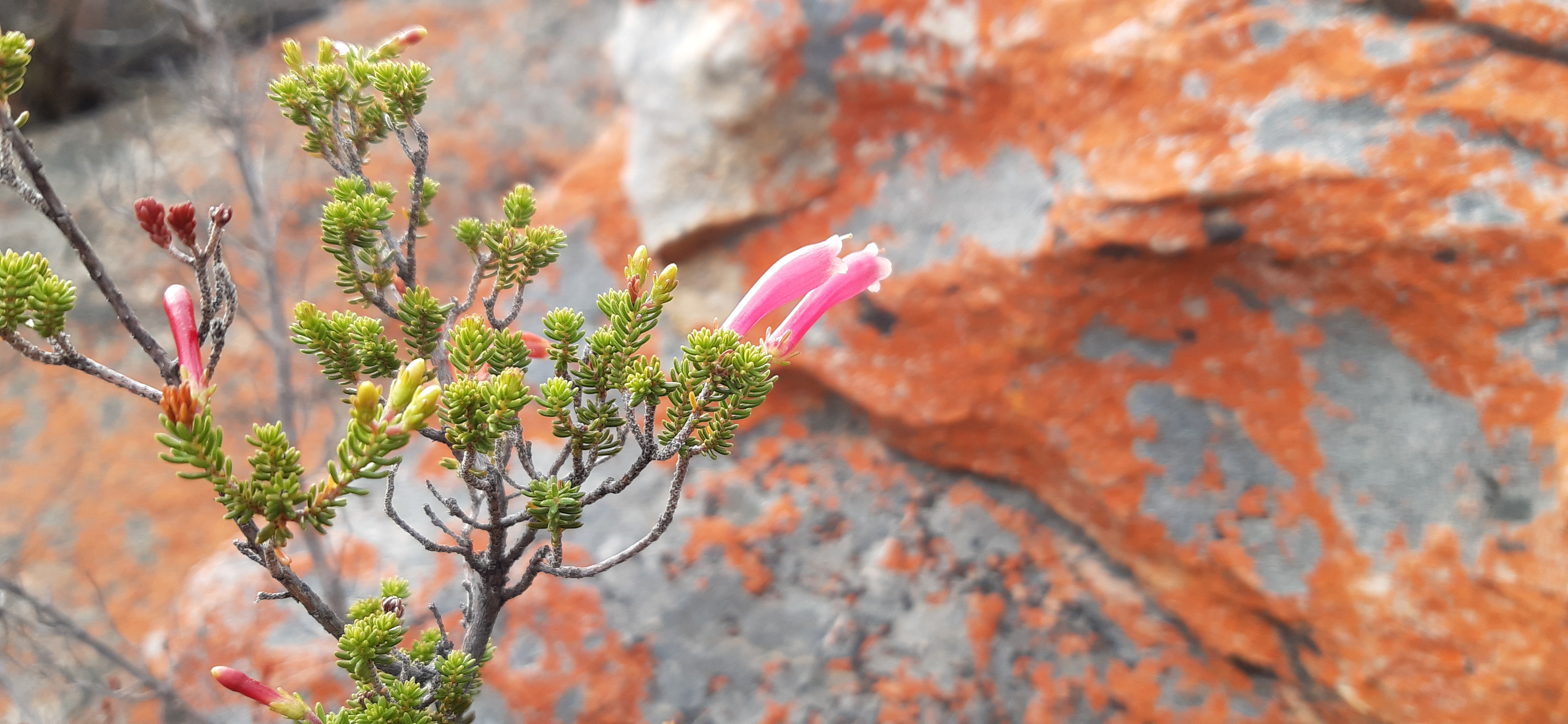
 The Succulent Karoo has many rare and endangered species, both plant and animal. (Photo: Endangered Wildlife Trust)
 South Africa’s Youth Day and the World Day to Combat Desertification and Drought fall in the same week. One is a heartbreaking reminder of what it costs when governance systems fail to protect our children. The other raises the question of whether we are governing our natural environment with sufficient care for those who will inherit the world we are shaping.
This question comes into sharp focus in South Africa’s Succulent Karoo, one of only two entirely arid biodiversity hotspots on Earth and an irreplaceable landscape under mounting development pressure.
At first glance, the Succulent Karoo offers the impression of emptiness. But the more you look, the more you notice.
Beneath scattered quiver trees and vast boulders lies an extraordinary concentration of life: more than 6,350 plant species – many found nowhere else on Earth and adapted in ingenious ways to survive scarcity – alongside endemic wildlife such as the speckled dwarf tortoise, which, at no more than 10cm, is the world’s smallest tortoise.
In a world largely defined by urgency and visibility, there is something powerful about a landscape that invites stillness and attention, and rewards it so richly. Beyond its rugged beauty, the landscape’s message of resilience is written into every hidden stem, buried root and dwarf succulent.
This resilience extends to the communities whose histories, livelihoods and identities have been shaped by the rhythms of this arid environment over centuries.
Intergenerational justice for Succulent Karoo biome
/file/dailymaverick/wp-content/uploads/2023/11/ISS-Today-map-3.png "Succulent Karoo hotspot, southern Africa. (Source: Critical Ecosystem Partnership Fund)")
These landscapes also bear the imprint of South Africa’s history of dispossession and exclusion. In some areas, communities have only recently regained recognition of land rights lost through apartheid and colonial-era displacement, while others are still battling for it.
Decisions affecting these landscapes therefore engage not only questions of biodiversity and development, but also of belonging, dignity and intergenerational justice.
As a living landscape where ecological, cultural and social values are inseparable, how decisions are made about it, matters.
The Biodiversity Law Centre (BLC) has been examining how environmental decision-making is unfolding across the Succulent Karoo, including in relation to prospecting and mining proposals.
The patterns emerging present a picture not simply of rapidly growing development pressure, but of governance systems being asked to make increasingly consequential decisions about landscapes whose value extends far beyond individual project boundaries.
The question is whether our environmental governance systems are capable of making decisions that are informed, accountable and responsive to the people and landscapes they affect, in the way that our Constitution requires.
Cumulative risks across landscapes
To date, the BLC has on record approximately 150 prospecting and mining right applications across the Succulent Karoo, at different stages of the regulatory process.
The significance does not lie simply in application volume, but in what they reveal about how environmental decisions are made, whose voices are heard, and whether cumulative risks to landscapes are being adequately understood.
The figure does, however, illustrate the scale of interest in a landscape that remains globally significant for biodiversity, cultural heritage and water security.
Much of this interest reflects growing global and national demand for minerals associated with industrial development and the energy transition.
Many of the minerals being prospected for in the Succulent Karoo, including copper, lithium, rare earth elements and uranium, appear on South Africa’s Critical Minerals and Metals Strategy list.
The global energy transition is urgent and necessary, and the economic and strategic significance of these resources is not in question. But that significance makes informed and accountable decision-making more urgent, not less.
South Africa’s own history of extractive industries leaving behind contaminated land, compromised water resources and unresolved social costs is a caution that constitutional rights to a healthy environment and sufficient water cannot be suspended by the strategic value of the minerals sought.
The scale of these applications illustrates what is being contemplated, with some spanning tens of thousands of hectares.
One uranium mining right application covers approximately 77,000 ha, an area larger than half of Namaqua National Park. While application areas do not necessarily translate into equivalent extraction site footprints, they highlight the importance of understanding impacts not only at project level, but across entire landscapes.
/file/dailymaverick/wp-content/uploads/2021/08/image1-3.jpeg "The Namaqua National Park forms part of the Succulent Karoo biome. (Photo: Graham Bean)")
Our review of environmental assessment documentation for prospecting and mining applications in the region has revealed recurring concerns about non-compliance with South Africa’s Environmental Impact Assessment (EIA) regulations and wider environmental governance frameworks.
Many reports appear to contain material carried over from unrelated projects: one basic assessment report included several paragraphs dedicated to the wrong mineral. Such overt errors raise questions about the degree of project-specific scrutiny being applied and whether environmental assessments are functioning as meaningful decision-support tools.
Biodiversity assessments frequently rely on long-outdated spatial and census data, while alternatives assessments often appear superficial, with little evidence that different development pathways have been meaningfully explored.
Financial provision allocation figures for rehabilitation post-operations are often very low. Public participation is at times treated as mere procedural formality, with site notices for new applications placed on remote fences along dirt roads and announced in an English newspaper notice, despite census data confirming that 97% of the area is Afrikaans-speaking.
We are also seeing the clustering of mining and prospecting applications in and around protected areas, Critical Biodiversity Areas and landscapes identified for future conservation expansion.
In the case of national parks and nature reserves, mining and prospecting is prohibited by law. Yet applications covering these areas are accepted and processed.
Even where direct overlaps are eventually amended, these adjustments do not necessarily address material concerns about ecological connectivity, landscape integrity or South Africa’s long-term conservation commitments. That these adjustments are left to interested and affected parties to raise, rather than screened out at the point of acceptance, points to a broader failure of landscape-scale decision-making.
Governance of mining applications is lacking
/file/dailymaverick/wp-content/uploads/2025/06/8-2.jpg "Stone plants or vygies, as they are also known, are endemic to southern Africa’s dryland biomes, including the Succulent Karoo and Fynbos. (Photo: Kristin Engel)")
This connects directly to possibly the most concerning dimension of the governance of applications in the area: the persistent failure to assess cumulative impacts.
Prospecting and mining applications are generally assessed one at a time without regard to others in their immediate vicinity, even as increasing numbers of proposals emerge across the same landscapes. The result is a fragmented approach that risks systematically underestimating combined effects on biodiversity, groundwater systems and ecosystem integrity.
This matters particularly in an arid landscape. Many of these projects are highly water intensive. A recent uranium mining rights application scoping report cited an estimated water usage of 200,000 litres per day, to be acquired through a combination of groundwater abstraction and extracting and trucking from the Orange River. Groundwater underpins agriculture, settlements, livelihoods, cultural practices and community wellbeing, and the Orange River is a significant national and transboundary resource.
Decisions that appear localised on paper may have consequences that extend far beyond individual project footprints and across generations.
Environmental governance in irreplaceable places is therefore not only about protecting species or habitats but about safeguarding the ecological systems upon which people depend and the landscapes with which communities maintain cultural, historical and livelihood connections.
The constitutional rights to an environment that is not harmful to health or wellbeing, and access to sufficient water are directly implicated.
More than a decade after the One Environmental System placed environmental authorisation of prospecting and mining at first instance with the Minister of Mineral and Petroleum Resources, questions remain about how effectively that framework is functioning.
This concern is sharpened by the fact that the current Flexi-EIA reform process, which proposes significant changes to how environmental assessments are conducted, has not interrogated how the One Environmental System has functioned in practice.
A reform process that improves procedural efficiency without first accounting for systemic assessment failures risks entrenching those failures under a new framework.
Places of exceptional ecological, cultural and social significance demand exceptional care. The situation unfolding in the Succulent Karoo demands that we ask whether we are capable of governing such places with decisions grounded in law, evidence, accountability and genuine regard for those who may be affected, including future generations.
Youth Day reminds us that the Constitution’s commitments are not made only to those alive today. They are also made to those who will inherit the consequences of the decisions we take now.
The question is not whether development should occur. The question is whether we can make decisions about irreplaceable places in a way that is constitutionally sound, transparent, accountable, and commensurate with what is at stake. In the Succulent Karoo, that is ultimately a question about the kind of future we are choosing to leave behind. DM
Lara Wallis is a senior attorney at the Biodiversity Law Centre, a nonprofit law clinic that uses the law to protect and restore biodiversity across Southern Africa.


Comments
Scroll down to load comments...