



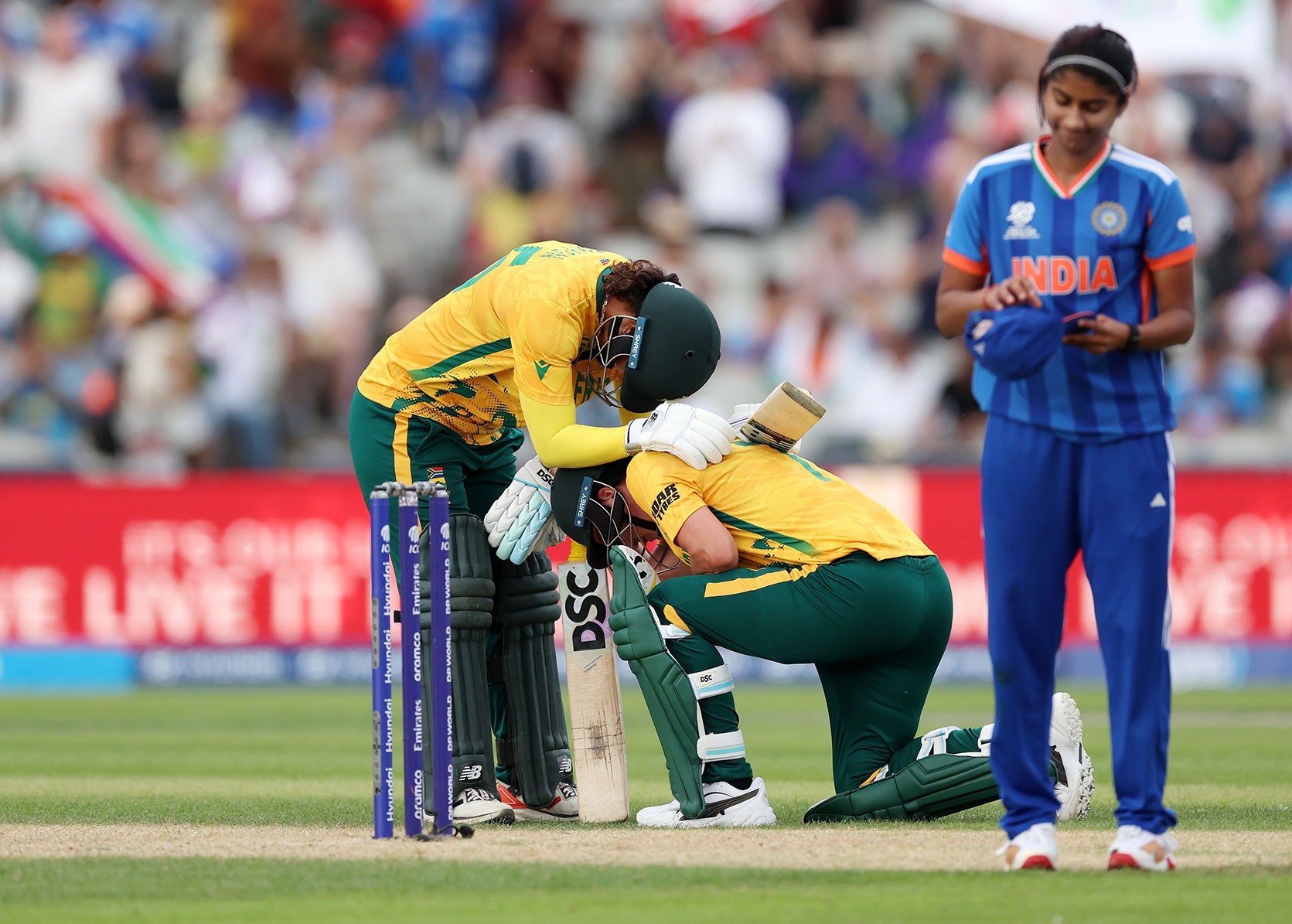
 Marizanne Kapp and Chloe Tryon of South Africa celebrate victory in their T20 World Cup match against India on 21 June 2026 at Old Trafford in Manchester, England. (Photo: George Wood / Getty Images)
“I think she’s probably the biggest big match player that I’ve ever seen,” said skipper Laura Wolvaardt after Marizanne Kapp steered South Africa to a historic six-wicket victory over India in the T20 World Cup on 21 June.
In a must-win encounter, Kapp delivered with both bat and ball as the Proteas completed the third-highest run chase in women’s T20 World Cup history, reaching 159 for four with five balls to spare to keep their semifinal hopes alive.
This was the first time India and South Africa had played against each other in a T20 World Cup, and Kapp helped restrict the dangerous Indian batting line-up to 158 with two wickets, conceding just 27 runs, the side’s most economical figures.
She then anchored South Africa’s chase with an unbeaten 81 from 45 balls, making that her maiden T20 World Cup half-century. Kapp is now also the first player to score more than 70 runs and claim two wickets in the same game.
/file/attachments/orphans/2282635599_192553.jpg "All-rounder Marizanne Kapp steered the Proteas to victory with an unbeaten 45-ball 81 against India on 21 June. This also makes it her first half-century in a T20 World Cup and her sixth overall. (Photo: George Wood / Getty Images)")
“It was a tough game. Playing India is always tough,” said Kapp at the end of the game. “I am very proud of the way the team came back.
“I really struggled those first few balls and eventually got my timing, and then I just put my head down, and I felt like that partnership with Taz (Brits) set it up beautifully for us.”
Slow off the mark
In contrast to India’s blistering opening innings, where they ended the Powerplay 59 for two, South Africa got off the blocks much slower. The Powerplay ended with a maiden-wicket, and South Africa were 25 for two after losing Wolvaardt and Annerie Dercksen.
Joining Tasmin Brits, who replaced Suné Luus and was one of two changes, including Dane van Niekerk coming in, Kapp and Brits produced exactly what batting coach Andrew Puttick had identified as crucial: an established partnership.
The pair started slow and steady, and against a solid Indian outfield, were only managing singles and dots. After 10 overs, South Africa were 59 for two, equalling India’s Powerplay score. It almost seemed that they would not get over the line.
Brits played the supporting role, anchoring the innings with 40 from 36 balls before departing after a pivotal 97-run stand for the third wicket.
/file/attachments/orphans/2282620949_855093.jpg "South Africa's Nadine de Klerk celebrates with teammate Sinalo Jafta after taking the wicket of Jemimah Rodrigues of India on 21 June 2026. South Africa successfully chased 159 runs, the third-highest chase in women’s T20 World Cup history. (Photo: George Wood / Getty Images)")
Eventually, Kapp picked up the pace, achieving her first T20 World Cup half-century and sixth overall. She scored seven boundaries and four sixes, steering her side over the line with five balls to spare.
India were not without their chances though, as they dropped Kapp twice, albeit a tough one on 25 and then a simple one on 65.
“It seems like whenever there’s something on the line, or we’re playing a World Cup, [Kapp] finds a way to bring out her best cricket,” said Wolvaardt. “She’s two players in one.
“The way that she bowled in the previous game and now to play a knock like this is incredible. She just has that competitive nature, and it just brings out the best in her.”
Continued pace barrage
After having to bowl first for the third time in a row in this World Cup, the South African bowlers knew they had the important job of restricting India to a modest total for the South African batters, who have been struggling with spin, to chase.
Before this, India had opted to bat first in both their games, posting high totals, one of which surpassed 200 against the Netherlands.
While all South Africa’s opponents have relied on spin, the Proteas have continued to find success through their seam attack.
Kapp once again took the new ball, and although she was unable to get a wicket in the first over, as she had done against Australia and Pakistan, she struck in her second to provide an early breakthrough. She fittingly returned at the death and dismissed the dangerous Richa Ghosh in the final over.
Also claiming two wickets was Shabnim Ismail. After a very expensive start that saw her concede 14 runs in her opening over, the veteran responded emphatically in the sixth over to claim the all-important wicket of Shafali Verma for a blistering 31 from 15.
It was a searing bumper, filled with so much aggression, and Verma was completely taken aback, nicking the ball with her glove through to the wicketkeeper. Ismail clocked 122km/h, making it the fastest delivery of this year’s World Cup so far.
She then bowled out captain Hermanpreet Kaur, breaking a crucial 33-run partnership with Deepti Sharma, halting India’s momentum once again just as they looked to accelerate.
/file/attachments/orphans/2282624534_492334.jpg "Shabnim Ismail of South Africa celebrates taking the wicket of Harmanpreet Kaur of India during their game on 21 June 2026. (Photo: George Wood / Getty Images)")
Ayabonga Khaka also made an early impact, trapping Yastika Bhatia lbw with just her second delivery, while Jemimah Rodrigues fell to Nadine de Klerk after spooning a leading edge into the air, leaving India on 82 for four in the 11th over.
Despite a rapid start from the Indian top order, South Africa’s bowlers consistently pulled back the run rate through the middle overs, restricting India to a total that ultimately proved just within reach.
“We were very stressed up on the bench there,” said Wolvaardt post-match. “To win from the position that we were in was absolutely incredible, and it’s probably one of the best knocks I’ve seen under so much pressure.”
“I think the way that they started the first two overs, they pretty much smashed. To be able to come back like that, I think our bowlers in the middle were excellent. They all changed up pretty well. I think we just didn’t leave the stumps and didn’t give them much to work with.”
The result keeps the group alive, with India and South Africa both on four points. South Africa play the Netherlands next on Thursday, 25 June at 7.30pm South African time. DM
Comments
Scroll down to load comments...