




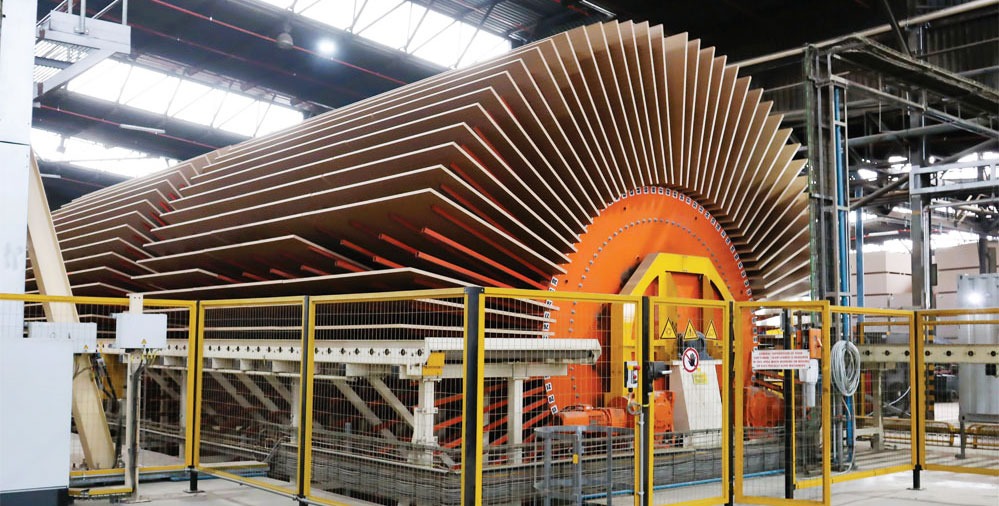
 Site preparation for the MDF expansion project at Mkhondo began in April 2021, with construction and installation following in March 2023. (Image: PG Bison)
Last week in this column, I wrote about how MTN is riding the tailwind of smartphone penetration in Africa.
The key learning was that companies swimming with the tide have a far easier time than those swimming against it – a simple truth that many investors tend to forget as they deal with the daily noise of the markets.
Structural factors (i.e. changes that are here to stay) tend to be simpler to identify than cyclical ones (that come and go). It’s also easier to see how these factors filter down into investment ideas, giving investors more confidence to place greater value on the resultant growth prospects.
The smartphone example is perfect, as thinking through the benefit for MTN of increased smartphone penetration is nothing more than an exercise in common sense.
Cyclical issues, often driven by global geopolitical and macroeconomic events, are far more difficult to assess. Not only is it tough to think through all the second-order effects, but it’s also risky to bet on how long the cycle might last.
This is why the market tends to react with caution when a company is the surprising beneficiary of a broader macroeconomic trend. It’s like being given a particularly wonderful gift for your birthday – you’re thankful for it when it happens, but you won’t assume that it will happen every year from here on out.
Share prices will move in response to cyclical movements of course, but often by a lower percentage than the underlying earnings. This is because the market is hesitant to assume that either the good times or the bad times will be here to stay. This is why companies driven mainly by structural factors tend to have less volatile valuation multiples than cyclical names.
Industrial group KAP gives us a great way to see the impact of cyclical vs structural factors. The share price is up 44% year-to-date, yet it is almost perfectly flat over three years. The recent cycle is clearly positive, but the broader structural story has been highly disappointing for investors.
The upswing in KAP share price
This is why KAP is largely seen as a value trap – a company that trades at a “cheap” multiple for a reason. The group’s diversified operations always seem to be a mix of positive and negative news with an offsetting net effect.
It’s easy to say that the group should change its approach and focus on only a few sectors, but which ones would it choose? It feels as if all the underlying divisions have suffered at some point. It’s not obvious which ones the market would prefer to keep.
But what has driven the recent upswing in the share price?
Some of the move is thanks to a partial recovery in the group numbers after a particularly awful year in FY25. That year was severely affected by the double-whammy of significant issues in the local vehicle OEM market (where KAP is a major supplier), along with a slow ramp-up of PG Bison’s new medium density fibreboard line.
Both these situations have improved in FY26, as confirmed by an operating update for the 11 months to May 2026. KAP expects Heps (headline earnings per share) for FY26 to increase by more than 50%. That’s all good and well, but it means that KAP will still be some way off the earnings generated in FY24.
There’s more to the performance in FY26 than these two businesses. This brings us to the surprising cyclical boost in KAP’s numbers: the knock-on effect of geopolitical tension in the Middle East. America’s decision to have a fight with Iran has done wonders for Safripol, KAP’s polymers business.
Safripol has been struggling with global overcapacity, putting pressure on polymer prices and thus on margins as well. On top of this, the availability of cheap import alternatives in South Africa has exacerbated the challenges of operating in an emerging market with sluggish growth.
The stronger rand may be helpful for consumers, but it hasn’t done our local manufacturing players many favours. In the first six months of this financial year, these factors hurt Safripol’s numbers severely: revenue was down by 18% and operating profit fell by 40%.
Middle East impact
But things changed dramatically as the world responded to the conflict in the Middle East. Imports were suddenly far more expensive, making local manufacturing more competitive. There were also higher polymer prices, giving KAP some reprieve from the overcapacity that has plagued Safripol’s business.
The swing has been so significant that Safripol will achieve a marginal increase in operating profit relative to the prior period. Against the backdrop of a 40% decline in the first half of the year, that’s a remarkable outcome.
Yet KAP is only trading in line with levels we saw in early 2025, with the market reluctant to invest too far ahead of growth. The company still has serious catching up to do to recover to FY24 levels of profitability, with the real test being the performance of Safripol in a world where things return to normal.
Cyclical businesses are as difficult to invest in as they are to manage. Investors are forced to keep guessing when the tide might turn. Guesswork will always trade at a discount to structural growth trends that don’t require heroic assumptions to believe in. DM
Comments
Scroll down to load comments...