




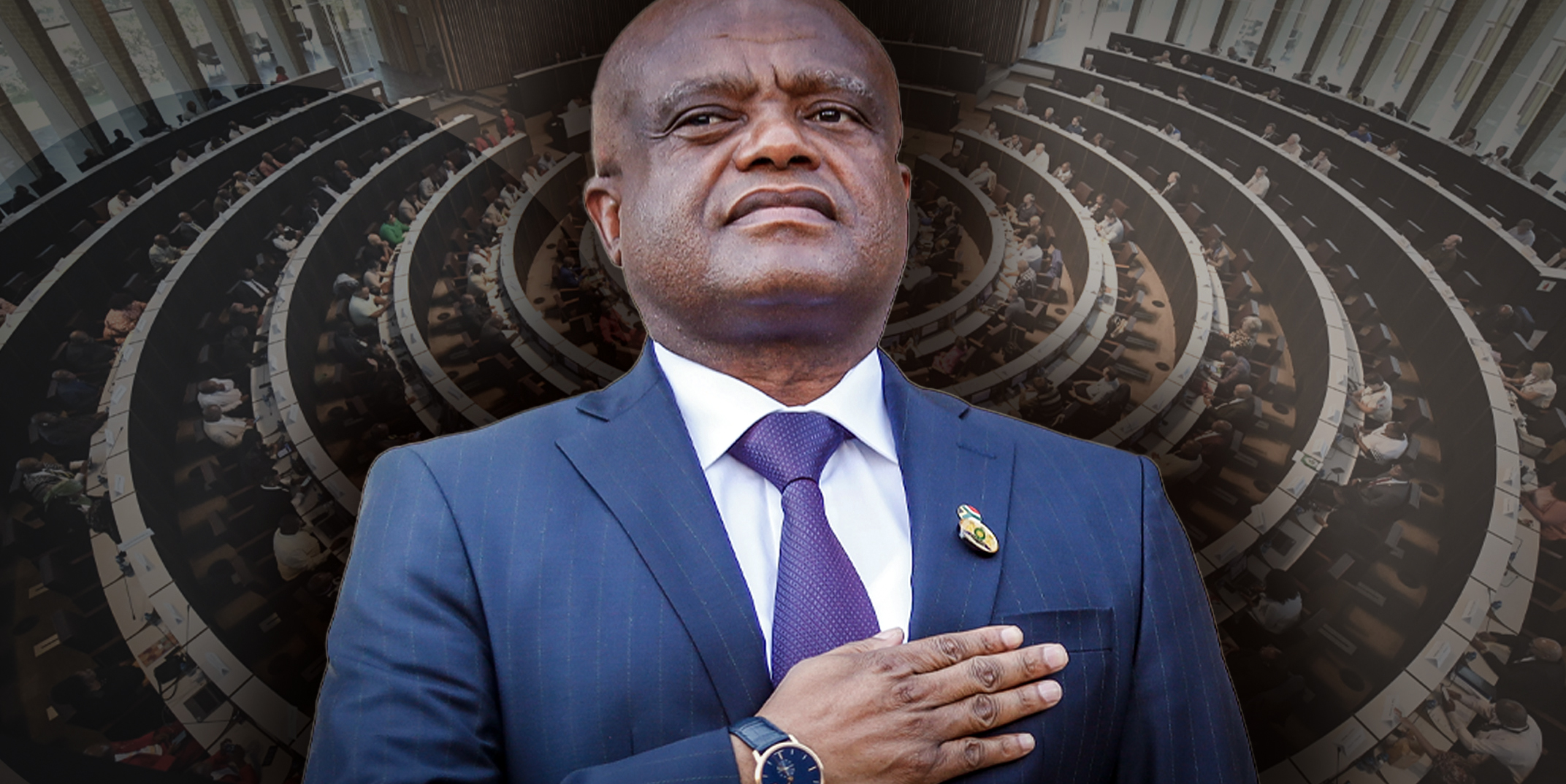
 Illustrative image | Johannesburg council chambers. (Photo: Gallo Images / Sydney Seshibedi) | Johannesburg mayor Dada Morero. (Photo: Gallo Images / Sharon Seretlo)
 Johannesburg spent just 1% of its budget on infrastructure maintenance against an 8% benchmark, achieved only 36% of its infrastructure development targets, lost R8.5-billion through water and electricity losses and still has R7.6-billion worth of irregular expenditure under investigation, while 34 disciplinary cases and six criminal matters are being pursued, Parliament heard during recent hearings into the state of South Africa’s largest city.
These were among the most shocking revelations to emerge from back-to-back briefings by the Auditor-General (AG) and City of Johannesburg officials before Parliament’s Standing Committee on Public Accounts (Scopa), which laid bare the scale of the challenges facing the metro – and the City’s efforts to convince Parliament that it is turning the corner.
In another striking contradiction, the City told Parliament it had resolved 82% of the previous year’s Auditor-General findings, yet the AG still recorded 527 findings in 2024/25, up from 472 the year before. The discrepancy goes to the heart of the debate that dominated the hearings about whether Johannesburg is making meaningful progress in addressing years of governance failure, or whether improvements on paper are failing to translate into measurable improvements on the ground?
This is the breakdown:
Infrastructure: A city struggling to maintain itself
/file/attachments/orphans/joburg-infrastructure_853277.png)
What the AG says
The AG linked weak maintenance, delayed project implementation and deteriorating infrastructure to broader governance failures, warning that service delivery failures are increasingly becoming visible in communities through failing infrastructure, maintenance backlogs and delayed projects.
What the City says
The City argues that infrastructure renewal remains a central priority. Officials told Parliament that an R8.43-billion capital programme is under way across 354 projects and that recovery plans have been implemented for underperforming projects. The City attributed spending delays to procurement bottlenecks, contractor performance challenges, site-access issues and project readiness constraints.
The question
If infrastructure renewal is a priority, why are capital spending targets still being missed and when will residents begin seeing measurable improvements in roads, water networks, electricity infrastructure and wastewater systems?
Billions leaking from the system
/file/attachments/orphans/leaky-city_629388.png)
What the AG says
The AG identified utility losses as one of the major threats to the City’s financial sustainability and service delivery performance. The losses are linked to ageing infrastructure, inadequate maintenance, illegal connections, metering problems and weak controls.
What the City says
The City maintains that interventions are beginning to show results. Officials reported that non-revenue water has declined from 46.18% to 44.79%, while City Power losses have reportedly fallen from 40% to 28.4%. The administration pointed to smart metering, leak detection programmes, revenue protection initiatives and the removal of illegal connections as evidence that corrective measures are working.
The question
Are the reported improvements significant enough to reverse billions of rands in annual losses, or are they being overwhelmed by the scale of the problem?
The irregular expenditure mountain
/file/attachments/orphans/irregular-expenditure_933021.png)
What the AG says
The AG warned that recurring governance weaknesses continue to generate audit findings and material irregularities. Parliament repeatedly questioned whether reductions in irregular expenditure balances necessarily indicate improved accountability.
What the City says
The City argues that the figures demonstrate significant progress in dealing with historical backlogs. Officials told Parliament that more than R45-billion in UIFWE has been regularised over the past five years and that the balance has fallen from R23.6-billion to R13.3-billion. The administration maintains that regularisation is part of a structured process involving investigation, assessment and resolution.
The question
The 43.8% reduction in the UIFWE balance represents one of the City’s strongest indicators of progress. However, Parliament sought greater clarity on how the reduction was achieved, including how much resulted from completed investigations, regularisation processes, disciplinary action, recoveries or write-offs.
Accountability and consequence management
/file/attachments/orphans/accountability_436851.png)
What the AG says
Weak consequence management remains a recurring concern in local government audits. The AG has repeatedly highlighted delays in investigations and disciplinary processes as a key governance risk.
What the City says
The City says accountability processes are active and ongoing. Officials told Parliament that 34 matters are currently before the disciplinary board, six matters have been referred for criminal investigation and eight historical material irregularities have been certified as resolved. The City argues that disciplinary and criminal processes are distinct from the accounting treatment of irregular expenditure and should be assessed separately.
The question
How many officials have ultimately been sanctioned, dismissed or prosecuted as a result of these investigations?
The audit contradiction
/file/attachments/orphans/audit-findings_448062.png)
What the AG says
The increase in findings suggests that significant governance and control weaknesses remain despite efforts to address historic problems.
What the City says
The City argues that it has resolved 82% of the previous year’s findings and is steadily strengthening internal controls, governance systems and audit action plans.
The question
If 82% of findings were resolved, why did the number of audit findings increase from 472 to 527?
Financial sustainability
/file/attachments/orphans/finances_269188.png)
What the AG says
The AG raised concerns about financial sustainability and warned against relying on “false assurances” regarding the City’s financial position.
What the City says
The administration says financial sustainability has been elevated to a strategic risk and that measures are under way to improve revenue collection, strengthen debt recovery and secure external infrastructure financing.
The question
Can Johannesburg generate enough revenue and maintain enough financial discipline to fund the infrastructure investment needed to reverse years of decline?
The bigger picture
The AG’s presentation was a diagnosis of a city under pressure: deteriorating infrastructure, weak controls, major utility losses, recurring audit findings and ongoing governance risks.
The City’s presentation was a defence of a municipality that says it is steadily working through historic backlogs, reducing irregular expenditure, strengthening accountability and improving financial management.
Between those two positions lies the question Parliament spent two weeks trying to answer: is Johannesburg finally turning the corner, or are new problems emerging faster than old ones are being solved?
In a statement issued after the hearing, the City said it accepted the AG’s findings and had shifted its focus from simply addressing audit findings to tackling their root causes. It highlighted a turnaround programme aimed at improving governance, financial sustainability and service delivery through stronger revenue collection, tighter expenditure controls, infrastructure renewal, reduced water and electricity losses, improved procurement management and enhanced consequence management.
The administration acknowledged concerns about deteriorating infrastructure, maintenance backlogs and utility losses, but said restoring confidence would require “measurable results, not just commitment”. The City pledged improved audit outcomes, fewer repeat findings, reduced irregular expenditure exposure, stronger internal controls and greater accountability across the institution.
The Scopa hearings revealed a city of contradictions. On the one hand, Johannesburg has reduced its UIFWE balance by 43.8%, resolved 82% of the previous year’s audit findings and initiated dozens of disciplinary and criminal investigations. On the other, the AG continues to warn about weak controls, deteriorating infrastructure, major utility losses and a growing number of audit findings.
Whether the City’s reforms are gaining ground faster than new problems are emerging was the question that hung over both hearings. DM