



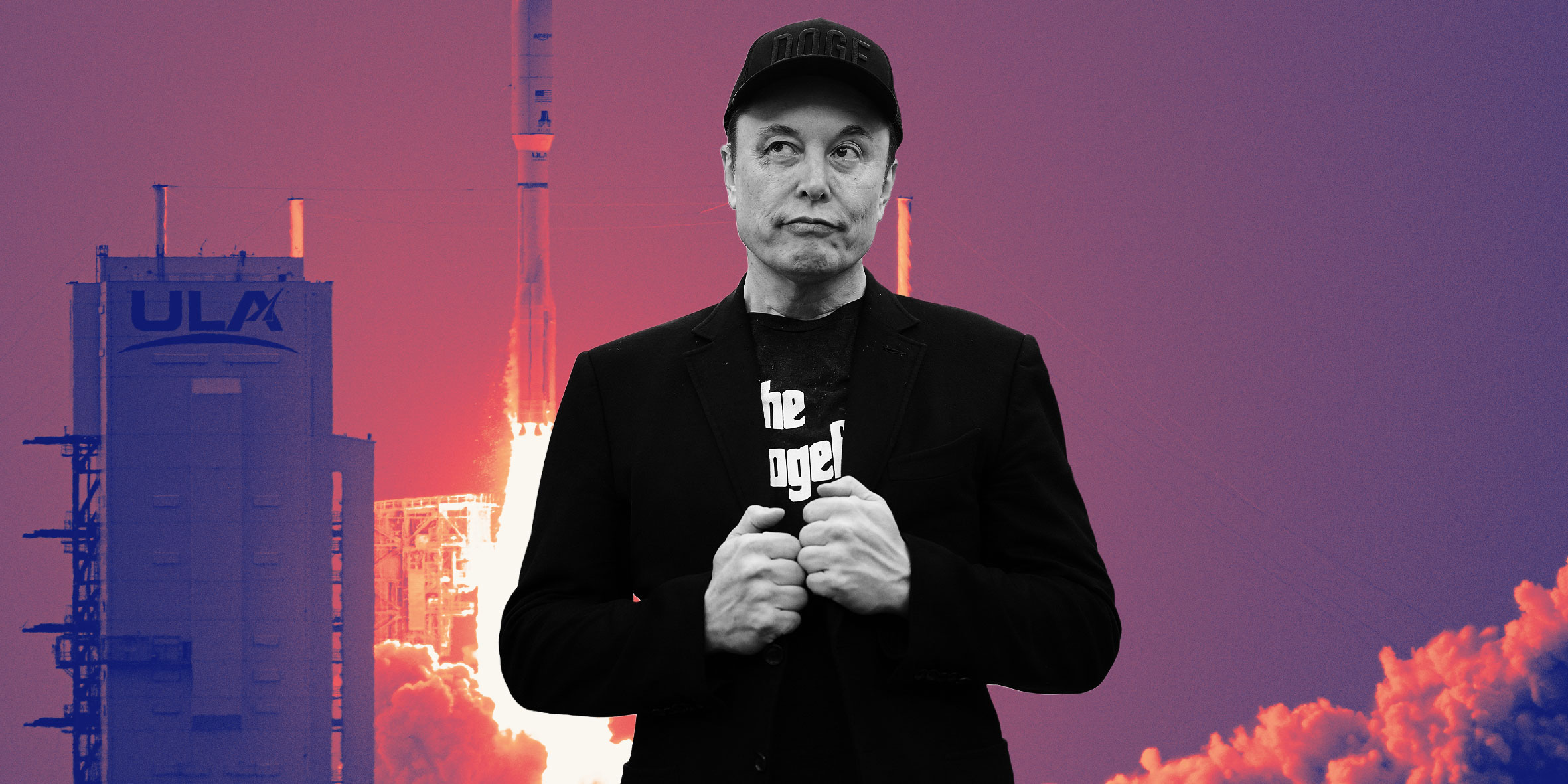
 Illustrative Image: Tesla CEO Elon Musk. (Photo: Kevin Dietsch / Getty Images) | SpaceX rocket launch. (Photo: Miguel J. Rodriguez Carrillo / Gatty Images)
Here’s a thought. Elon Musk’s trillion-dollar-plus paper fortune (and the leverage it brings) will be allocated to noble and altruistic projects. He will do the allocating; it will not be contracted out. He will not be allocating capital to increase his wealth (his pursuit of wealth is probably no longer an interesting goal for him, having well and truly climbed that mountain). He will be allocating his wealth in pursuit of what he sees as a better world for all. He will be history’s greatest philanthropist.
This view is, of course, a giant red flag to all manner of bulls. But indulge me a moment while we take a look at the history of billionaire philanthropy, and then we will come back and re-test this proposition.
There is a peculiar by-product of fortunes this size — they confer a licence to do “good” at industrial scale, on the holder’s own terms, answerable to no electorate and no board of trustees. Some of history’s richest people have used this licence well; others not at all. But what most of us find disquieting (if not downright repulsive) is not the impulse to do good, but the sheer quantum of wealth that has pooled in single pairs of hands; the scepticism that trails behind is aimed at the undemocratic character of these altruistic inclinations, not at the altruism itself.
Something feels wrong about an unelected individual deciding which diseases get cured, which schools get built, which slice of humanity gets connected. The concentration offends a democratic instinct that insists such choices belong to all of us, collectively, through the grinding machinery of the state.
And yet.
It turns out the historical ledger is a little awkward for the sceptics. Time and again, causes that governments fumbled and that cash-strapped NGOs could only gesture at were carried over the line by private fortunes deployed with scant regard for profit.
Andrew Carnegie, the steel baron who held that “the man who dies rich dies disgraced”, gave away roughly 90% of his money and built 2,509 free public libraries across the English-speaking world. Most did not even bear his name. No government of the era proposed anything half as ambitious, and a great many of those libraries still stand.
John D Rockefeller, a man hardly remembered for his warmth, did something stranger still. The foundation he built drove hookworm out of the American South, where some 40% of the population had been infected and enfeebled; it funded the 17D yellow-fever vaccine still in use today; and it bankrolled the agricultural research behind the Green Revolution, an effort credited with saving as many as a billion lives.
For decades, it dispensed more foreign aid than the entire United States government. This was not charity in the collection-plate sense. It was research and development for the species, financed by one oil monopoly’s profits.
Techno-philanthropists
The model survived into the software age. Bill Gates, having extracted a fortune from a near-monopoly of his own, has given away some $60-billion and pointed his foundation at the hard and often thankless work of vaccinating the world’s poor. Gates-backed vaccine work in Aids, malaria and TB alone is reckoned to save two to three million lives a year.
Musk’s own generation has, for the most part, kept faith with that older model: his fellow tech billionaires give the money away. Michael
Dell channels billions into schools and childhood health across America, India and, as it happens, South Africa; Mark Zuckerberg and Priscilla Chan have pointed their fortune at curing disease; Jeff Bezos has pledged $10-billion to the climate; the Collison brothers of Stripe and the former Google chief Eric Schmidt bankroll the unglamorous machinery of basic science.
Most striking are the two women who walked away from tech-fortune divorces and proceeded to out-give the men who kept the companies: MacKenzie Scott, who since
divorcing Bezos has handed roughly $26-billion, almost entirely
unrestricted, to thousands of organisations serving the poor and the
overlooked; and Melinda French Gates, who left the Bill & Melinda
Gates Foundation she co-built in 2024 with $12.5-billion, and trained
it squarely on women and girls worldwide. Both watched their fortunes
swell even as they gave. Whatever one makes of the optics, the cash
flows outward: to other people’s institutions, for other people’s
priorities.
Of course, there is another cohort, much larger, made more of heirs than self-made titans. For every fortune turned to upliftment, there are many that were inherited, hoarded and spent. The Vanderbilts are the cautionary classic. Cornelius built a railroad and shipping empire that made him the richest man in the US; his descendants built marble palaces, threw legendary parties and married into European titles.
Within a few generations, the money had evaporated into mansions and excess, having uplifted no one but the architects and the couturiers. There is no Vanderbilt vaccine, no Vanderbilt library. The difference between a Carnegie and a Vanderbilt was what each man decided the money was for.
Which brings us back to Musk and the trillion. By conventional metrics, he is a strikingly thin philanthropist — he has his Musk Foundation, which does not disburse a whole lot, and most of what it does disburse flows to entities he himself controls.
Colonising Mars
His answer to what the money is for is not written on a foundation cheque. It is written into the SpaceX prospectus, which ties his compensation not merely to a future $7.5-trillion SpaceX valuation but to colonising Mars with at least a million inhabitants. That is the vision, filed with the regulator — the wholesale relocation of the human future, with the visionary at the controls.
The rest of his empire is supporting the same end — filled with projects no government and no NGO has shown the appetite or the capacity to attempt. Starlink has put high-speed internet into the hands of more than 12 million subscribers across some 160 countries, reaching war zones, refugee camps and rural hamlets that terrestrial carriers wrote off decades ago: communications for all, delivered by a private constellation of thousands of low-orbit satellites.
Tesla’s batteries and grid-scale storage have done more to make renewable energy practical than most climate accords. His Optimus robots are designed to free humans from their physical limitations. None of it is charity. All of it is the worldview of Musk.
Mars, in Musk’s telling, is a backup drive for humanity — a hedge against the full catalogue of existential risk, from asteroid strike and nuclear war to runaway artificial intelligence and, in the fullness of (a very long) time, the swelling of a dying sun. A self-sustaining city on another planet is, as he likes to put it, life insurance for life collectively. Should Earth ever be rendered uninhabitable, “consciousness” would carry on elsewhere.
That word — consciousness — does some heavy lifting. Human-grade awareness, Musk argues, may be vanishingly rare in the universe. “I think we have a duty to maintain the light of consciousness, to make sure it continues into the future”, he said (from an interview with Ross Andersen, in Aeon).
From this, he has derived something close to a sacred obligation.
This is philanthropy reimagined by a would-be galactic emperor — a colossal fortune spent not to repair the world as it is but to engineer a particular version of the one to come. Carnegie gave power away in the form of knowledge, dispersed across thousands of small towns; Musk concentrates it in the form of infrastructure that many of us will come to depend upon, owned and steered by one man. Some of the good works he is achieving are real, and at a scale the state cannot match. But the future being built is emphatically his — and the rest of us, increasingly, are living inside it.
Yes, well. His is a vision that I cannot see and am not buying — neglecting the only planet we actually inhabit and the community that we share in favour of some ill-defined and wildly risky destiny far, far away. The zealotry of his plans for humanity assumes that we are acting against our best interests here and now, and we are in danger of self-extinction. Perhaps so, but Mars is not the answer to that threat.
His one-man vision as humanity’s sole insurer is indeed interesting, even exciting in a weird furrowed-brow kind of way. Good things like Starlink will spin out of it, of that there is no doubt.
But it’s not philanthropy and Musk is no Carnegie. DM
Steven Boykey Sidley is a professor of practice at JBS, University of Johannesburg, a partner at Bridge Capital and a columnist-at-large at Daily Maverick. His new book, It’s Mine: How the Crypto Industry is Redefining Ownership, is published by Maverick451 in South Africa and Legend Times Group in the UK/EU, available now.
Comments
Scroll down to load comments...