



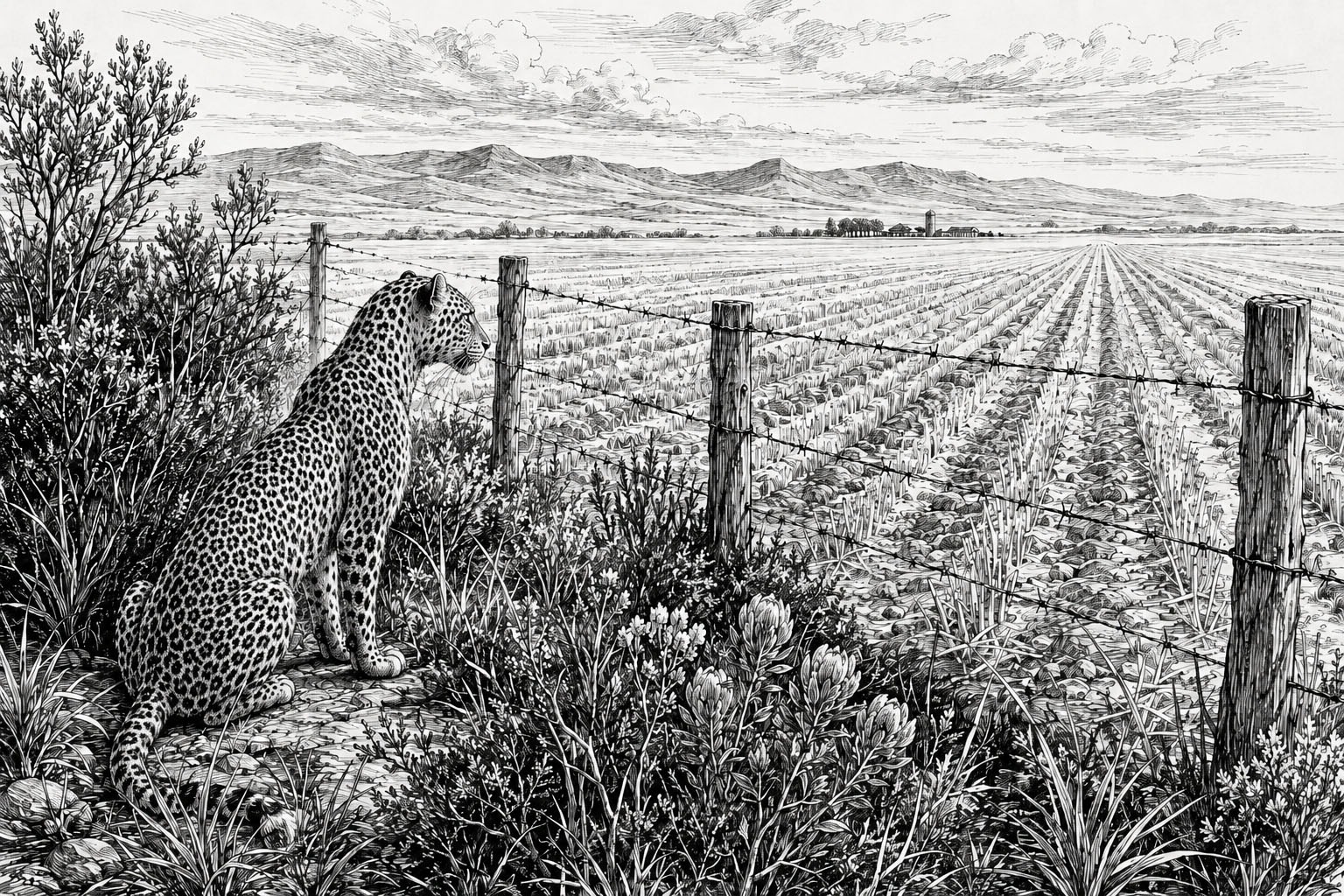
 If you’re a leopard, how do you get from one safe area to another when the land between has been colonised by humans? (Image: Sketchy)
/file/attachments/2987/NOtesfromasmallfinal_916700.jpg "Logo")
Islands may be chunks of land surrounded by water, but they don’t have to be. Think traffic island. A bit of grass, maybe a tree. A bird or two can come and go. But anything not able to fly is marooned. Wiggle or walk off the edge and you’re history.
That’s a good analogy for what we’re doing to the planet.
The mountains of the Cape Peninsula are quite literally a traffic island surrounded by a sea, roads and people. For the baboons, caracals and maybe a leopard or two as well as other creatures without wings there’s no escape across the Cape Flats. We’ve islanded them. A disease or a fire that traps them and they’re gone.
Take the wheat fields of the Western Cape. They used to be renosterveld, but what remains is often confined to valleys, rocky slopes or hilltops not suitable for cultivation. Maybe 5% is left. The walking, crawling creatures of the renosterveld cannot cross the wheat fields without being picked off. We’ve islanded them too. What wild things need in a hyper-humanised world is escape routes.
There’s solid science behind the idea.
It was the Prussian naturalist Alexander Humboldt who laid the foundations for the concept that would become biogeography. His South American explorations between 1799 and 1804 helped establish the idea that life is an interwoven fabric patterned by geography, altitude and climate, not scattered randomly across the planet.
The term itself comes from the biologists Edward Wilson and Robert MacArthur in their 1967 book The Theory of Island Biogeography. Island size and number of species, they found, is a mathematical constant. Smaller equals fewer. No links, no renewal equals decline.
In his book The Song of the Dodo, American writer David Quammen deepened the idea, noting that islands are not confined to the sea. A forest patch in a field is an island. A wetland behind a highway is an island. A reserve ringed by fences, farms, roads and settlements is an island.
Sometimes the ocean is wheat, sometimes it’s tar, sometimes it’s a poisoned verge or a hard municipal boundary.
The trouble with islands is not only that things cannot get out. It is also that they can’t get in. A small population can survive for a while in a leftover patch. To the passing eye, it looks fine. A place can look alive while its future is shrinking.
The losses come later: drought, fire, too few mates, a pollinator that no longer visits, a local extinction that cannot be repaired.
This is where wildlife corridors enter the story: not sentimental green ribbons on planning maps, but acts of urgent repair. They’re attempts to let bottled up landscapes flow again.
Proofing the theory
/file/attachments/orphans/mountains1_770894.jpg "The Riviersonderend mountains, in the Overberg region of Western Cape, are a wild refuge from human activity. (Photo: Wild Restoration)")
Rupert Barnard and Michelle de Bruyn of Wild Restoration came to this idea, not through theory but through work on the ground. Their organisation began with alien invasive clearing in the Overberg, particularly in the Riviersonderend mountains. The work is physical: crews and volunteers hiking into high-altitude areas with chainsaws on their backs.
Then they put up camera traps.
Their idea was simple: clear the invasives, monitor what happens. But the cameras began telling a bigger story. Leopards appeared. So did honey badgers, caracals, foxes, small antelope and lives that make an ecosystem more than scenery.
As Wild Restoration began working from the Riviersonderend mountains through nearby systems, they started asking how protected cores might connect.
If you’re a leopard, how do you get from one safe area to another when the land between has been colonised by humans?
The abstract idea of corridors was appearing as data each night in their camera traps. The theory says isolated fragments are vulnerable, and that connection matters. The cameras showed connection happening. Not in perfect wilderness, but in compromised strips between places: river lines, rocky slopes, neglected edges, hills on farms, bits of land too steep or awkward to plough.
These were leftovers. But life, desperate and inventive, was using them.
That’s persuasive evidence for the importance of corridors. A leopard on a farm track at night. A honey badger in a strip that looks too small to matter. A caracal moving through alien-infested ground.
The theory was being proved in the older, earthier sense: tried on the ground and found to be true enough to act on.
Towards ukama
/file/attachments/orphans/IMAG2646honeybadger_157669.jpg "A honey badger makes an appearance on a camera trap in the Riviersonderend mountains. (Photo: Wild Restoration)")
/file/attachments/orphans/IMAG0025leopards_240433.jpg "A pair of leopards saunters past a camera trap. (Photo: Wild Restoration)")
/file/attachments/orphans/IMAG0001porcupines_979658.jpg "Porcupines. (Photo: Wild Restoration)")
It also changed the meaning of corridor. We might imagine corridors as passageways, as if animals were commuters hurrying between proper destinations. But Rupert and Michelle found something more interesting. These narrow, compromised pieces of land were not only routes. They were also habitat. A corridor can be road and home.
Conservation often thinks in containment. Draw a line around the mountain, the wetland, the reserve. Declare it safe. But nature doesn’t read our maps in the same way consultants do.
A leopard doesn’t know it has crossed from one municipality into another. Water doesn’t pause at a boundary. Seeds don’t understand zoning schemes. A frog cares not whether the seep is on private land, state land or a puddle along a jeep track.
Michelle spoke about this as ukama, a Shona concept of relatedness and links it to being in better relationship with the more-than-human world. If we thought of ourselves as belonging to a catchment, a mountain system or a bioregion, rather than only to an erf, a farm or a municipality, she told me, we might notice where we’re blocking the flow.
Flow is the key word: animals, plants, water, seed, genes, insects, energy.
A general principle holds. Fences, alien invasions that squeeze out local plants, human danger zones all turn possibility into a wall. The scale differs, the need does not. A line built for our purpose becomes the edge of their world. Wild creatures need options.
Sometimes that flow happens in stealth mode. Rupert described leopards appearing on cameras during the day in the mountains, where there are few people, but moving mostly at night in transformed lowlands. They’ve learnt our timetable. When we quieten down, they come through.
A general principle holds. Fences, alien invasions that squeeze out local plants, human danger zones all turn possibility into a wall. The scale differs, the need does not. A line built for our purpose becomes the edge of their world. Wild creatures need options.
Not just leopards seeking mates: the beetle crossing the road verge, the tortoise nosing through grass, the frog needing damp cover, the renosterveld plant relying on a pollinator that must move from patch to patch. Corridors are for the small and seldom publicised too.
For this reason our national road verges deserve a second look.
Roads are dangerous. They kill animals, spread disturbance and carve landscapes into pieces. But the strips beside roads can help if managed with care: not scalped to bare earth or routinely poisoned into tidiness. A road reserve may serve as refuge, seed bank, pollinator route or stepping stone.
Opening the spaces
/file/attachments/orphans/IMAG0185fox_559573.jpg "A bat-eared fox wanders past a camera trap in the Riviersonderend area. (Photo: Wild Restoration)")
/file/attachments/orphans/IMAG0171buck_703968.jpg "Duiker. (Photo: Wild Restoration)")
/file/attachments/orphans/IMAG6470bushpigfamily_879563.jpg "Bush pig family. (Photo: Wild Restoration)")
/file/attachments/orphans/IMAG6443caracalbyriver_251210.jpg "A caracal follows the river. (Photo: Wild Restoration)")
Wild Restoration’s work also shows that clearing thickets of invasive aliens opens up corridors, allowing indigenous systems to recover. The question is what replaces the aliens, and whether maintenance means ecological care or simply making nature look obedient.
In the Overberg, much corridor land is in private hands. Rupert and Michelle described showing landowners what they have living on or near their land. Often, they say, this changes the conversation. A farm is no longer just a productive unit. It may also be a link between mountains, a buffer beside a reserve, a night road for leopard.
Corridors will not save everything. A line on a map is not a corridor unless animals and plants can actually use it. Still, the lesson is hard to avoid. Isolation kills slowly. Connection keeps options open.
There’s something radical in a camera trap photograph: look, this is here. This life is moving through the space you share. You’re already part of the system. The more they healed the land, the more it was able to breathe life.
Corridors will not save everything. A line on a map is not a corridor unless animals and plants can actually use it. Still, the lesson is hard to avoid. Isolation kills slowly. Connection keeps options open.
In Quammen’s framing, extinction doesn’t begin when the last individual dies. It begins earlier, when a population is cut off from the processes that sustain it. When mates cannot be found. When young cannot disperse. When genes cannot move. When a drought cannot be escaped. When a local loss cannot be repaired by arrival from elsewhere. When a patch of life becomes an island and the sea around it widens.
Wildlife corridors are one way of narrowing the seas we’ve made. Building bridges. A traffic island is not a conservation plan. The creatures trapped there need a way across. DM


Comments
Scroll down to load comments...