




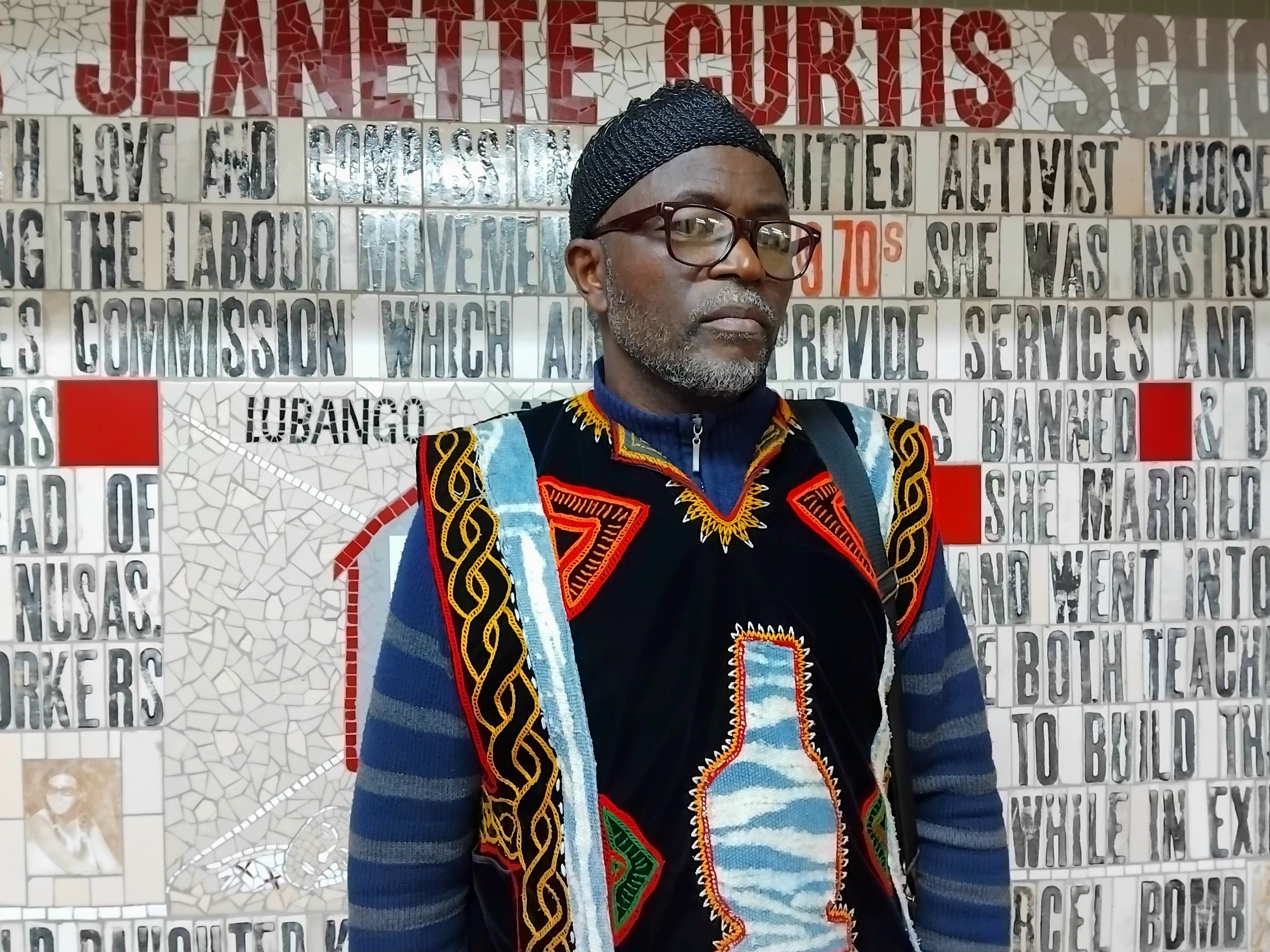
 Lumumba Chia spoke at a World Refugee Day event in Cape Town on Thursday. (Photo: Marecia Damons)
Lumumba Chia has lived in South Africa for more than two decades. He holds a Refugee Permit, has filed the necessary applications, and has done everything the system requires of him. And yet, when his son in Belgium asked him to visit, he could not go, because he did not have travel documents.
Born in the English-speaking region of Cameroon, Chia came to South Africa in 1999 after becoming involved in a pro-democracy student movement. He says his political activism made him a target.
“The system declared me a persona non grata, so I can’t go back there,” he said.
More than 20 years on, Chia’s status remains stuck in bureaucratic limbo. He applied for a refugee identity document, which is required before a refugee can apply for travel documents. But he was given conflicting explanations for why his application did not progress.
At one point, a Home Affairs official told him his documents had “got a hit” on the system, without further explanation. When he followed up at another office, he said officials indicated there was no such flag on the system.
Without the refugee ID, he cannot apply for refugee travel documents, leaving him unable to travel despite holding refugee status.
“It feels like a deliberate act not to process your documents just to make you frustrated,” he said. “On paper, there are things you need to do, but in reality it’s not working.”
Chia shared his experience at a World Refugee Day symposium in Salt River on Thursday, 18 June, where panellists discussed the barriers faced by refugees, undocumented migrants and stateless people, including difficulties obtaining identity documents and accessing citizenship.
Statelessness
Fatima Khan, director of UCT’s Refugee Rights Unit, explained that a stateless person is someone who is not recognised as a citizen by any state.
Causes range from ethnic discrimination to gender-based citizenship laws that stop mothers from passing nationality to their children.
“There are still 24 countries where mothers cannot confer citizenship to their children,” Khan said.
Refugees are also at risk. Those who flee without documentation may find that neither their host country nor their country of origin will recognise them as citizens.
According to the UN Refugee Agency, there are an estimated 4.5-million stateless people worldwide, though Khan said the true number is likely much higher because stateless people often “live in the shadows” and are not counted.
Without legal recognition, stateless people often struggle to access basic rights and services, Khan said.
“Children become stateless because they find themselves migrating with their parents. They have no say,” said Mary Tal, CEO of the Whole World Women Association, which works with refugee and migrant communities.
South Africa’s Constitution states that every child has the right to a name and nationality, and the Citizenship Act contains provisions allowing some children born in the country to acquire citizenship. Some people born in South Africa to non-citizen parents can apply for citizenship when they turn 18. But accessing those rights can be difficult.
“There are people who come to my office who are nearly 30 years old who were born in South Africa, and they have applied for citizenship at Home Affairs over the past five years. They go every month, but they get the same response: their documents are still being processed,” Tal said.
International human rights lawyer Thandeka Chauke said awareness of statelessness has improved in recent years, partly due to the UN Refugee Agency’s decade-long #IBelong campaign.
“There were some gains there. There is increased awareness of the issue of statelessness, and it’s coming up more in conversations about human rights, whereas before it had been one of the most neglected human rights issues,” she said.
“When you walk into Home Affairs, there are no application forms you can complete for citizenship,” Chauke said. “So you can walk into a Home Affairs and say you have the right to citizenship, but there are no forms.”
Asked about solutions, Chauke said political will remains critical. “If there is political willingness to act to change something, states will do it,” she said. DM
Originally published on GroundUp.
Comments
Scroll down to load comments...