




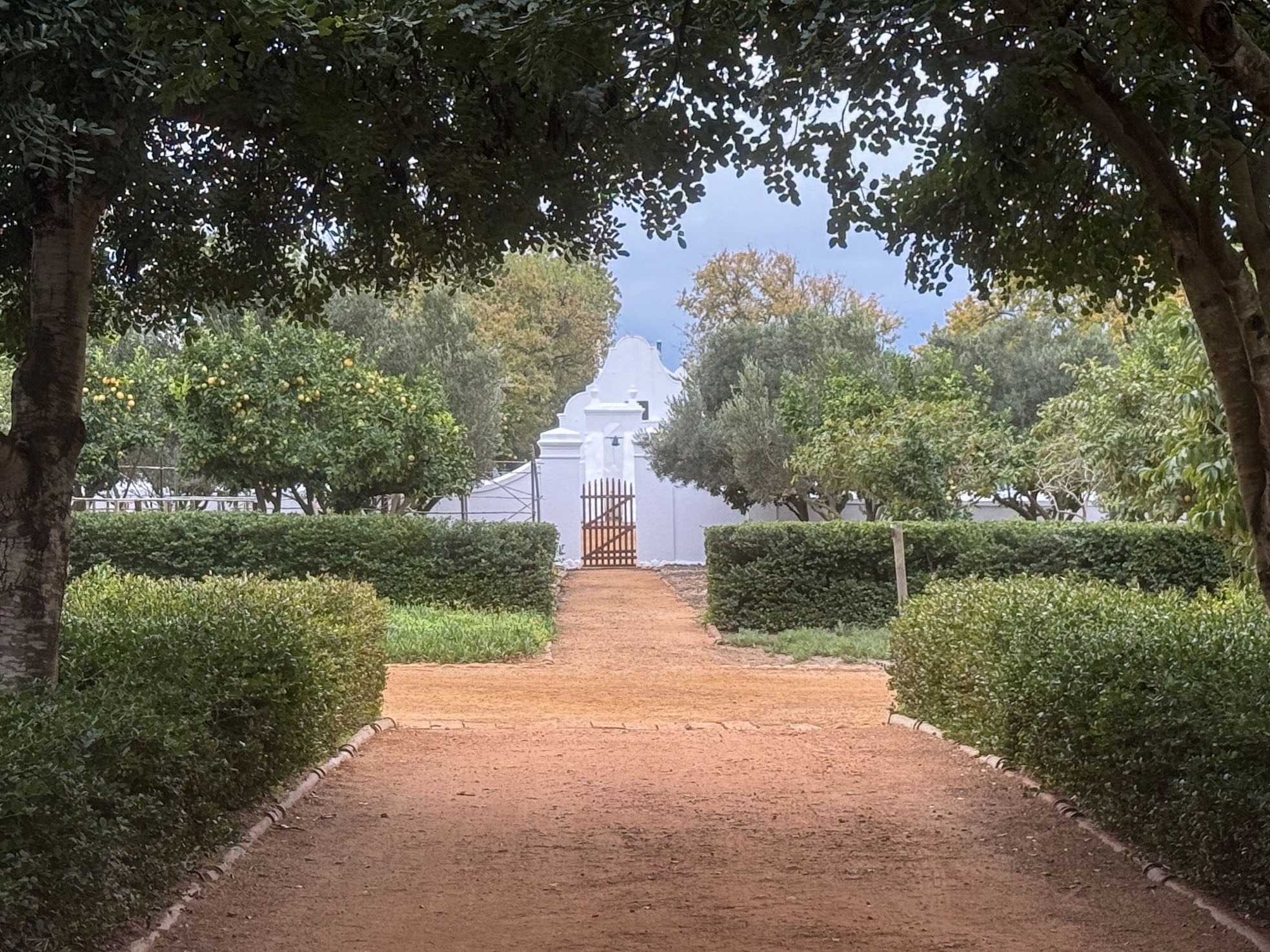
 In the garden of Babylonstoren, there is beauty at every turn. (Photo: Tony Jackman)
Babel. Babble. First the biblical flood, Noah’s Ark, people and creatures on the move. Humans and animals desperate to find purchase for foot, hoof and claw. Deciding to build a great tower, of which their God disapproved. Then, a garble of voices, indistinct, no one ear discerning what any mouth nearby is saying. A confusion of languages. Sown by their God. Babel.
When Pieter van der Byl, a burgher at the Cape in the short years following the landing of Jan van Riebeeck and his cohort, first arrived on the land he had been granted by Governor Simon van der Stel in 1692, only 40 years after those ships had arrived in Table Bay, he spied a strange looking mountain that seemed to stand guard over his newfound land.
There’s a tendency to pronounce the farm’s name as if it were Babylon Storen, whereas it means Babylon Tower, or Tower of Babel. So it means Babylon’s Tower. That mountain seemed, to the nascent farmer, who had been stationed in the Company’s Garden in the shadow of Table Mountain, like the Babel’s Tower of the Bible. It would be the name of his farm.
/file/attachments/2993/Kunsthistorisches_Museum_Wien_Pieter_Bruegel_dA_der_Turmbau_zu_Babel_193115.jpg "Pieter Brueghel the Elder’s oil painting of the Tower of Babel, which is displayed in the Kunsthistorisches Museum (Museum of Art History) in Vienna. (Photo: Wikimedia commons)")
What more could Van der Byl do but what he knew? He planted. He sowed. Watered, irrigated. Tended, watched the sky. Adored the sun, prayed for clouds while fearing them. Took his losses, revelled in his harvests. Drank wine to his sunsets, rose early to greet every dawn. Like all farmers do.
If there are ghosts of Van der Byl, his family and the early labourers of his lands, they must look upon the Babylonstoren of our times with heavy satisfaction. Heavy in the way that something you love is also regretted for having passed into time; for no longer being a part of something that was yours.
/file/attachments/2993/babeltower_855623.jpg "Pieter van der Byl was reminded of the Tower of Babel when he first saw this mountain on his new farm. (Photo: Tony Jackman)")
The gardens of the Babylonstoren of today were designed in 2007 by French architect Patrice Taravella, at the invitation of Babylonstoren co-owner Karen Roos, who had admired his mediaeval cloistered garden layout at the restored 12th century Prieuré Notre Dame d’Orsan in the Loire valley.
Nobody from Van der Byl’s day could have imagined the wealth that would be brought to the land 300 and more years later, or the incredible world of vegetables, fruit and nuts from all parts of the globe that grow here now. Many of which were never among the simple fruit and vegetables grown by Van der Byl and his fellow gardeners in the Company’s Garden in those 40 early harvests before the Babylonstoren earth was first tilled.
Like blood orange and mandarin, persimmon and custard apple, dragonfruit and prickly pear – and carob trees whose fruit is used in granola and other health products, and coffee trees that are actually bearing their first ever young green fruit today. Yes, fruit – the young, round clusters are sometimes called coffee cherries. Nuts here include macadamia, almond, and pecan, and olives hold massive sway – their olive oil production covers 60 ha planted and 13 varieties.
There are hedges of kumquat, but everywhere you walk in these gardens you stroll past hedges of many other things. There are four hectares of this garden, and I’m glad it took me so long finally to visit Babylonstoren because if I had come earlier I would not have found the full extent there is today. I have been invited often over the years since it fell into the hands of Koos Bekker and Karen Roos in 2007, and my mind’s eye version of how it would look and feel is not much like the reality I found last week.
I had expected prettier, whereas the farm is more workmanlike – every space is purposed for something useful. It’s hardy in the way a good tree, well grown, is hardy. It’s beautiful more than pretty, arresting more than merely nice. Busy things are happening everywhere you go. Staff are at work everywhere. Groups of visitors follow their tour guides, others are in the middle of a workshop. It is a farm of industry, quite unlike the likes of a Spier, where all is for show, designed to impress.
/file/attachments/2993/fowl_369174.jpg "The ancient fowl house, where chicken and pigeon droppings are collected to fertilise the soil and help the garden grow. (Photo: Tony Jackman)")
One example: the ancient fowl house, a long thatched building you might expect to be made into a function space today – a restaurant, art gallery, wine tasting room – is still used to house the chickens whose droppings, along with those of pigeons, are collected to fertilise the gardens.
/file/attachments/2993/turkeys_691342.jpg "These birds are no turkeys when it comes to being useful. (Photo: Tony Jackman)")
Other creatures play their part too. Our knowledgeable and witty garden guide, Axwin Snyman, told us that turkeys “help with manual work”, while their bee and insect hotels, which put broken crockery, wood offcuts and bark to good use, look after their own insect habitat and pollination.
/file/attachments/2993/axwintrio_391871.jpg "Brilliant garden guide Axwin Snyman in typically animated poses, explaining the wonders of a bee and insect hotel. (Photo: Tony Jackman)")
At Babylonstoren, with its blend of Cape Dutch and European formal layout, no matter when you visit, there is something to harvest. Planting of rotational blocks means that there’ll be alternate top crops of tomatoes and peppers in one season and bottom crops – potatoes and carrots – the next. Companion planting includes marigolds to deter harmful insects. Weeding never ceases. Gravity water channels, or leiwater, keep water endlessly on the move to where it is needed.
/file/attachments/2993/mosaic-delish-espalier_524115.jpg "There are lovely surprises everywhere. Left, a mosaic in Dutch (and, earlier, Chinese) style made of fragments of broken old crockery; right: espalier training and pruning is used deftly; and, centre, did you know that a Delicious Monster, in sunlight, produces fruit? They taste somewhere between a banana and a pineapple. Perfect for pizza then. (Photo: Tony Jackman)")
There is use of espalier plant training for pears and quinces, and at certain points there is clever use of this method to make heart and diamond shapes which interplay to tantalise the eye. But it’s functional too. The espalier shaping of pear and quince helps concentrate the fruit.
The heart of the garden is the citrus block with its Lisbon and Eureka lemons (claimed to fruit nearly 365 days a year) — we saw blossoms alongside small young green fruit and larger lemons ripening on the same tree — kumquat, pomelo, grapefruit, blood orange, clementine and mandarin.
/file/attachments/2993/gardener_637323.jpg "A solitary gardener goes about his daily routine, rake in hand, in one small part of this 4 ha garden. (Photo: Tony Jackman)")
And if some of the stone fruit trees seem remarkably established, they are: the guava trees, for instance, were 65 years old when they were transplanted to their new soil here – soil that took some hard work. The initial garden site – 4 ha of it – was a dumping ground, with many tons of compost brought in to enable remediation (restoration of damaged soil) and planting.
When historical damage is undone, life abundant ensues. Axwin noted that the guavas are now between 75 and 85 years old and bear fruit abundantly. (For lunch later, as a sort of palate cleanser, I’m given a guava fresh from the garden, sliced in half and garnished with salt and blood orange olive oil, a speciality of the farm.)
/file/attachments/2993/soaring_723150.jpg "Trellised archways are beautiful as well as practical. (Photo: Tony Jackman)")
In this stone fruit region of the garden – they include plums, peaches, nectarines, apricots, and persimmons – the gravel beneath your feet feels strangely soft. It’s not gravel at all, but crushed peach pips. It takes my mind back to 1990 when I visited the Sandveld home of the late theatre maker Pieter Fourie, and whole peach pips were embedded in the floor. Awkward to walk on barefoot, but beautiful and oozing outyds character. Crushed, they’re a happy tread for tired city feet.
But there are exotics too. The tropical and subtropical trails in these seemingly never-ending gardens include 3,000 avocado trees that will only bear fruit about 17 years from now, alongside the dragonfruit, custard apple, mango, and papaya planted in experimental lanes to test climate variations. Future results will guide later choices.
/file/attachments/2993/greenhouse-clementine_712496.jpg "In the Greenhouse I enjoyed a ‘buffaccino’ made from water buffalo milk, and helped myself to an octubrina clementine. (Photo: Tony Jackman)")
In every public space, produce of the farm is on display for visitors to help themselves to. In the Greenhouse restaurant, where I enjoyed a cup of buffaccino (cappuccino made with water buffalo milk), a pile of octubrina clementines, a Spanish variety, invited you to help yourself. You may find yourself with a perky carrot or two, some crisp pak choy, preening red radishes, and whatever somebody on the staff has decided to pick and place somewhere for your pleasure.
/file/attachments/2993/shakes-oak-tortoise_238047.jpg "Look for oddities while wandering the gardens. Shakespeare’s mulberry, left, is the child of one that grew in his childhood home at Stratford-upon-Avon; right, a rockery home for tortoises, and, centre, near the Greenhouse restaurant I spotted workmen planting a seven-year-old Algerian oak, to replace an older one that had rotted at the roots. (Photo: Tony Jackman)")
They also have a gelato room where you can enjoy scoops of their sorbets – dark chocolate brownie, dark chocolate coffee, mulberry, spiced rooibos or mango, all made from water buffalo milk. There was nothing sugar-free for the likes of us diabetics; I did ask.
/file/attachments/2993/coffee_916698.jpg "They’re growing coffee now at Babylonstoren too. (Photo: Tony Jackman)")
What impressed me most about Babylonstoren is how every part of the farm is worked. There is no chance for waste. And we, the people, are made a part of it. We are welcomed as if the place were ours as much as it is the domain of much richer people than most of us could imagine. I think it says something about the hearts of those people.
After 90 minutes of traipsing through these gardens and being captivated at every turn, I found another Babel, the restaurant of that name. Their menu is unusual, broken into four sections: Stirrings, Progression, “for the table” and Culmination.
The first offers such starter portions as leek soup with smoked bacon and “Alta’s buffalo ‘hangop’ cheese”, Cape Point tuna with winter fennel, buffalo yoghurt dressing and sorrel, Babylonstoren buffalo mozzarella with Adine’s butternut atchar and spring onion, Selvin’s fattoria ham with wintermelon, frantoio olive oil and aged balsamic vinegar. These elements are made on the farm and some can be bought in jars and tins in their shops.
This rings a comforting bell for me: twice in the past year, my colleagues have sent me care packages, first when my sister Pat died and more recently when I was undergoing open heart surgery. On both occasions, the care packages came from Babylonstoren — this is what inspired me to visit the farm and go on this garden tour. It’s a kind of thank you.
/file/attachments/2993/chianina-marigold-carrottops_268394.jpg "Chianina beef fillet, tender and so flavourful. Served simply with balsamic shallots. (Photo: Tony Jackman)")
The sourdough at Babel was just as comforting, served with their own farm butter and even their own exotic salt. I had been told about their Chianina cattle, an Italian breed, and no matter what else was on the “Progression” menu I knew I would be ordering a Chianina steak. But for the record, other choices were carnarolli risotto with roasted cauliflower, roasted almonds and burnt butter; Riebeek-Kasteel lamb with braised butter beans tomato and mint gremolata; Paul’s linefish of the day with Tenecia’s steamed winter greens and almond romesco sauce, and Tenecia’s rainbow carrots with pickled red onions, winter pak choi and carrot hummus. I love the way their human workforce is credited.
That steak – well, it was not a tiny portion, and it was so good that I just had to respect every morsel. It was fillet, and served simply with balsamic sweet shallots and a splendid mustard jus – so delicious that I asked for more sauce, which is my perennial way of sending a compliment to the chef.
/file/attachments/2993/dalewood_402173.jpg "Dalewood cheeses with orange marmalade to end the meal. (Photo: Tony Jackman)")
I followed it with a cheese board of products from nearby Dalewood Fromage, always a fine way to end a meal. And then, on the road home, with a promise to Dalewood co-owner Petrina Visser to visit soon. We’ll come back to that thought. For now, dreams of the Garden of Babylon, which burrowed a place in this rejuvenated old heart. DM
The meal at Babel restaurant was paid for in full.
Comments
Scroll down to load comments...