



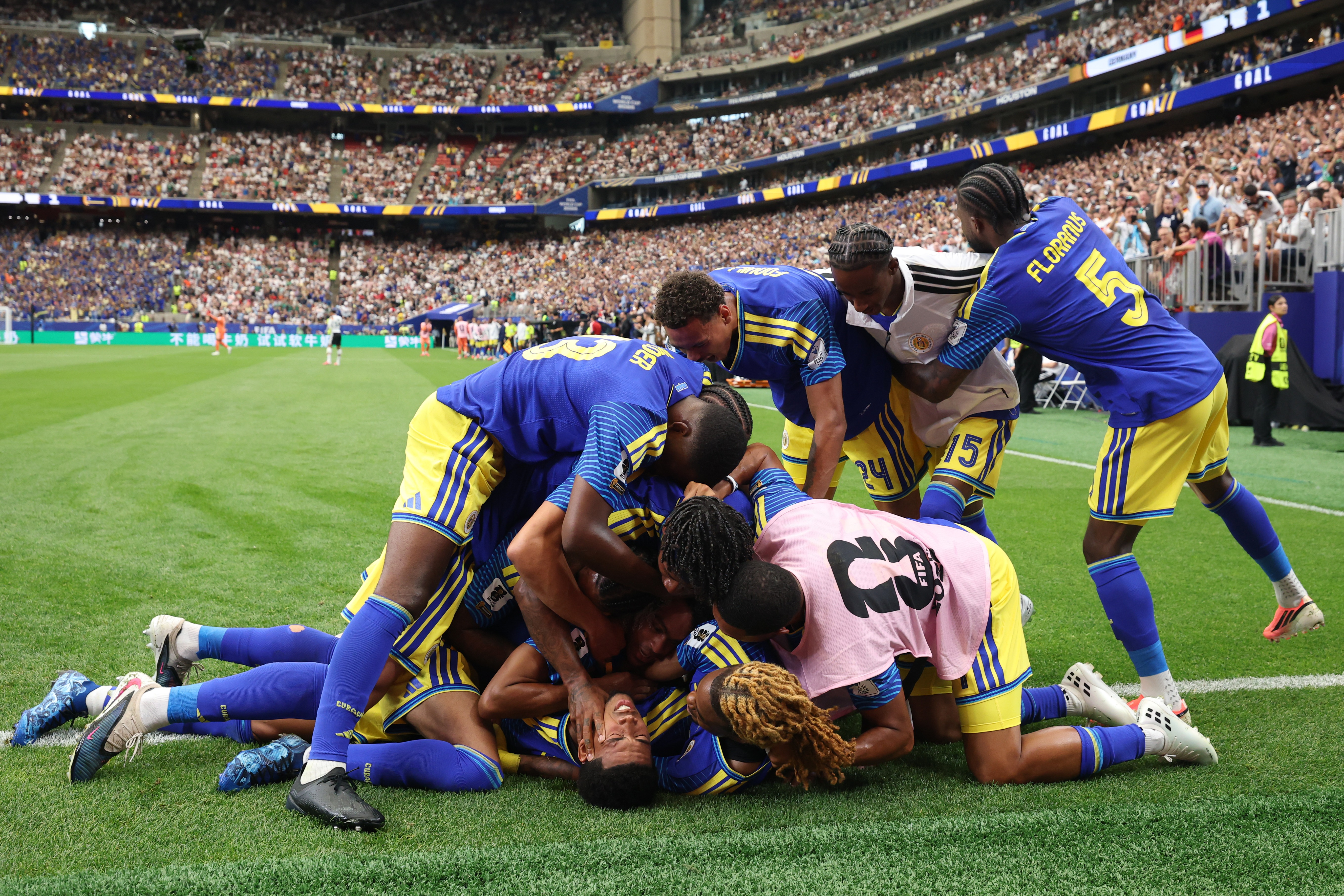
 Curaçao celebrate after Livano Comenencia scored the team’s first goal during their World Cup match against Germany on 14 June in Houston, Texas. (Photo: Alexander Hassenstein/Getty Images)
 In an ideal world, the Fifa World Cup would involve each and every country on the map as a truly global celebration of the most popular sport on Earth. However, due to the logistical demands that come with hosting such a major tournament, only a portion of the world is represented at the soccer spectacle every four years.
Over the past three decades, the tournament has grown immensely in terms of participating nations, from just 13 countries present in 1930, when inaugural World Cup hosts Uruguay were crowned the winners, to the tournament growing to 24 teams in 1982. Since 1998, the standard was 32 participating nations, but for the 2026 edition, cohosted by the US, Canada and Mexico, a record 48 countries are present.
They include four debutants: Cape Verde, Curaçao, Jordan and Uzbekistan. For the first time in their history, the people of these countries can truly feel that they are part of the World Cup, as opposed to being just soccer lovers watching the tournament without any emotional connection to it.
Dutch-Caribbean island Curaçao, with a population of about 158,000 people, was subjected to a baptism of fire on debut, getting pummeled 7-1 by four-time world champions Germany. But a day after this hammering, newcomers Cape Verde achieved a hard-fought 0-0 draw against pre-tournament favourites Spain.
Although the Cape Verdeans did not offer much in attack during the match, they put on a defensive display for the ages. The Blue Sharks showed great discipline and organisational structure to pick up their first point ever on the global stage. It was a special moment in particular for 40-year-old goalkeeper Josimar “Vozinha” Dias.
Vozinha to the world
The only man to play at every major tournament in which the Cape Verdeans have featured, Vozinha came into the World Cup as a player who is highly appreciated in his home country. His display against Spain, which featured seven goal-saving stops, further cemented this legacy. He had already starred for the Blue Sharks since the first time they made their Africa Cup of Nations (Afcon) debut in 2013.
After his World Cup debut, which ended in a player of the match award, Vozinha was mobbed by his compatriots as they celebrated his anchoring of a resolute team performance. The glovesman broke down in tears.
“I cried because I grew up with my grandparents,” Vozinha said later. “Unfortunately they were not here – they died a few years ago. They were everything for me, everything for my life.
“I also cried because of my mom. She didn’t manage to be here because of the visa. Because of the money you have to pay for the visa, we didn’t manage on time. I would have liked for her to be here.”
Then there is Vozinha’s compatriot Roberto Lopes. The centre-back also had an immense match against 2010 World Cup winners Spain. But just under a decade ago, he would not have imagined himself playing in a World Cup.
Originally dabbling in soccer part-time, Ireland-based Lopes quit his job as a mortgage adviser at a bank in 2017 after being offered a professional contract by Irish club
Shamrock Rovers. Two years later, he joined the national team after being recruited by the Cape Verdean Football Federation via a LinkedIn message. Initially, Lopes had ignored the message because he thought it was spam.
/file/attachments/2993/SaveClipApp_724119037_18593224369010669_8209156532547909046_n_854928.jpg "Goalkeeper Vozinha of Cape Verde dives across the pitch to stop a shot during their 2026 Fifa World Cup match against Spain in Atlanta, Georgia, on 15 June. Photo: Getty Images")
Soccer is for everyone
The 2026 Fifa World Cup has brought stories like these to the fore. However, some, including the president of the Union of European Football Associations,
Aleksander Čeferin, would prefer for these stories not to be told on the global stage.
The soccer boss was quoted by Slovenian publication Žurnal24 criticising the World Cup’s 48 teams: “We have a huge number of matches that are completely uninteresting,” he said. Then, perhaps to soften the blow, he added: “On the other hand, even small countries can participate and feel the pulse of the World Cup, which is a big thing.”
Čeferin’s comments sparked a joint clapback from some of the so-called smaller countries at the World Cup, including the four debutants and Africa’s 10 representatives at the 2026 edition: Algeria, Cape Verde, the Democratic Republic of Congo, Egypt, Ghana, Ivory Coast, Morocco, Senegal, South Africa and Tunisia.
“We respectfully but firmly reject these comments. For our countries, there is no such thing as an unimportant World Cup match,” read their joint statement.
“For Cape Verde, Curaçao and Uzbekistan, qualification for the World Cup represents a historic achievement and the realisation of a dream shared by generations.
“For nations such as Congo and Haiti, returning to football’s biggest stage after a long absence carries a special meaning for millions of supporters who have waited years, and in some cases decades, for this moment,” they said.
“To suggest that these matches are somehow less important is deeply disappointing and fails to recognise the efforts, sacrifices and aspirations of players, coaches, clubs, football leaders and supporters across the world,” they added.
/file/dailymaverick/wp-content/uploads/2024/08/75138637.jpg "Uefa president Aleksander Ceferin. (File photo)")
Representation is key
Prior to the World Cup growing from 32 to 48 teams, Africa could only be represented by five nations, despite the Confederation of African Football having 54 members. For the countries on the continent that were heavily plundered during the colonial era, appearances at the World Cup are invaluable for their soccer development.
Moreover, the World Cup should be about inclusivity. Unfortunately, the US has snubbed this ideal by, for example, refusing entry to Fifa referee Omar Artan. The Somali was turned back because of what US authorities allege is his affiliation “with suspected members of terror organisations”.
In doing so, the US seemed to disregard what the so-called smaller countries highlighted in their joint statement – that for many countries, participation in the World Cup is not only a sporting achievement.
As they wrote: “It is a moment that inspires a generation, accelerates football development and creates memories that last a lifetime.
“We believe that every nation that qualifies deserves respect. Every team has earned its place on merit. Every supporter has the right to dream. Every match carries meaning for millions of people around the world.”
After all, the World Cup is meant to be a global festival, not a closed club for a certain few. And as the Cape Verdeans have shown, a World Cup does not only boost the profile of a country’s soccer. It can even propel players representing that country to greater heights on the world stage. DM
This story first appeared in our weekly DM168 newspaper, available countrywide for R35.
/file/attachments/2993/DM-190626_946367.jpg)