



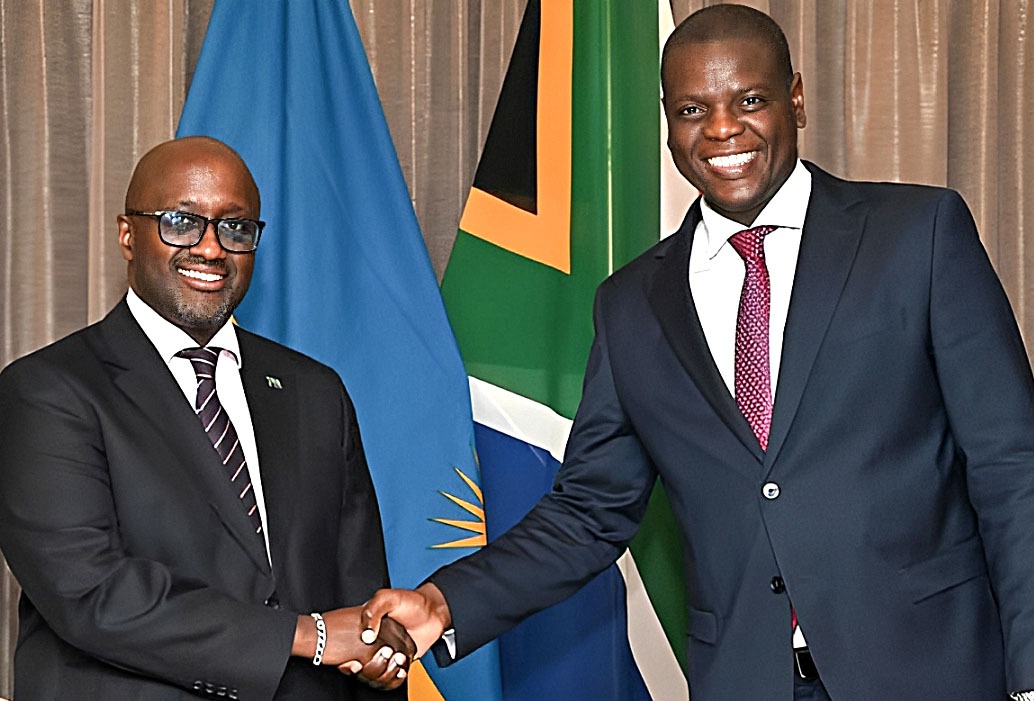
 The minister of international relations and cooperation, Ronald Lamola (right), and his Rwandan counterpart, Olivier Nduhungirehe, after their talks in Pretoria on Thursday. (Photo: Department of International Relations and Cooperation, SA / Facebook)
South Africa and Rwanda have begun to “reset” their troubled relationship, while postponing discussion on difficult issues such as the presence of several Rwandan dissidents in SA and the killing of 14 South African troops last year in Democratic Republic of the Congo (DRC) by M23 rebels backed by Kigali.
International Relations and Cooperation Minister Ronald Lamola was all smiles on Wednesday when he met in Pretoria with his counterpart, Olivier Nduhungirehe — whom he constantly referred to as “my dear brother” — to “normalise” strained relations.
Lamola noted they were meeting to realise President Cyril Ramaphosa’s and Rwandan President Paul Kagame’s “profound and deep commitment to reset and re-energise our bilateral relations”.
Nduhungirehe agreed that “Today’s meeting reflects the commitment of our heads of state to open a new chapter in the Rwanda-South Africa relations.”
He welcomed Lamola’s commitment “to facilitate the issuance of a visa to holders of ordinary Rwandan passports within 12 months. This important development will help strengthen people-to-people ties, promote business and tourism exchanges and further deepen the friendship between our peoples.”
The difficulty Rwandans face in getting visas to visit SA began when the two countries expelled almost all of each other’s diplomats in 2014. They have gradually replaced most, but not all, of the vacated posts.
The expulsion was the result of SA blaming Rwanda for responsibility in the assassination of Patrick Karegeya, Kagame’s former intelligence chief in Johannesburg’s plush Michelangelo Hotel in 2013 and several assassination attempts on General Kayumba Nyamwasa, Kagame’s former military chief of staff, between 2010 and 2014 in Gauteng.
/file/dailymaverick/wp-content/uploads/Fabricius-Rwanda-extraditeTW.jpg "Patrick Karegeya. (Photo: Supplied)")
It was after the last assassination attempt on Nyamwasa in March 2014 — when an armed commando raided his “safe house” in Gauteng — that the long-suffering SA authorities finally had enough and expelled all the diplomats from Rwanda’s embassy in Pretoria, except the ambassador. Rwanda retaliated by doing the same.
Rwanda denied any complicity in these crimes, though it accused Karegeya, Nyamwasa and other dissidents who had established the Rwanda National Congress (RNC) in South Africa of being terrorists and convicted them in absentia for terrorist acts.
Lamola and Nduhungirehe were asked about this issue at a press conference after their meeting. Nduhungirehe said they had not discussed it “because we wanted to focus on normalisation” and also because security organs of the two countries were separately discussing security issues.
“As the normalisation goes on, all institutions concerned, the foreign ministries or security organs, even the justice sector, will be able to address all pending issues,” he said.
Dissidents
He did note, though, that “what you call dissidents in this country … actually they were sentenced by Rwandan jurisdictions in absentia”.
Lamola agreed that the issue of dissidents would be dealt with separately by security teams later. But he emphasised that “at a principle level, in South Africa, we deal with anyone in the country in line with our Constitution”.
It is not clear if the two ministers discussed the tensions that arose between the two countries in January 2025 after M23 rebels, strongly backed by Rwanda, according to the UN, killed 14 South African soldiers in and around the eastern DRC city of Goma. They were part of a Southern African Development Community Force dispatched to DRC to combat the M23 incursion, or were part of the UN peacekeeping force Monusco.
/file/dailymaverick/wp-content/uploads/2025/03/AFP__20250206__36XB2JB__v2__HighRes__TopshotDrcongoUnrest.jpg "M23 soldiers at the Unity Stadium in Goma on 6 February 2025 for a public gathering called by the armed group. (Photo: Alexis Huguet / AFP)")
It seems likely that if the issue is discussed, it will also be part of the separate security engagement.
Lamola was asked how the decision to reset relations had come about. He indicated it had begun with a meeting between Ramaphosa and Kagame in 2024 when Ramaphosa visited Kigali for the 30th anniversary of the 1994 Rwanda genocide. They had also met at an EU event in Brussels last year and on the margins of the AU summit this year.
It had continued with discussions between SA and Rwanda in early 2025 about facilitating the exit of South African troops who had been trapped in Goma.

Then, he said, the two countries were mandated by the AU to support peace efforts in South Sudan, and he and Nduhungirehe had worked closely on that assignment. But he also noted that his predecessor, Naledi Pandor, and her counterpart had agreed to reset relations as far back as 2021.
Nduhungirehe noted that Kagame was supposed to visit SA last December but the visit had been postponed. He said he expected the visit to happen soon and added that he and Lamola had agreed there would be a joint commission on cooperation between the two countries in Kigali in the first quarter of 2027.
/file/attachments/orphans/6877516_365920.jpg "Rwandan President Paul Kagame and President Cyril Ramaphosa attend a panel session during the 49th annual meeting of the World Economic Forum in Davos, Switzerland, on 24 January 2019. (Photo: Laurent Gillieron / EPA)")
Lamola stated that resolving the visa issue within 12 months was vital, especially since Rwanda has lifted its ban on South African agricultural imports. This change makes bilateral travel essential for commercial and other opportunities.
He added that it was also important to normalise relations to be able to increase collaboration in trade and investment, infrastructure development, people-to-people and socio-cultural ties, tourism, wildlife conservation, health and education.
He noted that several SA companies were invested in Rwanda and it was important to increase the presence of Rwandan companies in South Africa. DM
Comments
Scroll down to load comments...