




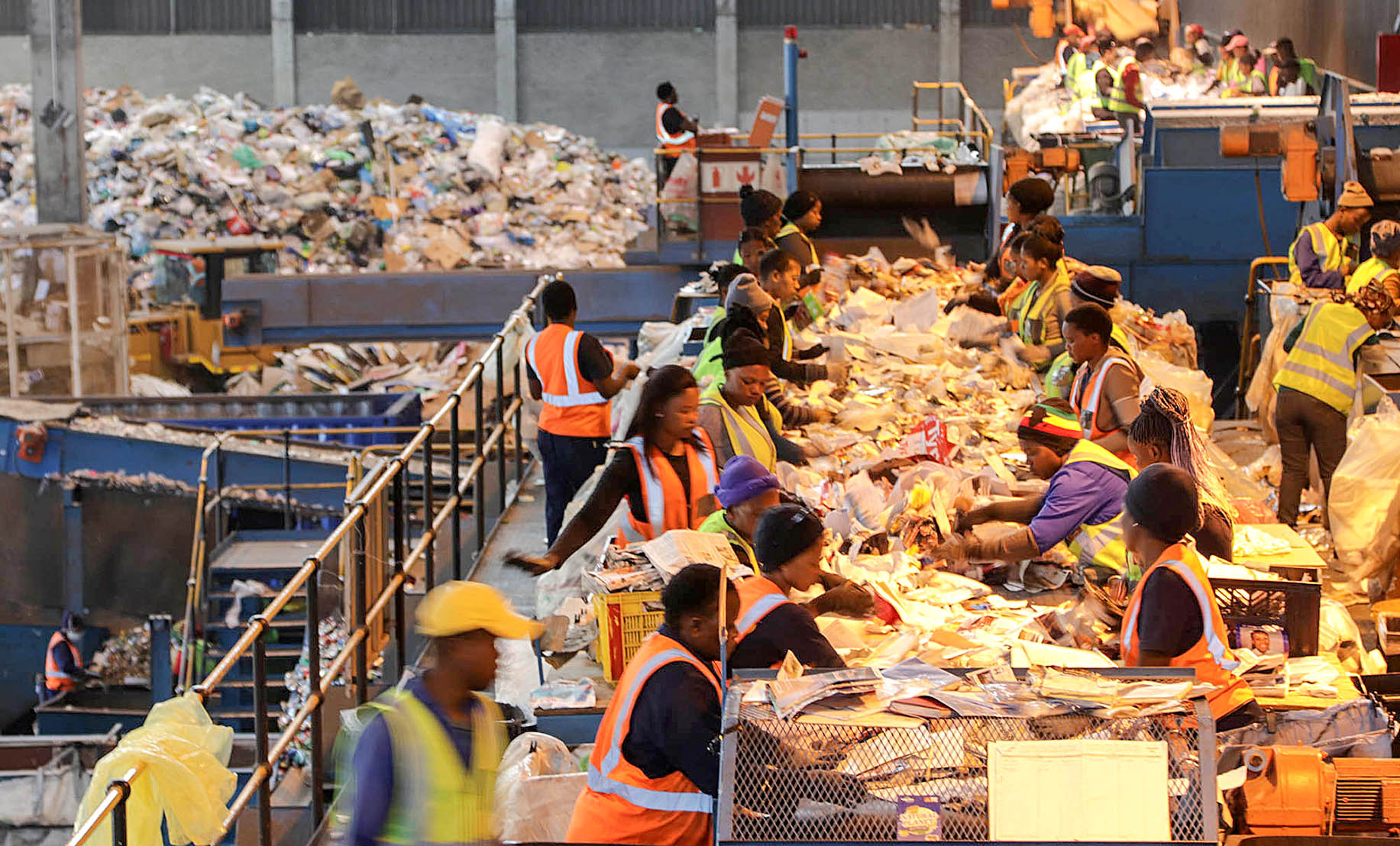
 Employees of the Kraaifontein Integrated Waste Management Facility in Cape Town pick recyclables off of a conveyer belt. The facility sorts through approximately 1,500 tonnes of waste per month. (Photo: Tessa Knight)
Only 9% of all the plastic ever produced on this earth has been recycled. After accounting for the 12% of plastic that gets incinerated – ignoring the associated pollution crisis that produces – it means that 79% of all plastic ever made is sitting in landfills or clogging up waterways across the natural environment.
“While biodegradable packaging is not the answer to everything, it is an important part of the solution set,” Nick de Beer, CEO of bioplastics maker Fortis X, explained to Daily Maverick in a recent interview. “Different products need different materials, and single-use packaging still has a place when it is designed responsibly.”
It’s a responsible answer from a company that manufactures 100% plant-based bottles and closures derived purely from sugarcane polymers. That raw material is thankfully abundant in an SA that produces about 11 million tons of sugarcane annually; a surplus exists due to sugar taxes and cheap imports.
But because their bottles are made entirely of a sugarcane derivative (categorised as Code 7 “other” plastic), they cannot be recycled alongside traditional polyethylene terephthalate (PET) and must instead be managed through commercial composting facilities.
It takes about two months for a Fortis X plastic bottle to biodegrade in a composter – which is not ideal, but it’s a good start.
The sting in the plastic tale
Economically, De Beer admits that the empty biodegradable bottles are “a little bit more expensive” to produce than standard plastic. However, he says the company competes against glass packaging, where the business case is incredibly strong.
Because glass is formed at 1,500°C, the energy output and carbon footprint are 10 times higher than Fortis’ manufacturing, allowing the bioplastic to beat glass unit costs by what he refers to as a “landslide amount”. That competitive advantage is extended because the machinery is fully electric, meaning their only manufacturing emissions are those that bake off the feedstock.
You cannot easily compare bioplastics and recycled plastic, though. And both categories lose in a price war with virgin plastics derived from fossil fuels.
The economic gap between virgin and recycled plastic is highly vulnerable to energy shocks. Because virgin resin production relies so heavily on fossil fuels, it acts as a direct proxy for global oil markets.
When crude oil prices jump above $115 per barrel due to geopolitical tension, the cost of virgin plastic can immediately increase by 30%.
The flip side is a lot more interesting. Because the recycling sector relies more on logistics and sorting than direct fossil-fuel feedstocks, its costs rise at a much slower rate during an energy crisis.
In the scenario above, recycled material becomes 20% to 25% cheaper than virgin resin, almost eliminating the cost premium that is driven by processing (sorting, cleaning and the associated costs of that equipment), yield losses (only about 60-75% of recycled plastic becomes usable polymer), and the supply chain (think: waste pickers and third party collection services).
This is where government policies and corporate commitments from retailers and goods manufacturers like Unilever and Nestlé really come into play to keep a healthy demand that sustains these costly businesses.
The shopping trolley problem
Woolworths has long been the poster child for sustainable retail practices and largely walks the talk, within reason. The cornerstone was, of course, replacing single-use shopping bags with reusable bags made from 70% post-consumer PET plastic waste. In 2023, the company sold 39 million of these reusable plastic bags (a 36% increase from 2022). In 2024, they sold another 39.2 million.
But over the same period plastic packaging in the food section nearly tripled. In 2022, Woolworths Food recorded 15,717 tonnes of packaging. This figure skyrocketed to 35,210 tonnes in 2023, jumped again to 44,467 tonnes in 2024, and remained high at 42,907 tonnes in 2025.
And many of the company’s packaging innovations for the ready-made goods are simply swaps to different types of plastic.
For example, Woolworths celebrates that its rotisserie chicken now comes in a “100% recyclable polypropylene bag” and that 100 food products were switched from multi-layer structures to mono polymer substrates. And their award-winning iced tea packaging simply swapped a non-recyclable polyethylene terephthalate glycol (PETG) clear shrink sleeve for a polyolefin shrink sleeve. It is all still plastic.
That polyolefin material is right up De Beer’s alley, and he believes that these kind of approaches are the way forward.
“Consumers and retailers still need practical, affordable packaging, so the goal should be to reduce environmental impact rather than pretend every category can go plastic-free overnight.”
Checkers has been grappling with similar solutions. The Shoprite Group reports that 99.3% of its in-store packaging (like carrier bags and fresh food packaging) is now reusable, recyclable, or compostable, featuring an average of 82.4% recycled content.
But recyclable is still just plastic that mostly ends up in landfills, and shopping bags are too low-value to be picked by waste pickers. And, paradoxically, the group reports that it recycled 6,924 tonnes of plastic in 2024. However, in the exact same year, they used 10,363 tonnes of recycled plastic just to manufacture their own recyclable shopping bags.
This shows that the sheer volume of plastic bags they are pushing into the market outpaces the volume of plastic their entire internal operations manage to recycle.
Higher profits, more waste
Checkers also tried the Woolworths play of selling reusable bags, but from a bright start selling 2.9 million in 2023 and 739,095 in 2024, they sold only 294,277 reusable bags in 2025.
And because fewer customers are bringing back reusable bags to be further recycled, the total value of rebates paid out to shoppers dropped again, falling from R715,223 in 2024 down to R524,611 in 2025.
But the biggest challenge to the great plastic problem lies in the premiumisation trend and home delivery.
Checkers Sixty60 is a massive growth driver for the Shoprite Group, increasing deliveries by 530% from 4.3 million in 2021 to 27.1 million by 2024, and expanding to 539 stores with more than 6,000 independent delivery drivers. While they use recycled cardboard and paper bags for these deliveries, the packaging inside those bags is where the problem lies.
Checkers is aggressively expanding its premium Forage and Feast and Simple Truth ranges. If you dig through the group financials , you’ll find boasting about how customers buying Forage and Feast items have shopping baskets that are 3.5 times bigger than the average Checkers customer. This massive increase in basket size directly correlates to a higher volume of individual, premium-packaged goods leaving the store.

On the Woolworths side, Fashion, Beauty and Home packaging grew from 4,231 tonnes in 2022 to 5,214 tonnes in 2024, and hit 7,632 tonnes in 2025. Of which home delivery courier bags make up a sizeable percentage.
And the fibres those garments are made of are becoming increasingly less sustainable in the sourcing. The company aims to source recycled synthetics (like recycled polyester) but admits they “face significant challenges in the premium price associated with recycled polyester”. As a direct result of these costs, their percentage of responsibly sourced synthetics has been dropping drastically: from 18% in 2022, down to 12% in 2023, 10.89% in 2024, and just 8.7% in 2025.
It seems like the costs of our convenience and increasing tastes comes with a heavy burden on the world we live in. And with the oil price falling, the economics of sustainable plastic are evaporating. DM
Comments
Scroll down to load comments...