




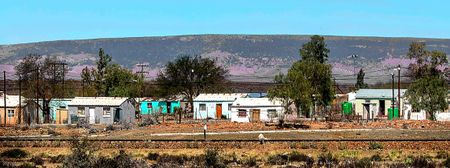
 The Dr Beyers Naudé Municipality in the Eastern Cape has managed to stop Eskom from cutting electricity for up to 14 hours a day in three Karoo towns. (Photo: Donna van der Watt)
The Makhanda high court has put a provisional stop to plans by Eskom to impose severe electricity cuts of up to 14 hours a day on three Karoo towns – Steytlerville, Jansenville and Klipplaat after the Dr Beyers Naudé Local Municipality racked up debt to the power utility of R532-million.
The order, given by Judge Justin Laing, is provisional, and Eskom can later argue why it should not stand. As it is, it will prevent lengthy power cuts until a court has heard an application to review Eskom’s decision to impose the drastic debt-management measures.
The crisis that the municipalities and Eskom face due to unpaid municipal debt is enormous, and now exceeds R110-billion, according to the latest numbers from the parliamentary electricity and energy committee.
According to Eskom, its decision to heavily restrict power supply to the three towns forms part of its efforts to prevent the municipality’s present debt from going out of control. In papers before the court, Eskom claimed that the municipality was using its electricity money to pay salaries and creditors.
Eskom explained that over the past three years, it had supplied R588-million worth of electricity to the municipality, but was paid only R55-million.
Eskom wants the municipality to sign an agreement that would see the municipality purchase electricity upfront from the utility and then distribute it to its customers, collect the tariffs, or allow consumers to pay Eskom directly.
The municipality admitted that it sometimes failed to meet its financial obligations but said that, due to its residents being mostly rural and indigent, the rates and taxes collected and the equitable share received from the Treasury were not enough.
Laing said in his ruling that the municipal failure to pay Eskom was unacceptable. He said it placed Eskom’s ability to supply electricity at risk. The power utility said in court papers that it could not pay for coal and maintenance to the national grid due to not receiving money due to it, and as a result, the national supply was increasingly compromised.
But, Laing added, Eskom’s decision to impose severe cuts to the electricity in the Karoo towns threatened communities’ constitutional rights to municipal services, including the right to dignity, a clean environment, healthcare, housing, access to sufficient food and clean water, and social security. While the power cuts proposed by Eskom would only be for a few hours in the first week, they would escalate to 14-hour cuts a day for seven days a week.
/file/dailymaverick/wp-content/uploads/2023/05/MC-ECDOE-Estelle.jpg "A community member prepares food for children in Klipplaat, Eastern Cape, as part of the school feeding scheme. (Photo: Donna van der Watt)")
According to papers before the court, the municipality alleged that the interruption of electricity would be catastrophic for the three towns, as it would compromise water and sanitation services, hospitals, clinics, funeral parlours, old-age homes, police and traffic services, the operation of the fire department, the court and the surrounding farms.
Concerns were raised that sewage pumps wouldn’t work and the drinking water supply would be severely compromised as the boreholes at Jansenville would be inoperative.
Laing said that in the past, the catastrophic effect that the cutting of electricity supply would have on communities was found by the courts to be a compelling ground for the review of such an Eskom decision.
But Eskom’s legal team argued that the municipality sought the continued supply of electricity without complying with its reciprocal obligation to pay for it. Even after Eskom undertook to write off some of the municipality’s debt in exchange for consistent payments, this did not happen.
Long-standing dispute
The municipality has long been in an unresolved dispute with Eskom over “wheeling agreements”, as Eskom uses municipal infrastructure to supply some of its communities with electricity.
When Eskom previously threatened to impose similar power cuts in 2020, an agreement was reached that it would refrain from this pending the arbitration of the dispute. However, a dispute over the participation of the Department of Cooperative Governance and Traditional Affairs appeared to have derailed that process.
The municipality then joined a debt relief programme offered to local governments to address their indebtedness to Eskom, and the matter was not taken further.
But in November, the municipality was invited to attend a meeting to discuss signing a Delivery Agency Agreement that would, among other matters, introduce prepayment for electricity.
On 22 February 2026, Treasury noted that the municipality had consistently been underpaying Eskom, violating its debt relief agreement. It was then threatened that it would be removed from the debt relief programme unless it signed the Delivery Agency Agreement. This would mean the municipality would become liable for all arrear amounts, penalties and interest.
But the municipality said it had not received a draft of the agreement that Eskom wanted them to sign, rendering consideration impossible for the town council.
The Dr Beyers Naudé Local Municipality is among 14 municipalities nationally that received notices of disconnection.
/file/attachments/orphans/ED_610262_876102.jpg "Minister of Electricity and Energy Kgosientsho Ramokgopa. (Photo: Sharon Seretlo / Gallo Images)")
On 27 May, Minister for Electricity and Energy Kgosientsho Ramokgopa said in a written answer to Parliament that the “Municipality failed to respond meaningfully to ensure that the disconnection does not proceed.” The court case followed.
“Having exhausted all reasonable avenues through the Intergovernmental Relations Framework Act, Eskom issued notices in terms of the Promotion of Administrative Justice Act (Paja) in early March 2026, providing affected parties an opportunity to make representations before further action was considered.
“Around 14 municipalities had been selected because they had not settled their accounts for at least the last 18 months, had not met the conditions of the National Treasury municipal debt relief programme, or posed a significant financial risk to Eskom. Initiating the Paja process ensured that Eskom complies with legal requirements while taking necessary steps to maintain the stability of the electricity supply system,” the minister said.
Ramokgopa indicated that the government was aware of the litigation initiated by the municipality.
He continued: “The escalating municipal debt burden also has wide implications for South Africa’s electricity reform agenda, which is designed to enable new entrants to enter the marketplace and is delaying progress on the legal and operational unbundling of Eskom’s Distribution business.
“Throughout the country, municipal debt has surpassed R110-billion, despite the National Treasury’s intervention through a municipal debt relief programme aimed at restoring sound financial management. The persistent rise in arrears highlights the urgent need for Eskom to proceed with debt recovery decisively,” Ramokgopa said.
/file/attachments/orphans/WhatsApp-Image-2026-02-25-at-14424_547847.jpg "Finance Minister Enoch Godongwana. (Photo: Phando Jikelo / RSA Parliament)")
Minister of Finance Enoch Godongwana said in a response to a parliamentary question in May that 61 municipalities countrywide weren’t complying with the debt relief programme offered by Treasury.
These failures, Godongwana said, included a failure to approve cost-reflective tariffs for electricity; a failure to address incomplete rates bases and therefore failing to bill all consumers for rates, and across all services; a failure to enforce credit control and collect what was due to them; a failure to address water and electricity losses (technical and non-technical); and a failure to enforce the national free basic services policy limits.
Godongwana had a stark warning for these municipalities.
“The National Treasury is in the process of terminating all persistent defaulters from the programme to facilitate Eskom to collect the remainder municipal relief debt over and above the post-debt relief growth since 1 April 2023, to prevent the municipal debt from further eroding Eskom’s balance sheet.
“As an alternative, their termination will provide the affected councils the option to benefit from a municipal relief debt write-off through a Distribution Agency Agreement (DAA) with Eskom.
“The DAA can only be concluded following due process in terms of the Municipal Systems Act and the Electricity Regulation Act and will reduce Eskom’s risk of municipal non-payment while sustaining the basic service to affected communities.
“In terms of the proposed DAA, it is envisaged that municipalities retain their electricity licence so that after the five years of the DAA, they can take back a stabilised service. The conditions for Eskom will be strengthened concurrently to ensure that Eskom collects from all municipalities as may be necessary.”
Johannesburg
The City of Johannesburg is another municipality facing power cuts over unpaid debt to Eskom of nearly R5.3-billion, and a court settlement now appears to be in peril.
On Wednesday, Eskom said the City of Johannesburg (CoJ)/City Power has continued to make payments towards the electricity account, but the account was still overdue by more than R2.7-billion.
“As of 11 June 2026, the CoJ/City Power owes Eskom an arrear debt of R5,281,414,085.38 (R2,702,336.196.37 overdue current account and R2,579,077,889.00 balance of the settlement arrangement that was made an order of the court),” the power utility explained in a statement.
The statement continued that its notice given in terms of the Paja process, to restrict power supply, had not been withdrawn.
“The Paja process remains an administrative consultation process that provides affected stakeholders and members of the public with an opportunity to make representations before Eskom reaches a final decision,” the statement continued.
“Following the Minister of Electricity and Energy’s announcement that Eskom and City Power had reached an agreement in principle to suspend the Paja process on the condition that City Power settles its account, the public ceased making submissions to Eskom.
“However, City Power has failed to meet its payment obligations under the agreement, and Eskom will now proceed with the Paja process.
“In the interest of ensuring a fair administrative process, Eskom has extended the deadline for the notice by 30 days, given that the minister’s intervention occurred within the first week of the Paja process.
“Accordingly, the closing date for public representations, submissions, comments and/or requests will now be the close of business on 17 July 2026,” the statement added.
/file/attachments/orphans/ED_611826_996052.jpg "Retired Justice Mbuyiseli Madlanga. (Photo: Gallo Images /Frennie / Shivambu)")
In 2022, attempts by Eskom to reduce the power supply to the Lekwa and Ngwathe municipalities was dismissed by the Constitutional Court, with the court stating: “[T]he skies will not fall if – purely in the interim – Eskom continues to provide electricity ... I would sooner have the residents of the municipalities – purely on an interim basis – living lives that are as near as possible to wholesome, than subject them to the current ‘human catastrophe’,” Justice Mbuyiseli Madlanga, now retired, wrote on behalf of the majority of the court in that case. DM
Comments
Scroll down to load comments...