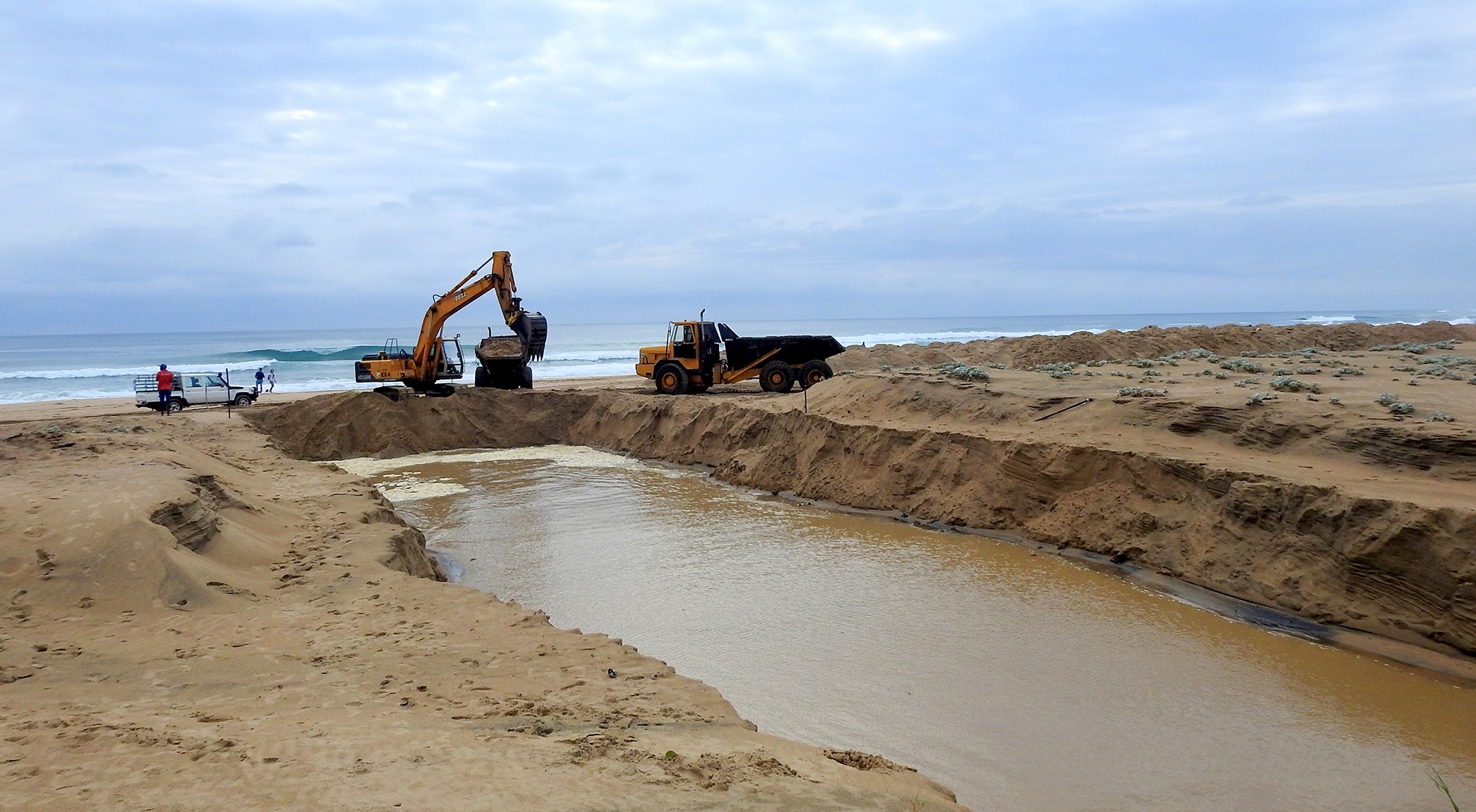
 The Lake St Lucia estuary was breached artificially using backhoes in January 2020, sparking widespread controversy. Now there are new proposals to resume artificial breaching. (Photo: Supplied)
 Debates have raged for decades over the best way to “save” Lake St Lucia, a vast and complex estuary system whose ecological health is shaped by the joint influence of fresh water and salt water.
The 70km-long lake, home to a rich variety of animals, birds and water life, is the centrepiece of the iSimangaliso Wetland Park, South Africa’s first World Heritage Site and second-largest protected area after Kruger National Park.
It is also the largest estuarine lake system in Africa, serving a vital and nationally important role as a nursery ground for sea fish, prawns and other marine creatures.
Depending on the year, the season and other factors, the shallow waters of Lake St Lucia can be completely fresh on one hand, or many times saltier than seawater.
/file/attachments/orphans/tonylake2Thistime-seriesofaerialimagesclearlyshowstheextremefluctuationsofwaterlevelsduringandafteradroughtperiodImageiSimangalisoWetlandParkAuthority_825254.jpg "This time-series of aerial images clearly shows the extreme fluctuations
<br>of water levels in the lake during and after a drought period. (Images: iSimangaliso Wetland Park Authority)
<br>")
of water levels in the lake during and after a drought period. (Images: iSimangaliso Wetland Park Authority)
Yet, despite its size and protected status, the lake and its abundant wildlife have been in trouble for decades, sparking heated debates over what should be done to protect them.
Now, more than a decade after a multimillion-rand rehabilitation project to reconnect the lake to its single biggest lifeline of fresh water (the Mfolozi River) – and a decision to ensure “minimum human interference” in natural processes – a group of four local estuarine researchers has stirred up fresh controversy by calling for the resumption of regular, human-driven breaching of the St Lucia estuary mouth, dredging and other management interventions.
/file/attachments/orphans/tonylake3mouthmaps1883to1966MapWhitfieldandTaylor2009_271327.jpg "The changing shape of the Mfolozi River mouth between 1883 and 1966. (Map: Whitfield and Taylor 2009)<br>")
Bulldozers and sugar cane: The degradation of Lake St Lucia
Before getting into the details of the latest proposals, it may be useful to go back in time to get a better understanding of how we got here.
The year 1952 was a pivotal moment in the recent ecological history of Lake St Lucia. This was the year that bulldozers and other machinery were deployed to sever the lake’s single-largest water artery – the Mfolozi River, which historically provided at least 50% of the lake’s freshwater inflows.
For hundreds, possibly thousands of years, the Mfolozi River emptied into the Indian Ocean at the same spot (near the present-day St Lucia village). Apart from flowing into the ocean, the Mfolozi waters also flowed sideways into the lake when the mouth closed off in dry periods.
But by 1952, park managers feared that the Mfolozi was now carrying too much silt into the mouth of the lake and – perhaps more importantly – neighbouring sugar cane farms were also pressing for action to protect their farms from being flooded when the river mouth closed up.
The first commercial sugar farms were planted here in 1911, smack inside the Mflozi River floodplain. The wet, fertile soils were great for growing sugar, but from an ecological perspective, the decision to reroute the mouth of the river turned out to be a disaster.
Before the arrival of the farmers, this floodplain was the place where the river slowed down before meeting the sea, dumping large volumes of sediment before its waters entered Lake St Lucia.
During the 1930s, farmers also began to alter the ecology of the floodplain by changing the natural course of the Mfoloizi, installing drains, canals and levies to protect their low-lying plantations from back-flooding during storms or periods when the mouth closed naturally.
Fairly soon, the lake’s ecological pendulum began to shift. Combined with canalisation, drainage and alterations to the position of the river mouth, Lake St Lucia was robbed of its largest water supply.
With less water in the lake, another ripple effect was that the St Lucia estuary mouth became increasingly clogged with sediments from both the sea and land, prompting a massive dredging operation in the mid 1950s.
According to former Ezemvelo KZN Wildlife ecologist Dr Ricky Taylor, it took nearly five years of dredging before the link between St Lucia and the sea was opened, and another eight years of dredging to remove all the accumulated sediment.
Eventually, however, when the lake almost dried up during another dry cycle in the early 2000s, estuarine experts made a decision to reconnect the Mfolozi River mouth to where it had always been.
The farmers fought back, demanding the right to breach the mouth artificially. But they lost their battle in the high court and a subsequent appeal to the Supreme Court.
In her ruling in 2017, high court Judge Mohini Moodley said that the farmer’s insistence on breaching the river mouth was self-serving and outdated, and reflected a conscious lack of concern around the environmental degradation.
/file/attachments/orphans/tonylake5sugarcanefieldsPhotoTonyCarnie_712802.jpg "Large sections of the Mfolozi floodplain — once a trap for muddy sediments — have been turned into sugar cane plantations. (Photo: Tony Carnie)")
/file/attachments/orphans/tonylake6deadfishPhotoTonyCarnie_705142.jpg "Most of Lake St Lucia dried up almost completely in 2016 due to the lack of fresh water, killing off fish and other aquatic life. (Photo: Tony Carnie)")
Now, 14 years after the Mfolozi River was reconnected to the St Lucia estuary with funding from the World Bank’s Global Environmental Facility, a group of estuarine researchers is calling for a rethink on how to manage the impacts of siltation and water movement between the lake and the ocean.
In two recent research articles published in the African Journal of Aquatic Science and the Water Wheel magazine, Dr Ricky Taylor, Prof Alan Whitfield, Prof Janine Adams and Caroline Fox have called for a “reassessment” of the largely hands-off management policy on mouth and lake management. They recommend the following actions:
- Blocking off the old Link Canal that was dug in the 1970s because it was carrying muddy sediments from the Mfolozi River into the Honeymoon Bend section of the estuary. They say it may also be necessary to remove (dredge) large volumes of sediment around Honeymoon Bend, which they believe is preventing seawater from flowing upwards into the main lake through The Narrows section of the estuary.
- Opening up (dredging) and clearing vegetation in the Potter’s Channel area around Makakatana Bay that was hindering water and fish movement between the main lake and The Narrows
- Artificial breaching (digging away river and sea-borne sediment) from the combined St Lucia-Mfolozi estuary mouth, if the mouth remains closed for more than three years. This is based on their view that marine fish, swimming prawns and other invertebrate species reach adulthood within three years and need to return to the sea to breed. Also, say Whitfield and his colleagues, muddy sediments from the Mfolozi become more difficult to flush away into the sea if the mouth remains closed for prolonged periods.
Overall, they argue that St Lucia has reached an ecological “tipping point” where it is close to switching permanently from a functional estuary and marine nursery to a predominantly freshwater coastal lake or muddy swamp.
/file/attachments/orphans/tonylake7SantaLuciatourboatPhotoTonyCarnie_536016.jpg "Visitors on the Santa Lucia tour boat keep a watch for hippos, crocodiles and other wildlife in The Narrows section of the lake. (Photo: Tony Carnie)")
It is the last proposal – to regularly breach the mouth – that is likely to be the most controversial, given the more recent management decision to abandon the artificial breaching of the mouth that had been a feature of previous management policy for nearly 60 years.
In response to the latest proposals, the iSimangaliso Wetland Park Authority says it “does not share the view that the St Lucia Estuary is approaching an imminent ecological tipping point”. A spokesperson for the authority also suggested that the Taylor/Whitfield review did not appear to incorporate more recent ecological, hydrological and geomorphological information.
While scientific debate on the future trajectory of the St Lucia Estuary was both “expected and welcome”, iSimangaliso said management decisions for a World Heritage Site must be based on the totality of available evidence, including long-term ecological monitoring, specialist investigations, environmental authorisations, independent expert review and current ecosystem observations.
Blunt response
Independent Marine and Estuarine Research (MER) scientist Prof Anthony “Ticky” Forbes was more blunt in his criticism, characterising Taylor and Whitfield as “fiddlers” who appeared to believe that complex ecology dilemmas could be resolved or ameliorated over a relatively short time scale through human interventions.
“They have been pushing this barrow for years ... this idea that you can fiddle with nature to make it better for the fish”.
Forbes argues that the 60-year policy of regular artificial breaching (from 1952 to 2012) and other measures to reduce the volume of siltration of the mouth and estuary had culminated in St Lucia drying up earlier this century, for the first time in living memory.
In a fundamental policy switch initiated around 2010, the mouth of the Mfolozi River was allowed to return to its original position at the mouth of Lake St Lucia on 6 July 2012 – reversing the six-decade policy of keeping the mouth separate.
Forbes argues that the impact of this policy change would take time to restore some form of natural ecological equilibrium.
/file/attachments/orphans/tonylake8FloodwatersopenthethemouthofLakeStLuciain2022ImageChrisRattrayBateleursFlyingfortheEnvironment_282191.jpg "Following major floods in April 2022, the mouth of Lake St Lucia breached
<br>naturally. (Photo: Chris Rattray Bateleurs Flying for the Environment)")
naturally. (Photo: Chris Rattray Bateleurs Flying for the Environment)
“There was an expectation that in two or three years (after the Mfolozi mouth was restored to its former position) everything would be ‘magnificent’ ... but it doesn’t work that way. You have to think beyond human time and life cycles.”
Forbes notes that the deliberate mouth management policy change was based on a consensus decision by a group of about 30 estuarine experts after a series of workshops and studies, most of whom acknowledged that past policies had not worked.
Forbes acknowledges that Lake St Lucia will eventually fill up with sediments, as has been happening over thousands of years.
“At worst, St Lucia would evolve over geological time into a wetland – would they (Taylor and colleagues) prefer in the short term a salt pan?”
“So, what are you going to do about it? ... Yes, it will sediment up. But if you get in with a dredger, will it make any difference? ... And who will pay for it?”
He further suggests that if the mouth is breached artificially, it is likely to close up again soon afterwards because of insufficient volumes of fresh water in the Mfolozi/St Lucia mouth to maintain a natural breach.
/file/attachments/orphans/tonylake9skiboatlaunchesPhotoTonyCarnie_373892.jpg "A fishing skiboat launches near the mouth of Lake St Lucia. (Photo: Tony Carnie)")
Nevertheless, pressure to dredge, or to breach the mouth artificially, also appears to be intensifying from local sugar cane and subsistence farmers.
Early last month, the Deputy Minister of Fisheries, Forestry and Environment, Narend Singh, held a “stakeholder engagement with commercial and small-scale farmers affected by back-flooding on the Msunduzi and Mfolozi Flats”.
Following his three-day visit to the park, his department posted a video clip in which Singh said the government was playing an important role in trying to alleviate concerns of farmers affected by back-flooding.
“We have engaged with the iSimangaliso authorities to facilitate and to fund a project that that will ensure that the mouth of the estuary is dredged and that water from the sea gets into the estuary to preserve the ecology and we are delighted that government can partner with the iSimangaliso Wetland Authority and the local community and the task team within the local community to ensure that this project can become a reality at least by the end of September this year.” DM