




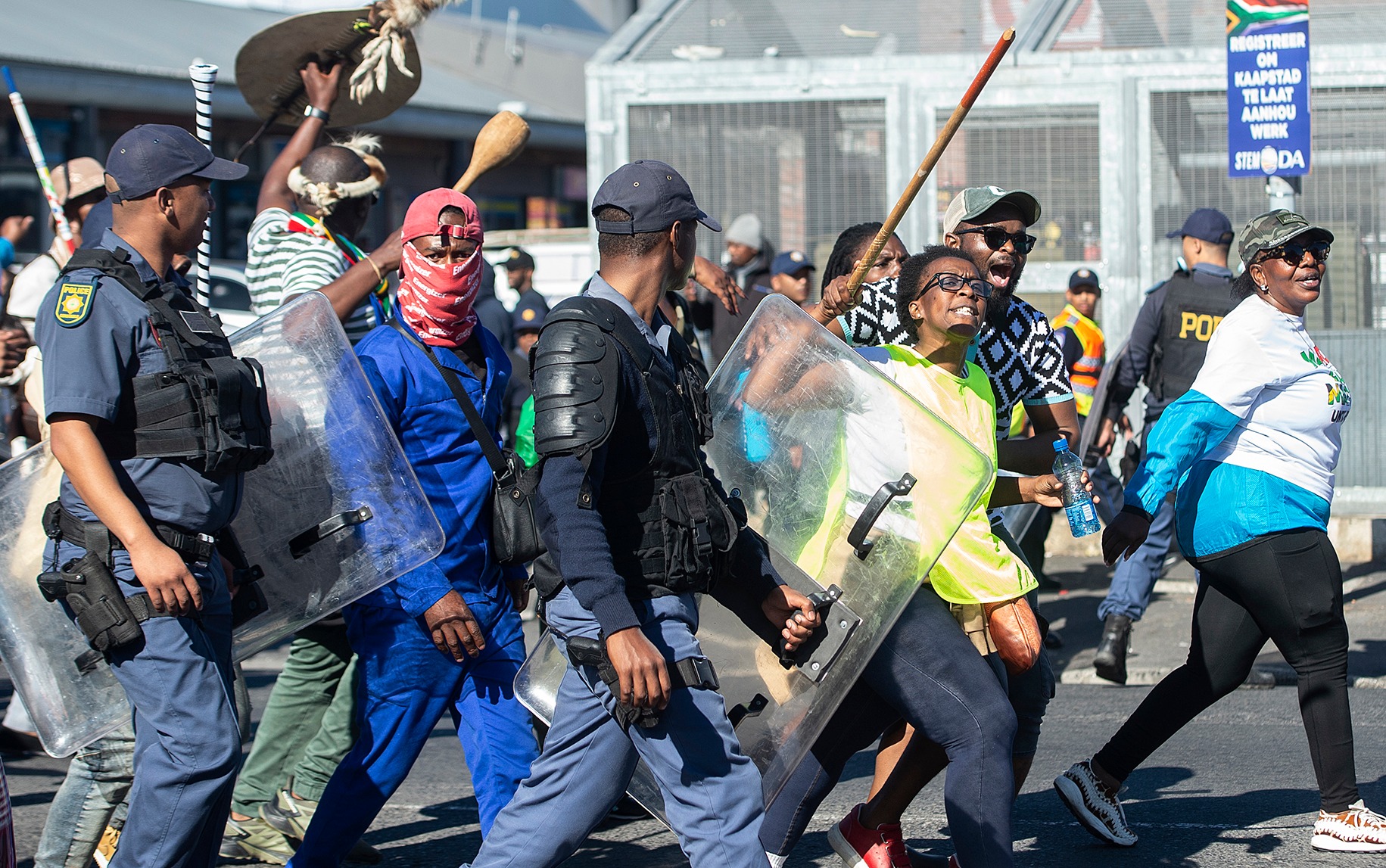
 About 50 people marched along Voortrekekker Road to Maitland in Cape Town to protest against illegal immigration on 30 May 2026. The group was advocating for stronger immigration enforcement, strict border control and the strict enforcement of municipal by-laws and local labour laws. (Photo: Gallo Images / Brenton Geach)
South Africa is hurtling towards a dread-inducing date for many: 30 June. Set by March and March, a self-described “citizen-led movement”, the deadline calls for all “illegal” foreign nationals to leave the country. While the leaders of this movement have been careful not to be seen to explicitly endorse any violence or unrest in furtherance of their call, social media accounts supportive of the deadline have shown no such hesitation. Social media feeds are saturated with videos naming alleged “illegal foreigners”, circulating unverifiable lists, spreading rumours and false information, and urging communities to take action.
The line between rhetoric and real-world harm is thinning by the day.
Accounts on X like that of @LeratoPillayZA, a key influencer in the South African anti-foreigner digital ecosystem with more than 65,000 followers on X, advertises in its profile bio: “DM [direct message] for Promos.” What this means is that the account is offering audiences to pay for or arrange promotional posts of various kinds, effectively offering its reach and influence as a commercial service, regardless of the specific topic or viewpoint being promoted.
A recent post pairs the 30 June deadline with an image of a man’s face marked by the imprint of a violent strike. In another example, @LeratoPillayZ reposted a tweet from an anonymous comment, which calls on “patriots” to visit Sherwood Hall, in Durban, before 30 June to deal with “little bugs”, language that thinly veils a call for hostile action against foreign nationals.
The @LeratoPillayZA account has been identified before as a central amplifier of the #PutSouthAfricansFirst campaign and a manufactured persona driving organised anti-immigrant sentiment in South Africa. Investigations linked the account to dismissed South African National Defence Force member, Sifiso Jeffrey Gwala. The account formed part of a tightly coordinated network that gamed Twitter’s algorithms, used misleading images and fabricated statistics about migrants, and pushed a constant stream of xenophobic content under the guise of patriotism.
What distinguishes this account is not only the persistence of its messaging but the extent to which it operates within a broader influence economy, openly soliciting paid promotions while building a following on the back of divisive and dehumanising content. In this sense, it exemplifies how anti-foreigner rhetoric can be cultivated, sustained and potentially monetised within platform systems that reward visibility and virality.
The hate economy
It is hardly a revelation that anti-immigrant sentiment is being rapidly amplified online, nor that some of those driving this amplification are doing so for financial gain. What is far more urgent, however, is understanding the structures that enable this phenomenon: who is paying, through which mechanisms, and what kinds of behaviour these economic incentives are actively encouraging.
It is in the hope of answering these questions that, earlier this week, the Campaign on Digital Ethics (CODE) and the Campaign for Free Expression (CFE) jointly wrote to social media platforms, TikTok and X, asking whether their monetisation systems are, directly or indirectly, rewarding accounts that traffic in xenophobic hate speech and disinformation.

Framed this way, the issue extends well beyond the familiar terrain of content moderation and take-down obligations. At its core, it is a question about platform design and the economic logics embedded within it – logics that do not merely host or distribute content, but actively shape what is produced, amplified and sustained.
Public debate around social media platforms has, for the most part, remained narrowly focused on whether harmful content should be removed. This framing fails to recognise that digital platforms are not passive hosts of content. They have become creator economies – in which attention is systematically converted into income through advertising revenue-sharing arrangements, subscriptions, digital gifts and brand partnerships. In such systems, engagement functions as currency, and content that provokes outrage, fear or anger often proves to be among the most lucrative.
In the South African context, TikTok’s monetisation infrastructure includes LIVE gifts, video gifts, subscription models and facilitated influencer partnerships, all of which translate directly into financial reward. X, for its part, operates a Creator Sharing Programme through which eligible accounts receive a share of advertising revenue generated by their content. These features are central to how visibility, influence and income are produced on these platforms.
X’s own policy explicitly prohibits monetisation of “content that depicts or portrays hateful activity, harasses, shames or insults an individual or group on the basis of race, ethnicity, gender, sexual orientation, gender identity, age, ability, nationality, religion, caste, victims and survivors of violent acts and their kin, immigration status or serious disease sufferers [emphasis added]”. The critical question, therefore, is not whether such rules exist on paper, but whether they are being enforced in practice, and with what degree of consistency and transparency.
Our letter to X simply asks that they disclose how they identify and demonetise accounts that post anti-immigrant hate speech and with what frequency they’ve done so over the past 24 months.
We asked both platforms whether they conduct enhanced reviews of their monetisation programmes during periods of heightened social tension. And we ask what transparency exists around these decisions.
These are not radical demands but questions of basic accountability that assume heightened importance in the face of real threats of violence and criminality that will inflict untold damage on South Africa, its economic and political stability and its regional and international standing.
Nor can it be convincingly argued that such transparency is technically infeasible. Under the European Union’s Digital Services Act, major platforms are already required to publish detailed disclosures relating to systemic risks, content moderation practices and enforcement actions. The capacity to provide meaningful transparency therefore clearly exists; what remains in question is whether it is being applied equitably across different regions.
If social media companies are capable of providing meaningful transparency to users in Europe, they should be capable of providing exactly similar transparency to users in places like South Africa where incitement to conflict and bloodshed produce crises that can be far less afforded than they might be by European member states.
South Africans deserve honest debate about immigration. They deserve effective borders, functioning institutions and a government capable of addressing legitimate public concerns. But as desperate as South Africans are for jobs and financial sustainability, we absolutely cannot afford economies that incentivise hatred and in which fear, resentment and scapegoating are made profitable commodities.
We aren’t making an argument for censorship but one for transparency. If technology companies are paying creators whose content contributes to the dehumanisation of migrants and foreign nationals, the South African public has a right to know. If they are not, they should have no difficulty demonstrating as much.
For too long, the focus of public scrutiny has been confined to what platforms remove. It is now equally necessary to interrogate what they reward, what they amplify, and what they are willing to pay for.
They unquestionably host hate. The question that remains is whether they are also funding it. DM
Nicole Fritz is executive director of the Campaign for Free Expression. Kavisha Pillay is executive director of the Campaign on Digital Ethics. Both are human rights activists.
Comments
Scroll down to load comments...