




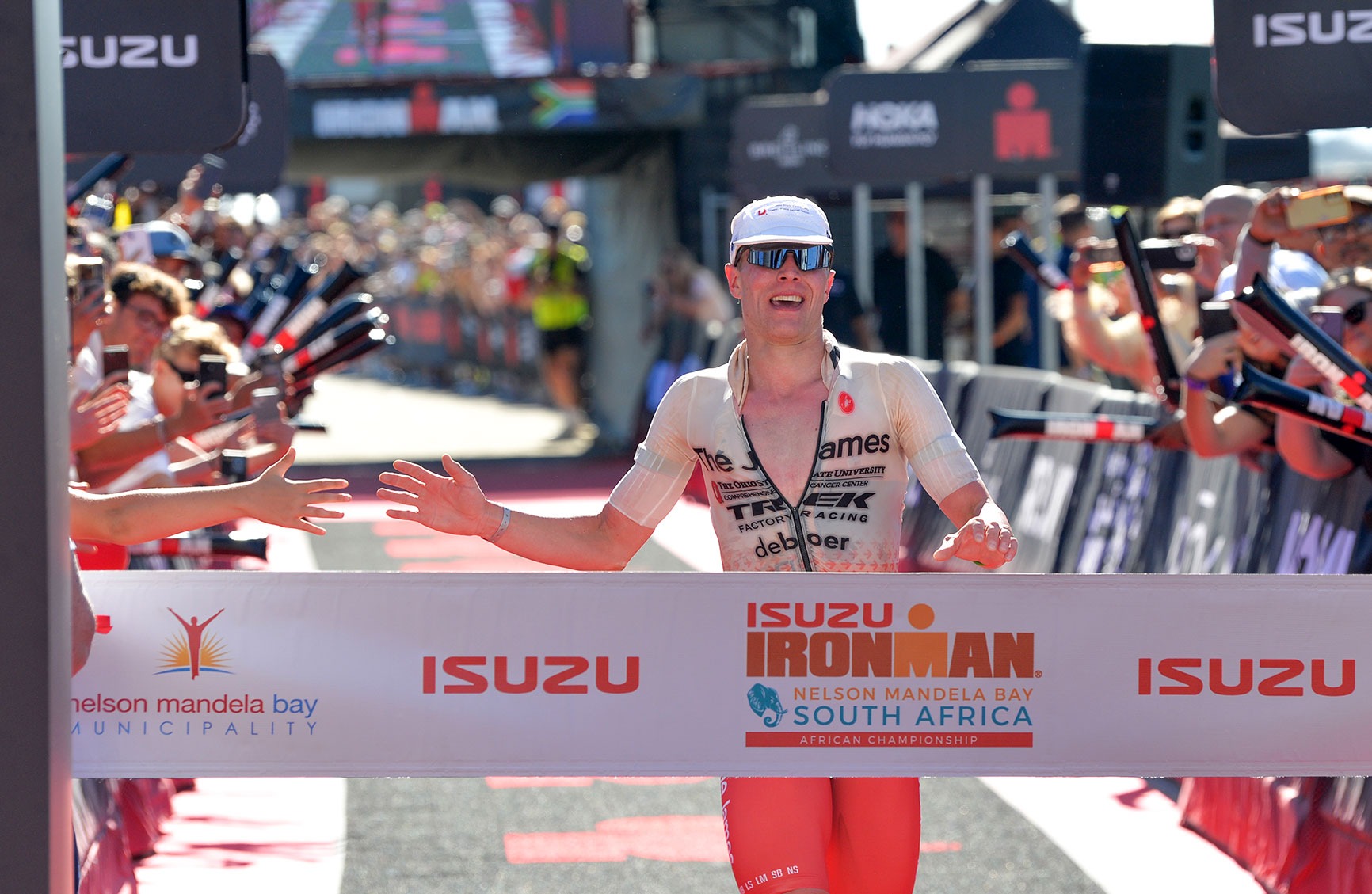
 Matthew Marquardt of the US wins the men’s event of. the 2026 Ironman African Championship in Gqeberha on 19 April. (Photo: Deon Ferreira)
Is half an Ironman better than no Ironman at all? That remains to be seen as Nelson Mandela Bay prepares for the shortened version of the endurance race in 2027, after more than two decades of hosting the full event.
Ironman South Africa is set to downscale the 226.3km African Championship in Nelson Mandela Bay to a 70.3-mile (113km) middle-distance triathlon.
The organisation claims the international event’s economic impact on the city is set to remain the same despite it coming with shorter stays by the athletes and visitors. But those in the hospitality and tourism industries have their doubts.
Rumours of the event’s relocation started circulating in May, when Mossel Bay Mayor Dirk Kotzé posted on social media that his municipality was in talks with the event organisers about changing their half-Ironman event to the longer format.
/file/attachments/orphans/Warrior-HR-20_789532.jpg "Spectators at the Ironman in Gqeberha on 19 April. (Photo: Deon Ferreira)")
These rumours were confirmed last week when Ironman SA operations director Michele Bronkhorst gave a presentation on the revised event at a municipal sport, recreation, arts and culture committee meeting in Nelson Mandela Bay.
The transition aims to drive growth, accessibility and long-term sustainability after the full-distance triathlon had seen a steady decline in athlete participation numbers over the years, said Bronkhorst.
The full event consists of a 3.8km swim, 180km cycle and 42.2km run, while the reduced event covers half these distances.
When Ironman was introduced to the city more than two decades ago, the full-distance race attracted more than 2,000 athletes, but participation dropped to less than 900 this year.
During her presentation, Bronkhorst said the estimated direct spend of the shorter event was between R60-million and R70-million, which was achieved this year.
/file/attachments/orphans/WhatsAppImage2026-06-12at123208_789443.jpeg "Ironman SA operations director Michele Bronkhorst presents new plans for Ironman SA in Nelson Mandela Bay. (Photo: Andisa Bonani)")
According to her, switching to the 70.3 course will allow them to grow the field from 900 starters to 2,500.
“If in SA that 1,000-athlete full distance is all that we have, and we move it to another location, we’re diverting the 70.3 athletes from that location back into Nelson Mandela Bay,” she said.
“So the hope for us is that we continue to drive the tourism and economic impact, and build a sustainable growth model in Nelson Mandela Bay by getting the development of our sport back up and running, and get our athletes back into 70.3 distances, which for the average triathlete is something they will do about three times in a year, for multiple years.”
Highlighting the event’s economic impact, Bronkhorst said the 2,500 expected athletes would each bring 2.5 to three supporters, driving average hotel stays of three to four nights over the Ironman weekend.
Festival weekend
“Because we would still maintain an Iron Kids, the 5150 race and all the side events on Saturday, so it would still be a festival weekend of events.
“We would still be looking at that same average economic impact, a similar average of bed nights across the weekend, and a slightly shorter stay in Nelson Mandela Bay ... but your total economic impact increases because the number of athletes is increasing.”
/file/attachments/orphans/Warrior-HR-33_470886.jpg "Daisy Davies of the UK on her way to winning the women's event of the 2026 Ironman in Gqeberha on 19 April. (Photo: Deon Ferreira)")
The breakdown to realising peak economic impact:
- Visitor numbers: 2,500 athletes and approximately 6,250 supporters equates to 8,750 total visitors;
- Bed nights created: 8,750 visitors multiplied by 3.5 nights equates to 30,625 bed nights (excludes staff, sponsors, suppliers and technical teams); and
- Direct visitor spend: 8,750 visitors multiplied by 3.5 days multiplied by R2,200 average daily spend equates t R67-million in direct economic impact.
Avid Ironman participant Alec Riddle said introducing the 70.3 race made sense as the numbers had been dwindling over the years.
Riddle recalled one year when 2,700 athletes took part, while last year’s race only attracted about 30% of that.
“There’s a lot of emotion among the athletes about the fact that [full-distance] Ironman is potentially leaving the city. All the people who have benefited over the years, such as Airbnbs, hotels and restaurants, are concerned, but we’ve got to look at the facts,” he said.
“What Michele is saying does make sense because we have seen a decline in Ironman numbers. Between 2005 and 2008, there were about 2,700 athletes, and now we have dropped to 700, which is less than 30% of that number, so it’s not economically viable to run Ironman with those numbers.”
Riddle said the 70.3 race would serve the city better.
“When we look at Mossel Bay’s 70.3, it attracted between 15,000 and 18,000 visitors, and Durban had roughly the same numbers. This means the metro will get double the amount of numbers in its 70.3.”
He said if the 70.3 had a professional division, this would attract more numbers, media coverage and publicity for the city.
“This will make the race economically viable. It also means more visitors, which will benefit the local businesses.”
Disappointing
Glenn Pappin, regional representative of the Federated Hospitality Association of Southern Africa (Fedhasa), said losing the longer Ironman was disappointing, but replacing it with the 70.3 was better than losing it completely.
“They claim a big drop in numbers, and we felt it in our hotels and guesthouses. We were not seeing the same number of bookings as in the past, and that obviously impacts on the viability of the event.
“But if their new numbers for the shorter event are accurate, and we can expect a larger field of athletes, then bring it on.”
Pappin said Nelson Mandela Bay had always delivered a good product in terms of the actual event, as well as accommodation and tourism offerings for international visitors.
“I think NMB is uniquely resourced to host any number of events, and this might be a good opportunity to explore some options to supplement tourism outside Ironman.”
Nelson Mandela Bay tourism expert Shaun van Eck said each version of the endurance race presented unique advantages and disadvantages.
He said roughly half of the competitors for the longer format came from overseas, while only 10% of participants in the shorter event were from abroad, which meant less business for the local hospitality industry.
“On average, international visitors book four nights in Gqeberha, while some stay for even longer as they train in preparation for the event. Meanwhile, local competitors generally stay for shorter periods and many stay with friends. This translates to a substantial reduction in accommodation bookings.”
He said the bigger event generally came with more marketing and media coverage, which did a lot to market Nelson Mandela Bay as a global destination.
“I also find it concerning that the biggest stakeholders — hospitality and tourism — were not consulted during the deliberation and decision-making process on the future of one of our biggest annual events,” said Van Eck.
Important decision
Mossel Bay Mayor Kotze posted on Facebook last month that the council had noted a proposal by Ironman to host the full-distance race in the area.
“Today, during a special council meeting, council has taken an important decision regarding the future of Ironman in Mossel Bay.
“During the meeting, it was noted that a proposal was received from Ironman South Africa on 14 May 2026 for Mossel Bay to host the Ironman Africa Championships from 2027 until 2029, replacing the current Ironman 70.3.”
Meanwhile, during her presentation in Nelson Mandela Bay, Bronkhorst apologised for the manner in which information about the relocation of the full-distance race was announced.
“I understand that there has been a lot of information that’s gone out in the media, a lot of conflicting and confusing information,” she told councillors.
“From myself personally and from Ironman, I would like to apologise for the way that this information was delivered. It is not the professional standard that we like to maintain, and it does not uphold the relationship that we currently have with Nelson Mandela Bay.”
/file/attachments/orphans/Warrior-HR-17_131991.jpg "Competitors take to the water in the 2026 Ironman in Gqeberha on 19 April. (Photo: Deon Ferreira)")
Bronkhorst would not confirm on record that they planned to move the full-distance race to Mossel Bay, referring questions to the Ironman media team.
Asked about the move to Mossel Bay, the Ironman SA public relations office said they could not comment as they were still in talks with the host municipalities.
“As we remain in close communication with all of our host city partners regarding the evolution of next year’s calendar, we have no further comment at this time. The South African triathlon community and host communities remain hugely important to Ironman, and we value our long-standing relationships across the region.”
More attainable
Bronkhorst noted that the 70.3 distance was more attainable for the average athlete. While Nelson Mandela Bay boasts a massive triathlete community, many of them travel elsewhere for 70.3 races rather than participating in the city’s full-distance event.
“We have 4% of our triathlon community in Nelson Mandela Bay participating, and that tells us that there is something in the Ironman model that is not necessarily working here now, and if the 70.3s are growing like they are growing everywhere else, it is the right choice for us to make this a 70.3 African championship race.
“We would maintain the status of an African championship, we would maintain their pro field, and we would essentially be able to take the athletes that only want to do 70.3-mile races and bring them into Nelson Mandela Bay.”
Sinebhongo Kwatsha, Nelson Mandela Bay’s MMC for sport, recreation, arts and culture, said she did not see how the city would benefit from sponsoring a downscaled event.
/file/attachments/orphans/Sinebhongo_194376.jpg "Sinebhongo Kwatsha, Nelson Mandela Bay’s MMC for sport, recreation, arts and culture. (Photo: Nelson Mandela Bay)")
“I understand what you are saying about the numbers dropping; what has Ironman done to develop athletes in this city when we have been sponsoring the event for more than 20 years? What have you done to develop athletes in underprivileged areas who do not get to be part of this event but are talented?”
Kwatsha said that while the committee would adopt the move to sponsor the event with a further R4.2-million, she did not believe they were getting value for money. DM
Comments
Scroll down to load comments...