




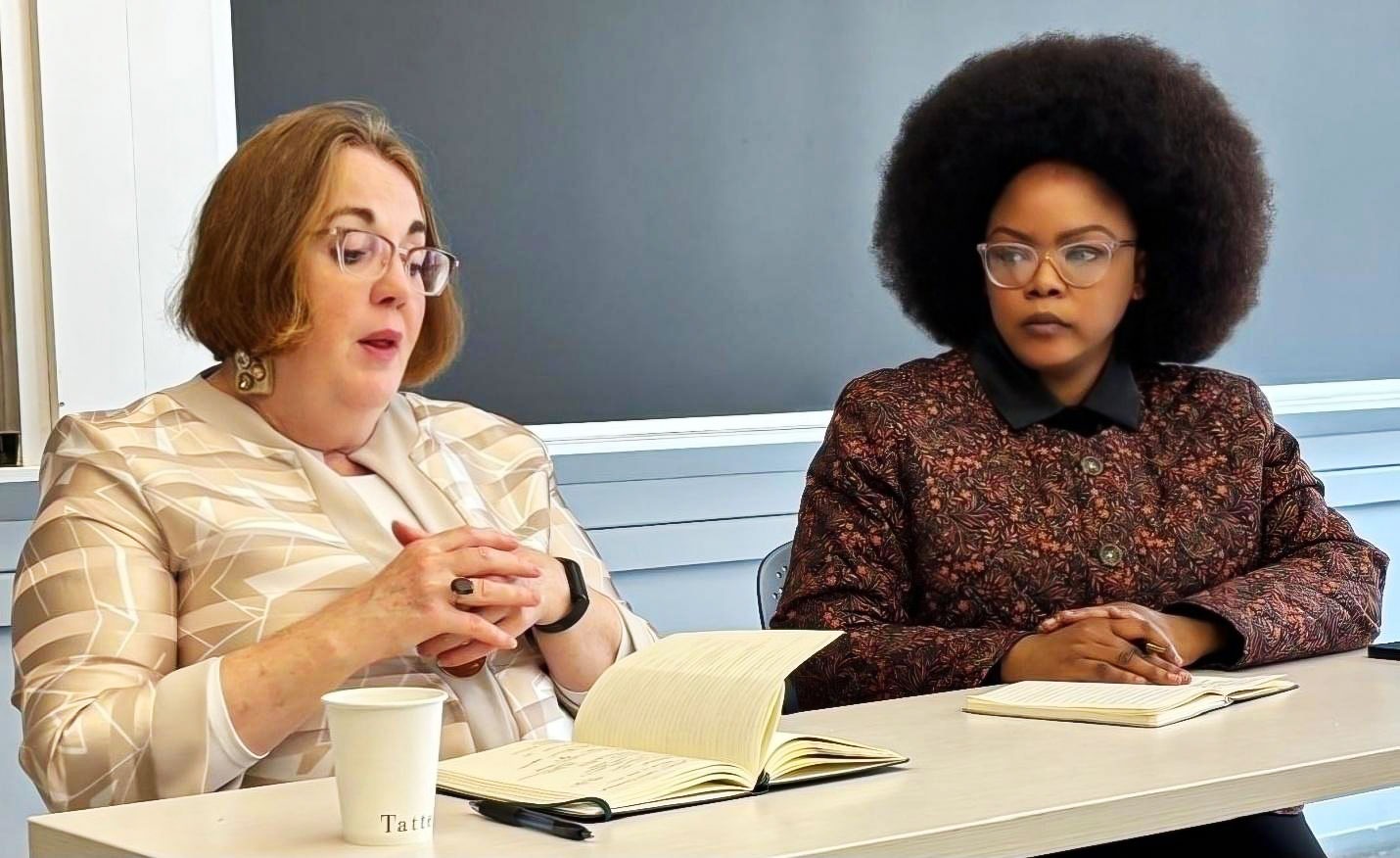
 Former US Assistant Secretary of State for African Affairs, Molly Phee (left), and Dr Sarah Setlaelo at the Massachusetts Institute of Technology on 29 April 2026. (Photo: supplied)
Africa Day in May this year arrived at a moment of tremendous global realignment in which relations between the United States of America (US) and Africa are being renegotiated – situationally, structurally and strategically.
This transformation runs deeper than policy adjustments. The shift in diplomatic tone, development engagement, trade and geopolitical alignment is shaped by competition over strategic resources, climate imperatives and diverging visions for a new global order. The central question here is: Are we witnessing a reset and recalibration of engagement, or a fundamental rupture in US-Africa relations?
During a recent fireside chat with former US Assistant Secretary of State for African Affairs, Molly Phee, at the Massachusetts Institute of Technology (MIT) in the US on 29 April 2026, I was privileged to gain first-hand insights into this evolving landscape. Our conversation excavated critical questions about leadership, ideology and agency.
Employing a political philosophy four-stage framework – the situational (symptomatic), structural (diagnostic), deliberative (consultative) and strategic (prescriptive) – helps us understand this phenomenon.
Situational analysis: The symptoms
The US has launched an affront against the terms “globalism” and “multilateralism” – while for Africa, Europe, and Latin America, among other regions, multilateralism remains important as a means for coordination and developing a global architecture to deal with common problems.
A glaring symptom contributing to shifting US-Africa relations is the erosion of the American diplomatic corps. Experienced senior US foreign service officers have been systematically driven out, a few replaced by political appointees, and others forced to resign. This exodus has weakened the US State Department, resulting in fractured US diplomatic capability abroad.
Given the prominent role of US assistance to Africa for decades, there is also a frustration by Africans and American friends of Africa that it is manipulated through nationalist ideological populist terms, causing some Americans to protest against the millions of dollars of aid to Africa. It is fair to question whether the US aid machine is still appropriate.
However, in fiscal terms, these million-dollar programmes are not statistically significant in relation to a five-trillion-dollar US budget (despite the US deficit). Effectively, there appears to be underlying ideological dynamics that inform current US-Africa relations regarding the provision of assistance.
Structural analysis: The diagnosis
Moving from description to explanation, the recent tensions are rooted in historical and geopolitical forces. Historically, it was partly at the urging of Nobel Peace Prize laureate Ralph Bunche in 1958 that the Bureau of African Affairs was established – albeit with limited initial funding – in the wake of the African decolonisation wave.
Since then, there have been decades of bipartisan US engagement, including Bush Pepfar, Obama Feed the Future, Power Africa, among many other policies that have benefitted Africa. In recent times, a Presidential Advisory Council on African Diaspora Engagement was established in 2023 under the Biden administration. This short-lived initiative was subsequently dissolved in 2025 by one of the Trump executive orders.
What is unique about the relationship between the US and Africa is the shared history of the Transatlantic Slave Trade and its legacy. The US’ domestic policies pertaining to descendants of slavery and African immigrants, and the pernicious anti-blackness of some of its racist segments, appear to be projected through its crass engagements with African states. Current tensions with SA, as articulated by Evan Lieberman, director of the MIT Center for International Studies, offer an apt example of the US projections of its own racial challenges upon a country that is more progressive in this regard.
The US has also curtailed its engagement and funding with the United Nations (UN) and other multilateral institutions, compromising the channels through which aid to Africa has flowed through technical agencies such as Unicef, WFP and WHO. This has led to significant structural damage.
On policy, nothing has disrupted the US-Africa relationship more singularly than the abrupt abolition of the United States Agency for International Development (USAid) and the rapid dismantling of decades of foreign assistance. The fallout will endure for years, as African states are now scrambling to reallocate sparse domestic budgets to programmes that were previously US aid dependent.
This dramatic shift from humanitarian aid to transactionalism and “commercial diplomacy” has impacted the African Growth and Opportunity Act (Agoa), established in 2000, in the short term. It expired in September 2025, and was extended till December 2026, amid talk of updating the legislation on Agoa .
We could ponder whether it is the “Great Man Theory” of history, where a charismatic leader shapes the trajectory of civilisation in fundamental ways, or a more Marxist conception of history, where it is structural challenges or economic factors that drive outcomes.
Deliberative analysis: The consultation
A consultative analysis cannot treat this as a unilateral phenomenon. African states also have enduring frustrations and knee-jerk reactions that have in some cases contributed to the tensions. At least three prevailing grievances can be identified.
First, African governments resent the dominant donor model of channeling aid and resources through NGOs, which they see as eroding their sovereignty. They instead prefer government-to-government financing.
African states are also concerned by the chronic shortage of capital to finance infrastructure and development at the scale the continent requires. Thus, the prominent role and physical presence of other global actors such as China in African foreign investment and infrastructure development, which requires the US to remain competitive in contested spaces.
Third, the area in which Africans are met with silence, is the impact of climate change on African agriculture. The current US administration has chosen to not acknowledge the challenges of global warming and has in fact withdrawn from the Paris Agreement on climate change of November 2016. This misalignment of expectations pours oil onto the already raging fire ignited by escalating tensions.
Strategic resolution: The prescription
Applying a dialectical lens (thesis-antithesis-synthesis) to these challenges might assist with a constructive path forward. The thesis is the liberal-institutionalist logic of the Biden era that emphasised partnership, multilateralism, aid and development. The antithesis evidences the realist-neo-mercantilist logic of the current Trump administration that prioritises power, leverage, trade and economic gain – “America First”.
These dialectical complexities reveal that US-Africa relations are not merely undergoing policy changes. This is an unprecedented paradigm shift. From cooperation to competition. From development to extraction. From multilateralism to transactionalism/bilateralism.
The African Union and African states are faced with the advent of a new era. The synthesis has yet to be realised.
The US could arrive at a hybrid strategy that pairs institutional partnership with strategic efficiency and economic pragmatism. Africa could move from dependency towards strategic autonomy, utilising trade agreements, resource governance frameworks, and institutional diplomacy.
While synthesis is currently elusive, African agency is now being put to the test. DM
Dr Sarah Setlaelo is a political philosopher who holds a PhD in Philosophy from the University of Johannesburg (UJ). She is currently a Research Associate at UJ, and a former fellow at the Harvard University Center for African Studies (2024/2025).
Comments
Scroll down to load comments...