



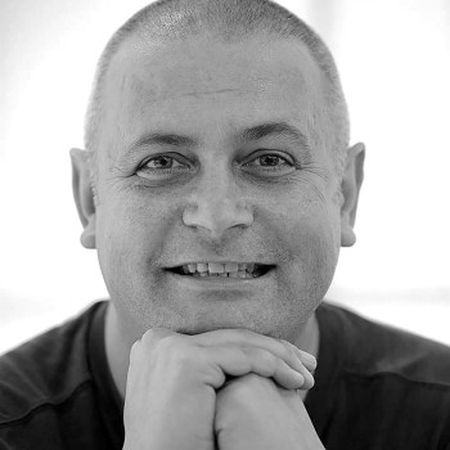
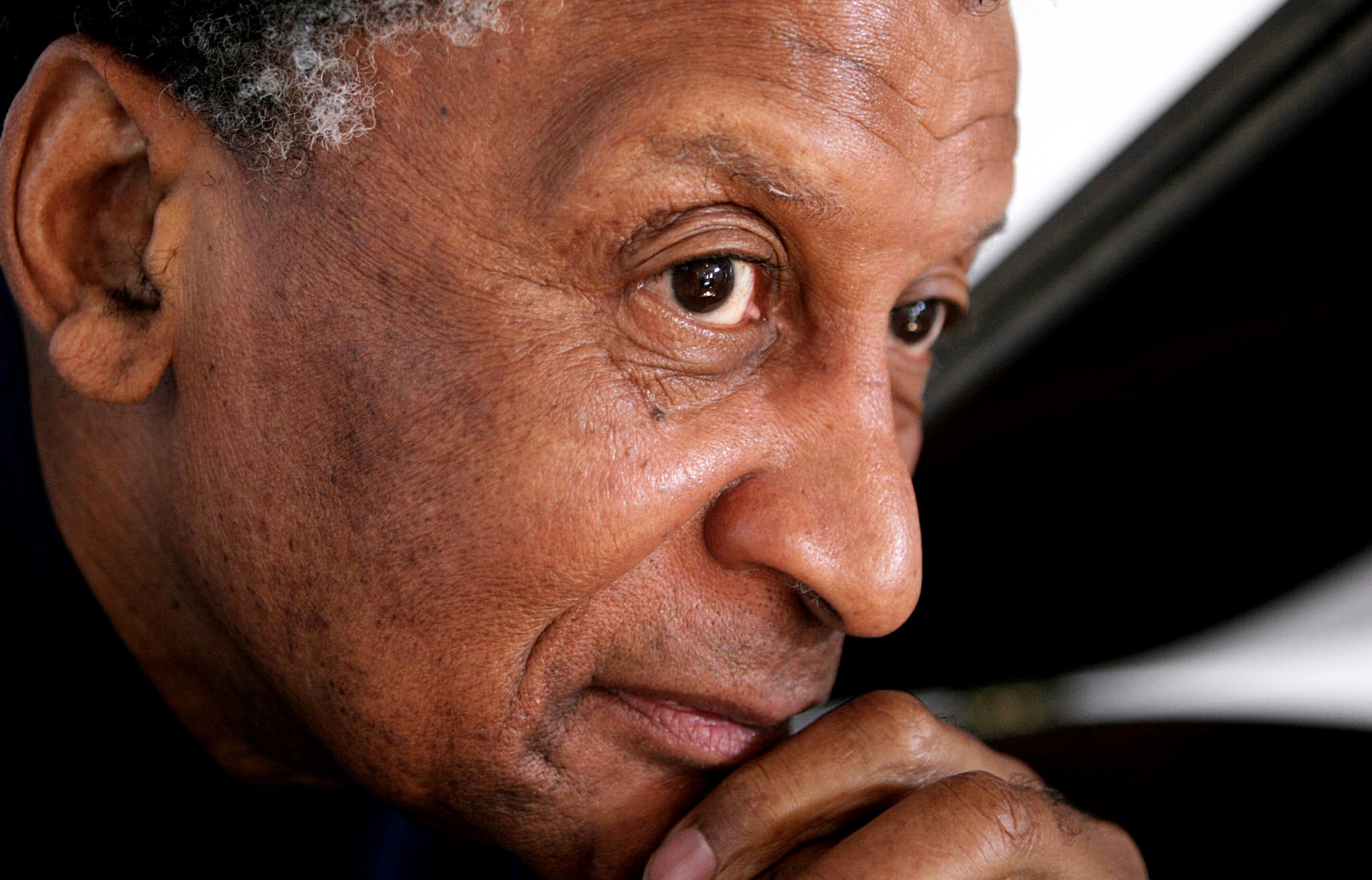
 Abdullah Ebrahim on 15 July 2005. (Photo: Gallo Images / Media 24 Pty Ltd (newspapers)
He should have carried his father’s name. The New York Times obituary says that Sentso Brand, a house painter of Sotho descent, was shot dead in Cape Town in 1938 – in circumstances, the paper observed, nobody ever properly explained – when his son was four years old.
The grandmother who raised that boy understood exactly what the name Sentso would cost him under a system built to sort people by colour, and gave him her choices of names instead. He was born Adolph Johannes Brand on 9 October 1934.
In an interview with the Cape Town broadcaster Lester Kiewit for Eyewitness News, the man the world came to know as Abdullah Ibrahim corrected the record himself. “My name is Sentso, my father was MoSotho,” he told Kiewit, explaining that his grandmother had given him different names altogether, which could pass as coloured or white under apartheid laws, to ease his passage through a regime that punished some kinds of blackness more harshly than others.
By the time that passage ended at the age of 91 in a hospital in Prien am Chiemsee, a lakeside town in Bavaria, Germany, in the early hours of Monday, 15 June, Ibrahim had answered to at least three names and lived on three continents.
He will be buried, his family said, in Aschau im Chiemgau, the small Alpine town near to where he spent his last years, an improbable resting place for a man whose music never really left Cape Town.
The New York Times defined his music as elegant, with a meditative style that folded the sounds of his home city into a much wider conversation with American and European jazz. Others say that the melancholic yearning for his country, the breath of the streets he grew up in, the father he hardly ever knew, could be felt in every slow sound.
The writer and researcher Professor Sean Jacobs, a South African who has lived for decades in New York, published one of the most seminal and well-researched profiles on him in The New York Review of Books on 7 June 2026, eight days before his death.
/file/attachments/orphans/ED_South0330_491023.jpg "Abdullah Ibrahim plays in Amsterdam 1986. (Photo: Paul Weinberg / Gallo Images / Media 24 Pty Ltd (newspapers)")
In the piece, titled Songs of Liberation, he writes that Ibrahim grew up in Kensington, a working-class, racially mixed suburb on Cape Town’s northern edge, in a household run by women. His mother, Rachel, and his grandmother, Margaret, were pianists and singers at the local African Methodist Episcopal church, which Margaret had helped found, and Rachel also played piano at the neighbourhood bioscope, accompanying silent films. His first piano lessons were arranged when he was seven and he began composing almost immediately afterwards.
Cape Town in the 1930s and 1940s was a port city thick with Indian, Chinese, Malaysian and east African influence, the Times notes, and District Six, where the family later moved, sat at the centre of all of it. The young Brand absorbed Indian ragas, Chinese folk melodies and the Zulu music of migrant work camps more or less simultaneously.
Jacobs traces his nickname, Dollar, to American sailors docked at the harbour during the World War 2, who paid him in jazz records he was forever pestering them to sell. By 15, he was performing publicly, first as a singer and then on a piano with the big bands working the country’s segregated dance-hall circuit.
In 1954 he made his first recordings, with the swing outfit Tuxedo Slickers. He wanted to study medicine, but apartheid closed that door before he could properly knock on it; barred from a medical degree, and rejected from the music department at the University of Cape Town for the colour of his skin, he read instead, and practised piano for hours at a stretch.
He then left for Johannesburg, where the marabi and mbaqanga scenes of the north pulled him into a different musical universe. There he met the pianist Todd Matshikiza and the saxophonist Mackay Davashe, and fell in with the formidable alto player Kippie Moeketsi, 10 years his senior and already spoken of, in Jacobs’s account, as South Africa’s answer to Charlie Parker.
/file/attachments/orphans/723961895_1549215419896623_3379411377547970860_n_168625.jpg "Abdullah Ibrahim performs with his four-horn septet Ekaya, and with special guests Terence Blanchard (trumpet), Kenny Garrett (saxophone) and Cecil McBee (bass), in the Rose Theater at the Lincoln Center in New York on 3 October 2025. (Photo: Nathalie Schueller / Jazz at Lincoln Center / Facebook)")
/file/attachments/orphans/720155595_1549215426563289_6118281016279429868_n_677266.jpg "Abdullah Ibrahim on stage in the Lincoln Center’s Rose Theater on 3 October 2025. (Photo: Nathalie Schueller / Jazz at Lincoln Center / Facebook)")
Between them they recruited a teenage trumpet prodigy named Hugh Masekela and his school friend, the trombonist Jonas Gwangwa; Brand brought in his own men from Cape Town, the bassist Johnny Gertze and the drummer Makaya Ntshoko. The six of them became the Jazz Epistles, the first Black South African group to release a jazz album, and for one charged stretch around 1959 and 1960, they played to sold-out rooms in Johannesburg and Cape Town, welding American bebop to the rhythms of home.
Jacobs says that the novelist Bessie Head, then an unknown reporter, caught one of those performances and wrote about the young pianist in a manuscript that would not surface for another 35 years. South Africa, Head wrote, was a cultural desert; Brand, by contrast, struck her as “a complete and perfect flower in this desert”. She was right that something exceptional was underway.
It did not last. In March 1960, police opened fire on unarmed protesters at Sharpeville, killing dozens, and the state of emergency that followed banned gatherings of more than 12 people, which in practice silenced the Epistles before they had properly begun; Mandela was arrested two years later as the underground resistance turned to guerrilla war.
Brand and his girlfriend, the singer Sathima Bea Benjamin, left for Zurich, where his old Cape Town bandmates, Gertze and Ntshoko, eventually joined him, and the trio took up a residency at the Africana Club, four and a half months a year on poor wages, the rest spent touring Europe.
Duke Ellington walked into the club one night, and Benjamin, who was light-skinned enough to be frequently mistaken for white, approached him directly and persuaded him to come and hear her boyfriend’s trio play. Ellington was sufficiently impressed to take them to Paris and supervise the recording of two albums in two days.
/file/attachments/orphans/724937612_10162710264446890_1739347990886738097_n_644456.jpg "Abdullah Ibrahim at the Jazz Cafe in London in 1996. (Photo: Marguerite Holtzhausen / Facebook)")
/file/attachments/orphans/724576447_1423284436487685_1856109636962590782_n_600062.jpg "Abdullah Ibrahim spent a lifetime improvising freedom. (Photo: Free State World / Facebook)")
The one, Duke Ellington Presents the Dollar Brand Trio, reached record shops in 1964 and effectively launched his international career. Brand and Benjamin married in London in February 1965, and that summer, with Ellington’s help, lobbying the writer Langston Hughes for a residency letter, they moved to New York.
His American debut, at the Newport Jazz Festival that July, was followed by dates at Carnegie Hall and the Village Vanguard, and within two years he was performing with the Ellington Orchestra itself and had joined drummer Elvin Jones’s band; and he was studying cello at Juilliard at the same time, on a Rockefeller Foundation scholarship.
He was drinking heavily and unsure of his direction. In June 1967, he gave his third performance at Carnegie Hall, and something in him shifted; he heard in the bebop he had loved since adolescence, and especially in the angular piano of Thelonious Monk, an unmistakably African root. “For us, what Monk did was so natural,” he told The Guardian, recalling the moment he thanked Monk to his face for the inspiration, only to be told he was the first piano player ever to put it that way.
What followed was a conversion in every sense. Ibrahim grew up Christian, but Cape Town’s Islam, brought by enslaved people from Indonesia centuries earlier and inflected by Sufi practice, had always been close at hand, and in 1968, back home in Cape Town, he took the faith and the name by which the world would finally know him: Abdullah Ibrahim, servant of God, father of many.
He gave up drinking and smoking and took up karate; for a spell in the late 1970s, according to the Salt River resident Faizel Brown, he even ran a small dojo above a shop on the corner of Lower Main and Goldsmith roads, where, Brown recalls, the karate classes came with an unadvertised bonus. “After giving classes, he would play his saxophone,” Brown says, adding that he had no idea how famous his neighbourhood karate instructor was until a cousin happened to catch one of his shows in Canada.
It was the return home in 1973, after three nomadic years between South Africa, the US, Europe and Swaziland, that produced the song on which his reputation in South Africa would finally rest. Drawing on a 2022 profile of the producer Rashid Vally in Wax Poetics, Ibrahim was in a Johannesburg studio working with a group of Cape Town musicians when he noticed an upright piano fitted with drawing pins on the hammers, giving it a tinny, harpsichord-like rattle, and sat down and began playing a simple two-chord vamp.
The engineer, without telling anyone, kept the tape rolling. “We thought we were practising the song,” Ibrahim said. Only when they listened back did the band understand what they had captured: the mood of an entire country.
He named the song after Manenberg, one of the bleak new townships to which the apartheid government had forcibly relocated coloured families displaced from District Six, adding an extra letter to the name as he wrote it down.
Jacobs says that the recording, driven by a loping ghoema rhythm and lifted by Basil Coetzee’s warm tenor saxophone, turned the name into something closer to defiance, even joy, and sold 43,000 copies in its first seven months with almost no promotion.
/file/attachments/orphans/723792625_1549215436563288_903088874442239840_n_595742.jpg "Abdullah Ibrahim performs at New York’s Lincoln Center on 3 October 2025. (Photo: Nathalie Schueller / Jazz at Lincoln Center / Facebook)")
The same account adds that through the 1980s it became the music of mass meetings and funerals, played at the 1983 launch of the United Democratic Front, the broadest anti-apartheid coalition since the 1950s. A sympathetic lawyer smuggled a copy onto Robben Island, where Mandela heard it and called it a sign that liberation was close.
At the end of the original recording Ibrahim can be heard speaking in Afrikaans, one of the few times his home language appears on any of his records: “Julle kan ma’ New York toe gaan. Ons bly hier innie Manenberg.” You can all go to New York. We’re staying here in Manenberg. It became the country’s unofficial second national anthem.
By the end of 1976, with the Soweto Uprising still smouldering, Ibrahim and Benjamin were forced back to America. Because of his public support for the ANC, the apartheid government responded by revoking his citizenship outright.
“When we left, the ANC asked us to play a more vocal role, and we accepted,” he told the writer Graham Lock for The Wire in 1984. Decades on, with the ANC he had once served mired in its own corruption, he grew noticeably cooler about the affiliation; asked in 2024 why he had never formally joined the party, he told the Philadelphia Inquirer (in an exchange again preserved in the New York Review of Books): “I don’t even belong to a football club.”
The couple spent most of the next two decades at the Chelsea Hotel in Manhattan, raising their two children, Tsidi and Tsakwe, largely without him, since Ibrahim was constantly touring. It put a strain on the marriage.
In a memoir published in 2025, In My Remaining Years, their daughter Tsidi, who performs as the rapper Jean Grae, described her father as “an abusive narcissist”, telling NPR (National Public Radio) that she had once hoped he would die before the book reached print so that she could finally say what she wanted without consequence, before deciding to publish it anyway so that he might face some accountability while he could still read it.
Her brother Tsakwe is a pianist and guitarist in his own right. Those who worked alongside Ibrahim professionally tend to describe a different, though not entirely contradictory, man. The Cape Town photographer Fanie Jason, in a written tribute, recalled an artist of total professionalism towards musicians and absolute unpredictability towards everyone else.
“He could be hot and cold at the same time,” Jason wrote, recalling being snapped at one minute and welcomed warmly the next, depending on a mood nobody around him ever quite learnt to read.
/file/attachments/orphans/000010481_278417.jpg "Abdullah Ebrahim on 15 July 2005. (Photo: Gallo Images / Media 24 Pty Ltd (newspapers)<br>")
“One day he got me sitting in the pub with a friend at the Cape Sun Hotel in Cape Town, then he asked me to join him for a cup of tea, because he doesn’t sit in pubs. I told him I don’t sit in pubs too, I only sit in shebeens, he just burst out laughing,” Jason says.
“I once went to him rehearsing at the Baxter theatre, I was just pushing my luck, I knew if he was in a bad mood he will tell me to leave, [but] that day he was in a good mood. He just stopped playing, telling the rest of his all-American band my name and I’m a veteran South African photographer.
“Just when I thought he was going to kick me out, [because] I exhaled when he suddenly stopped, expecting the worst, he played on and I started taking photos. I have witnessed Abdullah at his worst and his best, like any exceptionally good artist at his level.”
The composer and Wits lecturer Chantal Willie-Petersen says that Ibrahim is significant because he used music as a bridge between imagination and sound. He transformed traditional South African musical identities into a bold, radical form of self-expression that became part of the acoustic history of South African jazz.
Sibusiso Joseph Mashiloane, president of the South African Association for Jazz Education, lecturer at the University of KwaZulu-Natal, jazz composer and pianist, says: “What I have always admired about Bab’ Abdullah Ibrahim is that, from his days with the Jazz Epistles, he understood that the future of South African jazz could not rest solely on reproducing the language and lived experiences of bebop and American big-band music.
“While those influences remained present in his work, he increasingly turned towards the sounds and memories of home: Cape Town, District Six, church hymns, marabi, goema traditions, and the everyday lives of ordinary South Africans.
“This commitment is reflected throughout his body of work, in compositions and albums such as Mannenberg, Cape Town Flowers, African Marketplace, African River, and Ekaya, the Zulu word for home. Rather than treating local histories and musical traditions as peripheral, he placed them at the centre of his creative vision.”
He was never an easy man to corner for an interview, preferring parable to disclosure. The composer Charl-Johan Lingenfelder, in his own written tribute, recalled spending days recording conversations with him in London in 2016 for a stage piece that never materialised, and remembered asking him about jazz and ending up, 20 minutes later, in a discussion about bees. “Does the bee know that it carries pollen?” Ibrahim asked him, more than once, apparently in earnest.
Lingenfelder’s tribute describes how, before performances, Ibrahim would light incense and sit alone on an empty stage in meditation; how he never shook hands, only offered a fist, because, he told Lingenfelder, his hands were too important to risk; and how Lingenfelder himself would quietly switch on a small hidden cue light beside the piano after an hour, because once Ibrahim lost himself in the music he had no sense of how much time had passed.
In an interview with the journalist Dougie Oakes, Ibrahim traced all of it back to the unsung musicians of his childhood, men with day jobs and no stages of their own: Otto, the Woodstock banjo player who could turn a Duke Ellington tune into a carnival march; Chokka, who coaxed ghoema rhythms out of a homemade cello while children danced until the streetlights flickered out; the District Six barbers who kept a langarm beat going between haircuts. “The music was our oxygen,” he told Oakes. “We didn’t just listen. We lived it.”
He returned to South Africa for good once democracy arrived, receiving honorary doctorates from three universities and performing at Mandela’s presidential inauguration in 1994. His marriage to Benjamin ended formally in divorce in 2011, after which she returned to Cape Town and began performing again, to the delight of a jazz audience that had feared it had lost her for good, before dying two years later.
/file/attachments/orphans/HLABa8ZWUAADyGk1_700367.jpg "Abdullah Ibrahim carried the rhythms of resistance from Cape Town to the world. (Photo: Gaste Avrupa / Facebook)<br>")
Towards the end of his life, asked what gave music its meaning, Ibrahim kept returning to the same idea, that no sound truly belonged to the person who played it. “There is only one sound,” he said, “and all the rest is echo.”
He spent 91 years making sure that particular echo carried, from a backyard in Kensington to a concert hall in Vienna to a quiet Bavarian town where, by the end, almost nobody recognised him in the street. His last public performance took place at the Cape Town International Jazz Festival on the Rosies Stage on 27 March 2026. He is survived by his partner, Marina Umari, his son, Tsakwe, and his daughter, Tsidi.
This obituarist once stood at an ATM on Adderley Street, years ago, when Maria Callas’s voice came pouring out of a car behind. It was Giacomo Puccini’s heartbreaking “O mio babbino caro” from the 1918 opera Gianni Schicchi, which was incidentally the last song Callas would perform during her bittersweet farewell concert at London’s Royal Festival Hall in 1973.
He played it loud enough to set the whole street trembling. Turning round, I found Abdullah Ibrahim himself, sitting in his car at the lights, his face lit with something close to bliss. He never saw me looking. I have never forgotten it: that one unguarded moment of pure happiness on a face famous for giving so little away. DM
Comments
Scroll down to load comments...