




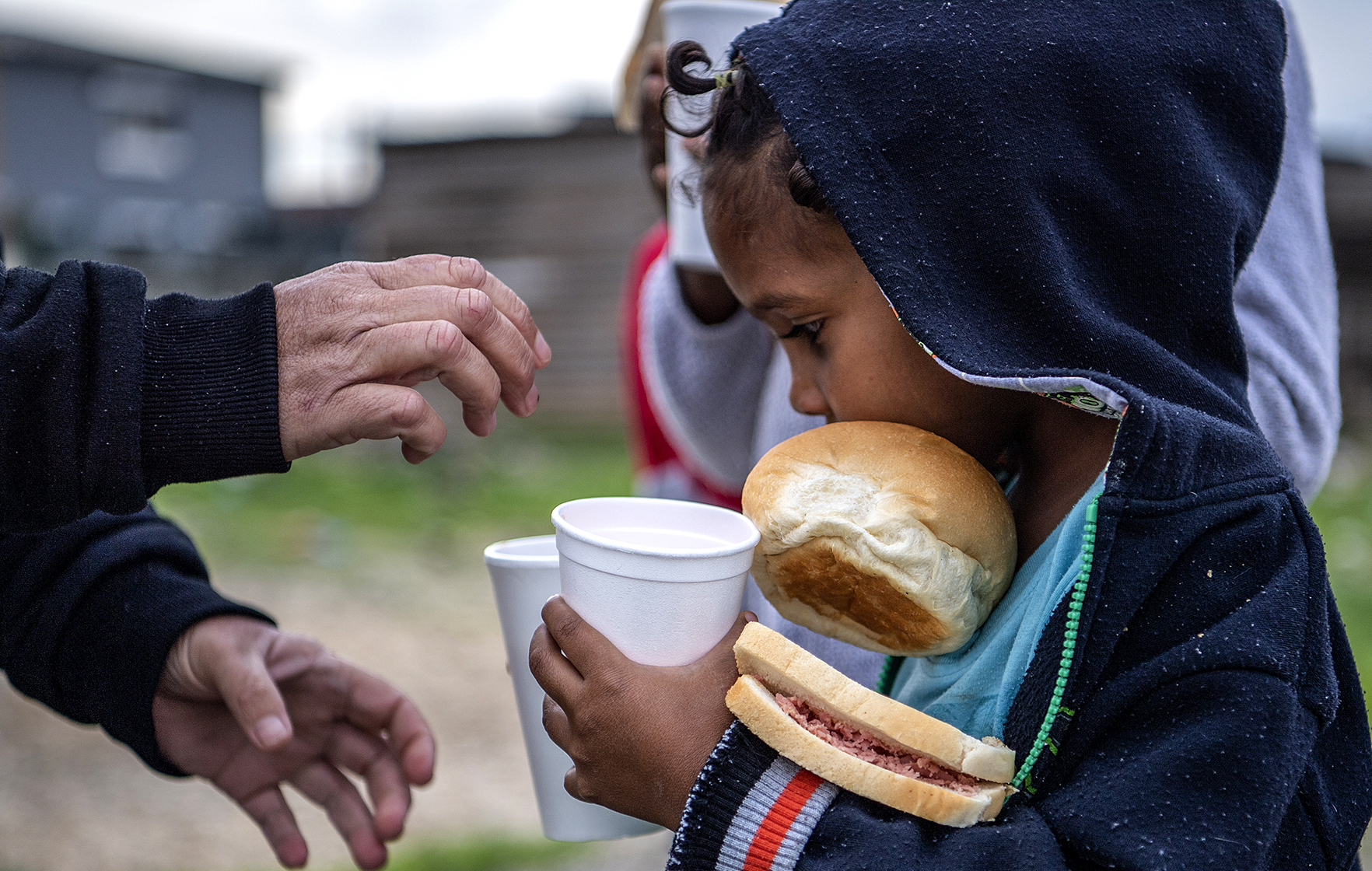
 Children receive a cup of hot soup and a bun at a soup kitchen in Seawinds, Cape Town. (Photo: Gallo Images / Die Burger / Jaco Marais)
Six days before our recent Food Safety Governance Policy Dialogue [3 June 2026], activist Mark Heywood was helping organise a memorandum directed at the government, in particular, aimed at the minister of Agriculture.
A few days later, he found himself sharing a platform with Director-General Mooketsa Ramasodi, senior regulators, industry leaders, consumer protection officials and public health practitioners discussing how South Africa could build a safer food system.
South African public discourse being what it is, one could have expected sparks. Instead, what followed was a lesson in democratic maturity.
Heywood questioned political will. Ramasodi responded thoughtfully, distinguishing between food security and food safety while acknowledging the fragmentation that many stakeholders had come to discuss. The exchange was robust, candid and respectful.
Remarkably, nobody threw a chair [well, almost, but a metaphorical chair, of course]. In fact, by the end of the discussion, there were handshakes, exchanged business cards, shared cellphone numbers and promises of future conversations. Stakeholders who had spent the previous hour challenging one another were suddenly discussing future collaborations.
In SA’s current climate, that may be more significant than it sounds. As moderator of the dialogue, hosted by the Wits Business School’s Food Safety Leadership Initiative (FSLI) at the 2026 Food Safety Summit South Africa, I had a privileged view of something we do not see often enough: People who fundamentally disagree on many things staying in the room long enough to discover where they agree.
And perhaps that is where the real food safety story begins.
Part One: Getting everyone into the room
Following the tragic food poisoning incidents that shocked South Africa in 2024, much has been written about food safety. I was among those who argued at the time that the issue was bigger than contaminated products and isolated failures. The events exposed deeper questions about governance, accountability, coordination and public trust.
Nearly two years later, many of those questions remain. Yet what struck me during the recent dialogue was how little disagreement exists about the diagnosis.
Around the table sat Director-General Mooketsa Ramasodi from Agriculture; Belinda Makafola from the Department of Health; Prudence Moilwa from the National Consumer Commission; Meisie Katz from the National Regulator for Compulsory Specifications (Department of Trade, Industry and Competition); Zinhle Tyikwe of GS1 South Africa; and Mark Heywood from the Union Against Hunger.
Different perspectives. Different mandates. Different constituencies. Yet remarkably similar diagnoses.
/file/attachments/orphans/0357022dac5749e490077a81057ef380_795683.jpg "Agriculture Director-General Mooketsa Ramasodi. (Photo: Supplied)")
Health officials acknowledged capacity constraints and the challenges facing environmental health practitioners. Consumer protection authorities reminded everyone that accountability cannot begin and end with the government. Industry representatives highlighted ongoing investments in standards, traceability and food safety systems.
Heywood challenged both the government and business to confront the realities of hunger, inequality and political will. Ramasodi spoke candidly about fragmentation across the food safety system and the need to rethink institutional arrangements.
Everyone agreed that SA possesses substantial expertise. Everyone agreed that the country has extensive legislation. Everyone agreed that food safety matters. The disagreement lies elsewhere.
SA’s food safety problem is not a science problem
Listening to the discussion unfold, I found myself reaching an uncomfortable conclusion. SA does not have a food safety knowledge problem. Nor does it lack technical expertise. We have committed officials. We have scientists. We have regulators. We have laboratories. We have standards. We have industry capability. We have consumer watchdogs. We have legislation. What we struggle with is coordination.
Responsibilities are spread across institutions. Information sits in different systems. Inspections occur under different mandates. Data exists but is not always shared. Accountability is everybody’s responsibility and therefore sometimes nobody’s responsibility.
The public, after all, does not experience food safety through organisational charts. Consumers do not care which department, regulator, municipality or agency is responsible. They simply expect food to be safe. And they are entitled to that expectation.
The surprising role of a business school
This raises an obvious question. What business does a business school have in food safety? At first glance, very little. Food safety is usually associated with scientists, laboratories, inspectors, regulators, manufacturers and public health professionals.
Yet perhaps that is precisely why business schools have an important role to play. Because beneath the science, the standards, the inspections and the regulations lies something else – leadership.
The more I listened to the discussion, the more convinced I became that food safety is not merely a technical challenge. It is a leadership challenge. Leadership is required when responsibilities are spread across institutions. Leadership is required when different stakeholders have competing priorities. Leadership is required when trust has been damaged and must be rebuilt. Leadership is required when difficult decisions must be taken before a crisis occurs rather than after one.
Most food safety failures are not ultimately caused by an absence of science. They occur when systems fail to communicate, when organisations fail to coordinate, when accountability becomes blurred, or when warnings are not acted upon quickly enough.
Those are leadership failures. And leadership is precisely the domain in which business schools can contribute. Universities do not possess regulatory authority. We do not inspect factories. We do not prosecute offenders. We do not write food safety regulations. Nor should we.
But we can convene. We can challenge assumptions. We can create neutral spaces where difficult conversations can occur. We can help stakeholders see the system rather than only the part of the system they occupy.
The government has authority. Industry has operational expertise. Civil society brings accountability. Consumer organisations amplify public interest. Academia contributes evidence and insight. Leadership is what connects them.
Part Two: Moving from diagnosis to action
The objective of the dialogue was never to solve SA’s food safety challenges in 90 minutes. That would have been naïve. The objective was to begin building a platform where difficult conversations could happen honestly.
By that measure, the event succeeded. Part One has been completed. The government showed up. Industry showed up. Regulators showed up. Consumer advocates showed up. Civil society showed up. The difficult conversations happened. Tick.
The policy dialogue confirmed that SA’s food safety challenge is no longer one of diagnosis. The diagnosis is largely agreed. The challenge now is collective execution.
Part Three: A food safety governance action agenda
The 90-minute dialogue was one year in the making. Building trust across institutions with different mandates, incentives, histories and perspectives is not easy work. It required the government, regulators, industry, consumer advocates, civil society and academia to believe that the conversation would be fair, balanced and worthwhile.
In many respects, the most important achievement was not the discussion itself. It was creating the conditions for the discussion to occur.
The Food Safety Leadership Initiative was established in the aftermath of the 2024 food safety incidents with a simple belief: SA needed a trusted space where stakeholders could engage openly, challenge one another respectfully and work towards practical solutions.
The challenge now is to convert a year of convening into years of collective action. SA must now move from dialogue to a Food Safety Governance Action Agenda. Such an agenda should connect Agriculture, Health, Trade, Industry and Competition, Cooperative Governance and Traditional Affairs, Small Business Development, municipalities, industry, consumer organisations, civil society and academia.
Many food safety failures ultimately manifest at district and municipal level, even when national policy is sound. The role of a business school is not to prescribe solutions. It is to convene leadership, facilitate difficult conversations, encourage evidence-based dialogue, develop a cutting edge curriculum to fill leadership gaps and help build the relationships required to solve complex societal challenges.
For a brief moment, that coalition existed in one room. The task ahead is ensuring it survives long enough to make a difference.
Act One: Complete
The room was convened. The difficult conversations happened. An unlikely coalition emerged. Act Two will be harder. Because the next food safety crisis will not ask whether we had enough meetings. It will ask whether we acted. DM
Ravi Pillay has a 25-year association with the FMCG sector and is a former adviser to the chairperson of Nestlé East and Southern Africa; Co-founder of the Food Safety Leadership Initiative (FSLI); He is currently a Wits Business School faculty member endeavouring to bridge the gap between business and academia; He is also a non-executive board member at Food Forward South Africa.
Comments
Scroll down to load comments...