





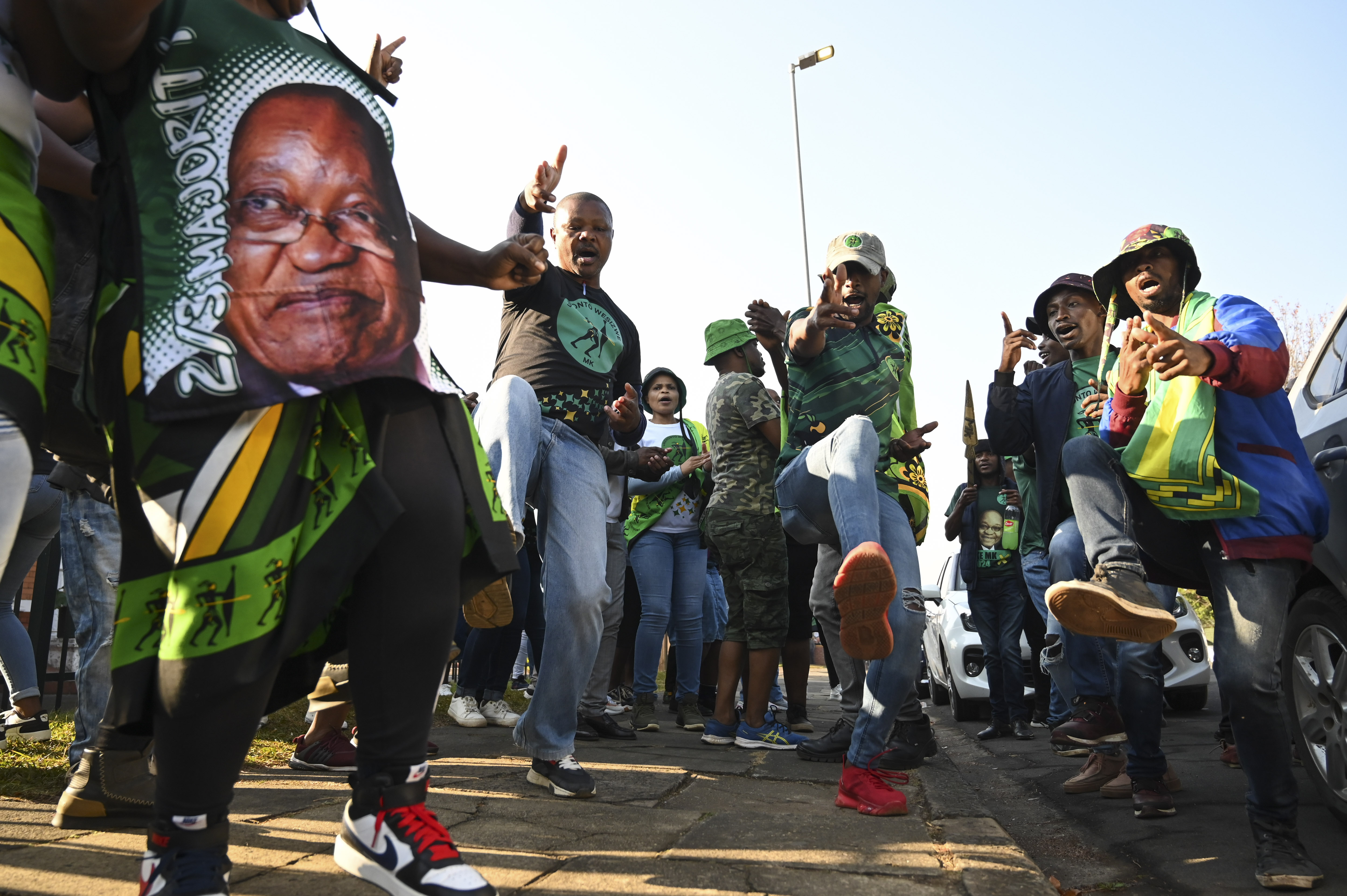
 MK party supporters march on 26 June 2024 in Pietermaritzburg against alleged IEC corruption. (Photo: Gallo Images / Darren Stewart)
 Nearly two years after alleging that the 2024 national election was rigged, the MK party has softened its court challenge, now focusing on a two-hour interruption in the Electoral Commission’s (IEC) results system rather than directly seeking to have the election declared unfair.
Appearing in the Electoral Court on Wednesday, 17 June 2026, the party’s legal team, led by advocate Thabani Masuku, argued that the court should hear oral evidence from technical experts about the circumstances surrounding the outage, which occurred while election results were being processed and displayed to the public.
/file/dailymaverick/wp-content/uploads/2024/06/PM_0416.jpg "Election results reflect on the screen at the IEC Results Operation Centre in Midrand on 1 June 2024. (Photo: Felix Dlangamandla)")
This is rather a big shift from the party’s initial response to the election outcome, when it accused the IEC of vote rigging and questioned the legitimacy of the results, despite getting millions of votes.
In court, however, counsel repeatedly emphasised that the immediate issue was the integrity of the results system, not a declaration that the election itself was invalid.
Focus on the results system
“We accept that committed patriots would love to see an election being managed in a free and fair manner. But we say that if that system that they’re using, that they have employed, if that system is compromised by their own conduct. Through their own decisions, those decisions that are open to doubt and questions. That election cannot be free and fair,” Masuku said.
Masuku emphasised that the court was not yet being asked to determine whether the election outcome should stand.
“I’m not arguing the main case, yet,” Masuku said.
Instead, the focus should be on the integrity of the results system itself, arguing that expert evidence could either vindicate the IEC or reveal more troubling explanations for the outage, he said.
/file/dailymaverick/wp-content/uploads/2024/09/0004.jpg "MK party supporters march on 26 June 2024 in Pietermaritzburg against alleged IEC corruption. (Photo: Gallo Images / Darren Stewart)")
“I’m saying look at the eye on the ball and look at the integrity of the results system. Because with respect, with better explanation from experts on both sides, we could come to the conclusion that in fact the ICC system has integrity and it behaved with integrity, that the downtime that occurred is a normal system failure that happens regularly in systems such as this,” said Masuku.
However, he argued that the court should also consider the possibility that the interruption was caused by something more serious, that the “interference, unnecessary as it was, had something more malignant than simply an innocent, inadvertent, decision to interfere with a live system. The whole country, the whole world was looking at those, those screens, two hours there was nothing,” he said.
Why the MK party wants oral evidence
At the heart of the MK party’s case is the IEC’s decision to carry out what it has described as an optimisation of, or intervention in, the results system. The MK party argues that the decision amounted to an unjustified interference with a functioning live system and should be tested through oral evidence.
The MK party is seeking an oral hearing where technical experts can be cross-examined on why the intervention was carried out and whether it complied with the protocols governing live election systems.
According to the party, the IEC’s own evidence shows that the system was not malfunctioning when the decision was taken.
“The optimisation decision, yes, there was no failure of the system,” the party’s legal team said.
Case should be dismissed — IEC
The IEC has urged the court to dismiss the application, arguing that the litigation forms part of a broader pattern of unsuccessful attempts by the MK party to challenge the election outcome.
Counsel for the commission, advocate Wim Trengove, argued that the case should be struck from the roll, describing it as an abuse of judicial resources and an attempt to cast doubt on the credibility of the electoral process without a factual basis.
Trengove told the court that the MK party had repeatedly failed in its efforts to challenge the election results.
According to the IEC, the party’s first application was dismissed by the Constitutional Court after it waited 10 days before challenging the election results and failed to provide an adequate explanation for the delay. A second application failed because the court found that it had not established a prima facie case, while a third application was later withdrawn, prompting criticism from the court over the party’s conduct.
“Information was made available, but the MKP never availed themselves.”
Trengove argued that the latest application was based on vague and scandalous allegations that appeared to be aimed at eroding public confidence in the electoral process.
“It’s not a genuine search, but [an] unsuccessful opposition who isn’t happy with the results.”
Trengove acknowledged that there had been a problem with the public-facing results website, but maintained that the interruption had no impact on the election outcome.
“There were no interruptions, glitches or flaws of any kind in the results system, and that evidence is uncontradictory, there is no evidence that there was anything more than a glitch in the uplift from the results system into the reporting system,” Trengove said.
He further argued that the debate over the outage was ultimately “irrelevant” because it had no effect, and could not have had any effect, on the actual election results.
According to the commission, the issue was confined to the reporting system used to display results to the public and did not affect the capturing, counting or verification of votes.
‘No basis for oral hearing’
The commission rejected the MK party’s request for oral evidence, arguing that no genuine disputes of fact had been identified.
“There is no general material to justify oral evidence.”
The Electoral Court must now decide whether the questions raised by the MK party warrant a full oral hearing or whether the application should be dismissed, as the IEC has requested.
Judgment was reserved. DM
Comments
Scroll down to load comments...