



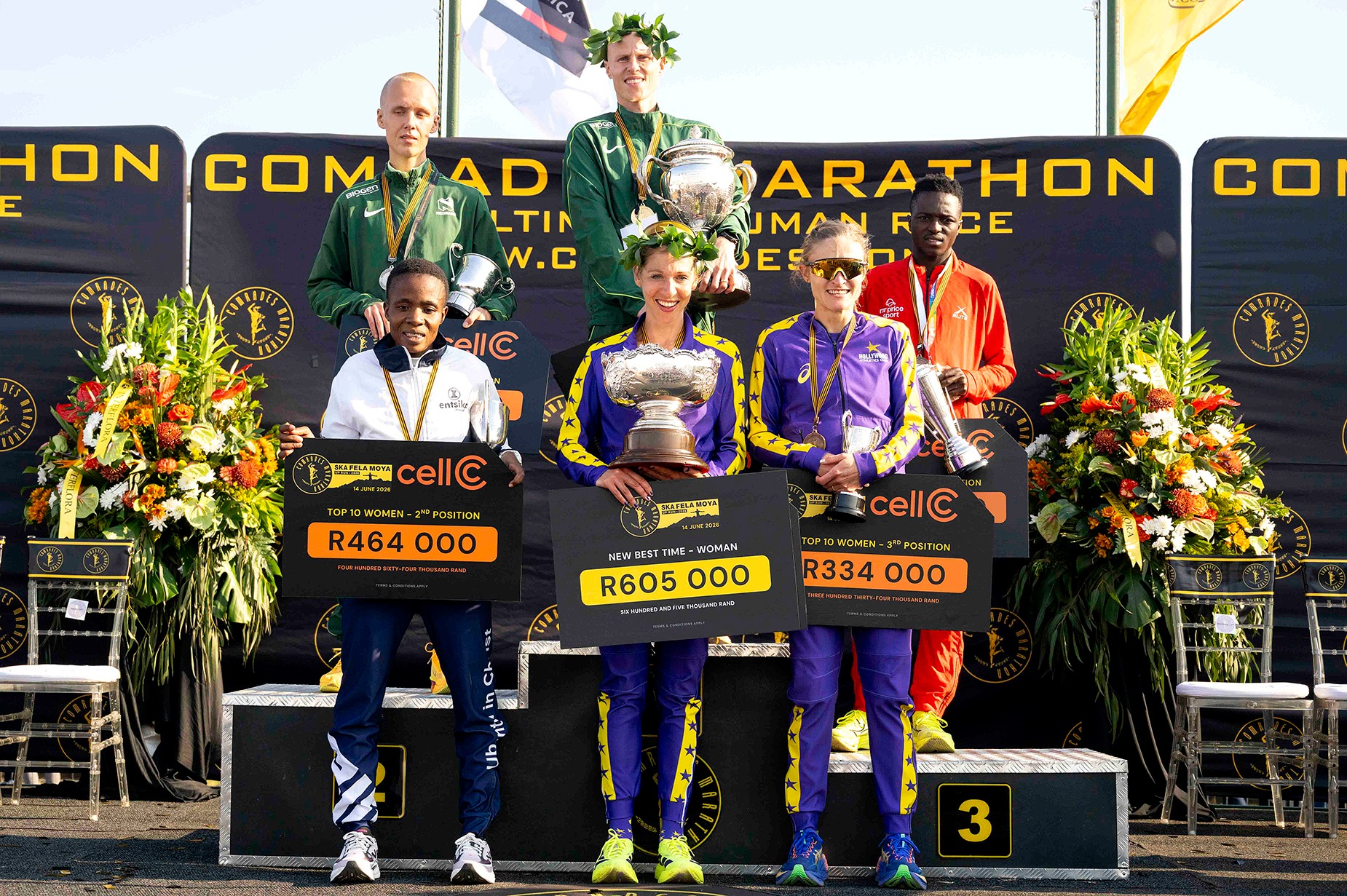
 The Comrades Marathon winners at Scottsville Racecourse in Pietermaritzburg on 14 June. (Photo: Gerhard Duraan / Gallo Images)
The Comrades Marathon is arguably South Africa’s most iconic road race; the ultimate test of human endurance.
It is a gruelling battle of pain and perseverance, where more than 20,000 elite runners and amateurs alike push themselves to the finish line before the unforgiving 12-hour cut-off.
Staging an event of this magnitude, stretching nearly 90km between two cities, is a massive logistical undertaking.
Considering the scale of the event, the Comrades Marathon still remains remarkably well organised. Speaking to General Manager Alain Dalais prior to the race on 14 June, he told Daily Maverick the Comrades Marathon Association’s (CMA) main focus was on runner safety and experience. Inevitably, however, there would be challenges.
On the ground, concerns emerged when water reportedly ran out at the first five refreshment stations, spanning 14km, for runners in Group 3 – this year the race had a three-group start process whereby each group was dispatched in 15-minute intervals.
According to a runner in Group 3, people were picking up any sealed and full sachets they could find off the floor and someone even broke off ice blocks just so the runners could hydrate.
/file/attachments/orphans/Winner3_GerdaSteyn_910480.jpg "Gerda Steyn claimed her third ‘up run’ title and fifth Comrades Marathon win overall in the 2026 edition of the race. (Photo: Supplied / Comrades Marathon Association)")
Meanwhile, for those unable to experience the race in person, the production and broadcast was mired in technical issues and broadcast mishaps. This year, the event was broadcast on the country’s public broadcaster SABC and streamed live on YouTube, making the race accessible to international audiences for the first time.
A special moment was lost, however, when men’s winner and record-breaker George Kusche was interviewed after crossing the finish line. Viewers could see the interview taking place, could see Kusche’s emotion as he held his wife and child, but could not hear a single word being said.
When five-time champion Gerda Steyn was interviewed, overlapping audio from another source drowned out her voice. When she finally could be heard, intermittent static and sound distortion made it difficult to follow.
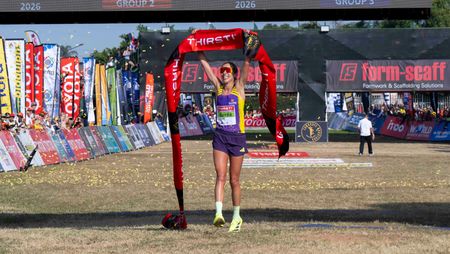
Additionally, at the start of the race it was difficult to determine who the lead woman was. The broadcast spent an extended period focused on Dikeledi Majara despite her being in fourth place.
Other issues included commentators’ audio overlapping with race interviews, cameras pointed aimlessly at nothing in particular and lagging and freezing reportedly on SABC 2’s live feed.
And people were not happy, taking to social media to vent their frustration, describing it as an embarrassment for SA and for Comrades.
And truth be told, it was. At times, the livestream was really difficult to watch.
/file/attachments/orphans/TL_2579110_839072.jpg "George Kusche celebrates his historic and record-breaking Comrades win with his family. Kusche broke Russian Leonid Shvetsov's 2008 record of 5:24:49 by almost nine minutes when he clocked 5:15:56 to claim a maiden Comrades victory on 14 June. (Photo: Gerhard Duraan / Gallo Images)")
The production company in charge of the broadcast that streamed live on the Comrades Marathon official YouTube channel was T+W. They are known for their work on documentaries such as Chasing the Sun and The Down: A Comrades Story.
“First and foremost, we certainly don’t take this responsibility lightly,” Jack Davis, chief operating officer of T+W, told Daily Maverick. “Myself and my partner, Gareth [Whittaker], we’re both green number runners. A lot of the people on the project are experienced Comrades runners, and so we understood the gravitas of the job at hand.
“As T+W, we are going to review and debrief and watch every single second again and continue to build and grow.”
The blame game
In previous years, SuperSport served as the principal broadcaster of the ultra-marathon. However, earlier this year Athletics South Africa (ASA) opted not to renew its agreement with the Canal+ owned pay television network.
Instead, the national athletics governing body sold the rights to the SABC “without consultation with the CMA”, said a joint statement between T+W and CMA sent to Daily Maverick.
Other events, like the CMA, are in a legal dispute with ASA over the legality of the arrangement. According to the statement, as the holder of the event’s broadcasting rights, ASA’s decision led the CMA to pursue an alternative arrangement.
The CMA approached T+W in March to produce a live stream of the race, said Davis.
At the time, there was no broadcast agreement between Athletics South Africa and the SABC.
“ASA only informed the CMA in mid-April of the arrangement, and the SABC only provided its technical requirements in early June,” said the statement. “Given the short timelines, and to ensure that the race was accessible to as many people as possible, the CMA board decided to proceed with its own livestream production for YouTube and its social media platforms.”
/file/attachments/orphans/TL_2579088_730764.jpg "Five-time Comrades winner Gerda Steyn celebrates with spectators after her historic victory on 14 June. (Photo: Gerhard Duraan / Gallo Images)")
The production company did the commentary and graphics for the livestream on YouTube. When the CMA offered the full production to the SABC, the public broadcaster elected to use only “the clean feed” as Davis put it, meaning it declined the use of T+W’s data, broadcast graphics and commentary.
The result was “two distinct viewing experiences” of the Comrades Marathon, said the statement. This led to outcries of frustration on race day from SABC commentators regarding the coverage, saying they relied on a “world feed” that was “out of our hands”.
Storytelling vs execution
According to Davis, the production involved a fleet of four drones, motorbike cameramen following the leading men and women (well, should have been), as well as a lead camera at the front of the field.
Additionally, there were cameras positioned at major landmarks of the race such as Polly Shortts, all combining to a total of 40 cameras. On top of that, T+W ran a separate platform where viewers could access live static camera feeds from 20 additional positions, including the finish line.
“A big part of our manifesto was that we wanted to be within the race,” said Davis. “We really wanted to make sure that we could tell the authentic story of Comrades from within. Where in the past Comrades has been very observational, this year we really wanted to get within and tell stories, which I felt we were ready to achieve.”
/file/attachments/orphans/Winner2_GeorgeKusche_241804.jpg "George Kusche lived up to pre-race expectations as he took the men’s win and shattered the ‘up run’ record in the 2026 Comrades Marathon. (Photo: Supplied / Comrades Marathon Association)")
On YouTube, the stream was viewed in more than 50 countries with 389,000 hours watched across the day and attracting approximately 742,000 unique views, said the statement.
Interwoven throughout the YouTube livestream were narratives that define the sentiment and history of Comrades, from the mythology about “Arthur’s Seat”, which every runner dares not pass without a pat on the wall, otherwise risking a race ruined, to the Wall of Honour and story of the legendary and dominant Bruce Fordyce.
“From an overall impressions point of view, I’m very happy that we had 14 hours of continuous broadcast,” said Davis. “We didn’t have any picture issues at all. Granted, we had some sound issues. But we streamed for the last 14 hours, which in itself is a real win.”
Comrades remains one of SA’s great sporting spectacles and, by most measures, an organisational success. Yet its stature also demands accountability.
The shortcomings were not caused by a lack of ambition and commitment. T+W attempted to modernise the broadcast and tell richer stories. But when viewers around the world tune in to watch records fall and champions crowned, a focus on the basics is what matters most.
Spectators need to be able to hear the winner speak, and see who is leading the race. DM
Comments
Scroll down to load comments...