




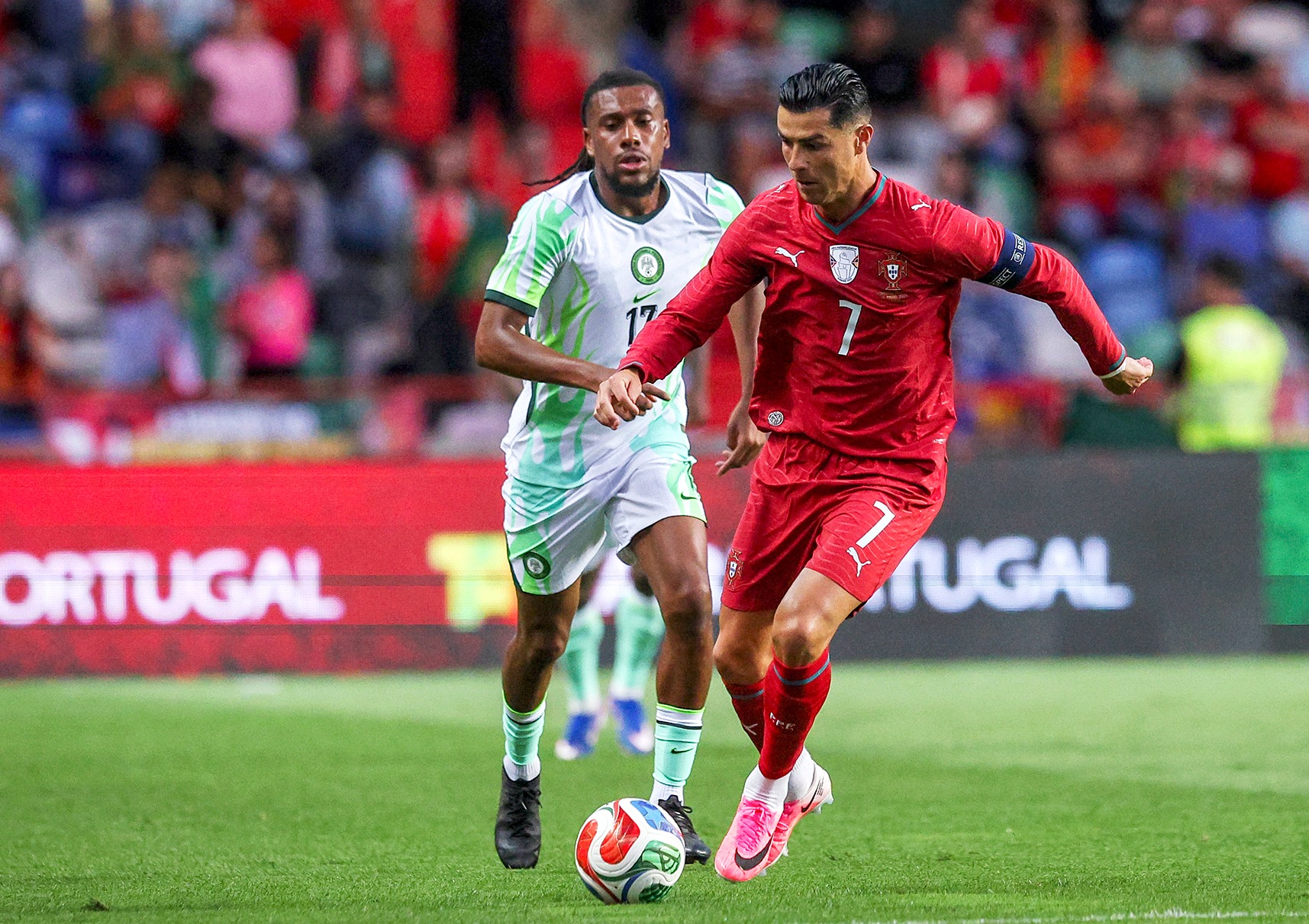
 Cristiano Ronaldo of Portugal is playing in his sixth World Cup. (Photo: Carlos Rodrigues / Getty Images)
Portugal
The plan
Portugal secured their ninth World Cup appearance, and their seventh in a row, with relative ease, even if a home draw against Hungary in October and a defeat in Ireland in November delayed the celebrations until the final matchday. In that final game, Roberto Martínez’s side (without Cristiano Ronaldo, who had been sent off in Dublin) thrashed Armenia 9-1.
Variability is the key quality here. Martínez is capitalising on the tactical versatility of his squad: João Neves and Matheus Nunes can operate as full-backs or midfielders (sometimes both in the same match); João Cancelo and Diego Dalot play comfortably on either flank; and Bruno Fernandes and Bernardo Silva constantly rotate roles. Despite this fluidity, the coach’s selections remain stable. While call-up surprises are rare, the starting XI has at least seven “untouchable” spots. The backbone is well-defined, led by figures such as Diogo Costa, Rúben Dias, Bruno Fernandes, Bernardo Silva, and Ronaldo, with Nuno Mendes and Vitinha also serving as undisputed starters.
“We won 10 games in a row on the road to Euro 2024, but the team wasn’t as prepared then as it is now. Challenges help you grow,” Martínez noted after qualifying. “Back then, we lacked the resilience needed to win titles. In the Nations League, it was different. We reacted when Germany scored, when Spain scored, and we won the tournament. That is where we are now. We must prepare well.”
The head coach wants his players to give everything and bring the values of the Portuguese people to the pitch, but there is also a more personal mission this time around after the tragic events of 2025. “It is a responsibility to fight for Diogo’s dream,” says the coach, who, since the deaths of Diogo Jota and his brother André Silva in a car accident, has included the former’s name on his squad announcements. “He [Jota] is our strength and our joy. His spirit, his strength and his example are the driving force, and they always will be.”
/file/attachments/2993/2282071299_906056.jpg "Roberto Martinez, head coach of Portugal. (Photo: Molly Darlington / Getty Images)")
The coach
Roberto Martínez was close to leaving the national team a year ago (with José Mourinho waiting in the wings), but winning the Nations League earned him a vote of confidence from the new FPF president, the former international referee Pedro Proença. Although he suffered his first-ever defeat in a qualifying phase after 43 matches, the Spanish coach secured his third World Cup appearance, having gone twice with Belgium, without much stress. However, this doesn’t mean the cycle with Portugal won’t end this summer, even with success. “The president and I are aligned: the focus is the World Cup. It’s not a matter of wanting or not wanting; it’s not on the table. The World Cup cannot wait, but the manager’s situation can,” he said in March, keeping the mystery alive.
Star player
It seems unlikely that he’ll celebrate his 1,000th career goal during this World Cup, but being so close to that milestone speaks volumes about the ambition of Cristiano Ronaldo.
/file/attachments/orphans/GettyImages-2280305132_954597.jpg "Cristiano Ronaldo of Portugal. (Photo: Carlos Rodrigues / Getty Images)")
At 41, he is participating in the tournament for a record sixth time (with 22 matches and eight goals in previous editions). Already a legend, the captain symbolises the hunger of a nation wanting to pair a World Cup trophy with their Euro 2016 title. He remains a magnet for fans and defenders alike, destined to inspire chants, selfies and viral moments. “The dream ended,” Ronaldo wrote on social media in 2022 after Portugal’s quarterfinal exit against Morocco.
Four years later, the forward returns to attack “the biggest and most ambitious dream” of his career one last time. No one is willing to bet on when this incomparable journey will end.
“People think when I talk about retiring soon, it means in six months or a year. I’m joking!”
One to watch
“Inácio was a backup left-back for the Under-23s and Under-19s. Some players can surprise you.” Those are the words of Ruben Amorim, the man responsible for Gonçalo Inácio’s rise at Sporting CP.
Despite his discreet and introverted nature, the centre-back became a pillar for his club and one of its captains. He sheds his shyness with every vertical, line-breaking pass, a trademark skill that will be vital for Portugal in this World Cup. Having already featured at Euro 2024 and played a part in last year’s Nations League win, he enters this tournament with bolstered status as the primary candidate to partner Rúben Dias in the heart of the defence.
/file/attachments/orphans/2280332137_296030.jpg "Gonçalo Inácio of Portugal passes the ball in a match against Nigeria on 10 June 2026 in Leiria, Portugal. (Photo: Luis Loureiro / Eurasia Sport Images / Getty Images)")
Unsung hero
He may still have fans to win over globally due to the lower visibility of the Portuguese league, but Diogo Costa is a guarantee of safety. The Porto captain is a worthy successor to Vítor Baía for both club and country. Portugal’s No 1 since 2022, he is heading into his second World Cup.
Cat-like between the posts and exceptional with his feet, he is also a penalty-saving specialist; he famously stopped three consecutive penalties against Slovenia in the Euro 2024 round of 16. “Portugal’s secret is Diogo; he is European football’s best-kept secret,” Martínez said at the time. Costa was equally decisive in the Nations League final a year ago, saving a crucial Spanish penalty.
What to expect from fans at games?
While a World Cup in North America is expensive, Portuguese fans are fiercely loyal. They will be present in large numbers, especially as the team progresses. They might not always dominate the stands numerically, but their presence will be felt.
While some supporters can’t leave club rivalries behind (even in their choice of attire), the green and red of the flag will predominate, often seen on jerseys bearing Ronaldo’s name. Support is typically loud but non-aggressive, characterised by encouraging chants and a touch of humour. Portuguese fans are generally relaxed, peaceful, and leave a positive impression on host countries.
Relations with the US/Trump?
Donald Trump divides opinion in Portugal just as he does elsewhere. The use of the Lajes Air Base (Azores) for American military operations remains a point of political debate. The Federation has sought to avoid delicate debates regarding the tournament’s organisation, with fans focusing more on the high cost of tickets and travel. While Trump rarely mentions Portugal specifically, he hosted Cristiano Ronaldo at the White House in November during a visit by Saudi crown prince Mohammed bin Salman. By Nuno Travassos
The Democratic Republic of Congo
The plan
The team’s transformation under Sébastien Desabre can perhaps be summed up by one sentence the coach said to me in an interview: “Discipline must begin on the pitch.” The Frenchman has imposed structure on a national team long associated with chaos and inconsistency.
More than a traditional coach, Desabre operates almost like a manager in the English sense of the term, obsessing over details ranging from defensive positioning to the federation’s communication strategy. So far, it has worked.
Initially favouring a 4-2-3-1 after taking charge in 2022, Desabre has gradually evolved his tactical approach. The DRC now most commonly play in a compact 4-1-4-1 with a deep holding midfielder, two energetic No8s given freedom to press and carry the ball, and a hard-working striker, usually Cédric Bakambu, constantly stretching defences with his movement.
/file/attachments/orphans/2281484344_961266.jpg "DR Congo head coach Sébastien Desabre. (Photo: Maria Lysaker/Getty Images)")
The Leopards are also comfortable switching to a back three, used notably during qualifying against Togo and South Sudan. With ball-playing defenders such as Axel Tuanzebe and Chancel Mbemba, plus wing-backs like Arthur Masuaku and Aaron Wan-Bissaka, the system allows the team to play more aggressively.
The main criticism of Desabre remains the attack, as the DRC rarely dominate games aesthetically or create freely in open play. But defensively, they have become extremely difficult to break down. Under Desabre, at the time of writing, they have never lost by more than one goal. That resilience defined qualification. Cameroon eliminated late. Nigeria beaten on penalties. Jamaica defeated in the 99th minute of the intercontinental playoff. Convincing? Not always. Mentally strong? Absolutely.
The coach
Sometimes nicknamed “Tatu Seba” by Congolese fans (“Papa Seba”), Sébastien Desabre arrived in 2022 carrying years of African football experience gained in Uganda, Egypt, Morocco, Tunisia, Angola, Ivory Coast and Cameroon.
The former Niort coach then left Ligue 2 to take on one of the continent’s most talented, and structurally complicated, football nations. “DR Congo is a true football country,” he told Afrik-Foot after qualification. “People love their national team and are proud of it.”
Pragmatic by nature, Desabre believes in continuity and stability above all else. Veteran striker Cédric Bakambu credits him with finally giving the Leopards “a framework”. More importantly, he has built a united squad around a clear collective identity, something DRC had lacked for years.
Star player
After missing the Africa Cup of Nations to regain rhythm following a knee injury, Yoane Wissa arrives at the World Cup carrying huge expectations. Nicknamed “Kovo” (“the bald one”) by Congolese supporters, the Newcastle forward became the first player from the DRC to score more than 10 Premier League goals in a single season during his time at Brentford.
/file/attachments/orphans/2279785914_327257.jpg "DR Congo star Yoane Wissa. (Photo: Pau Barrena / Getty Images)")
Usually deployed from the left in the national team, Wissa combines pace with intelligent movement and relentless pressing. His first season at Newcastle was disrupted by injuries, but when fully fit, he remains the Leopards’ most dangerous attacking weapon and their biggest international star.
One to watch
There is something unusually elegant about the way Ngal’ayel Mukau plays football. Tall, technically refined and blessed with a decent left foot, the Lille midfielder glides through games with a calmness that feels rare for a 21-year-old. He can recover possession, escape pressure, progress the ball and suddenly accelerate attacks with one touch. Belgium tried hard to keep him, but instead Mukau committed early to the DRC, becoming one of several highly rated Belgian-Congolese youngsters helping reshape the future of the national team.
Already linked with clubs such as Barcelona, Mukau could emerge from this tournament as one of African football’s next breakout midfielders.
Unsung hero
He never scores or assists. Yet few players are more important to the side than Samuel Moutoussamy. The midfielder is the engine of Sébastien Desabre’s system: pressing, intercepting, covering spaces and recycling possession endlessly with remarkable discipline.
Not spectacular, but relentlessly dependable, Moutoussamy sets the emotional tone of the team through his intensity and sacrifice. “We’ll leave our souls on the pitch,” he told Leopardsfoot before the playoff against Jamaica. “We can’t play with fear.” That mentality perfectly captures the spirit of this Congolese side: resilient, combative and emotionally charged.
/file/attachments/orphans/2268905668_804369.jpg "Samuel Moutoussamy (left) of DR Congo fights for the ball with Bobby De Cordova-Reid of Jamaica. (Photo: Simon Barber / Getty Images)")
What to expect from fans at games?
Even before the recent Ebola outbreak, travelling to the United States was already extremely difficult for most Congolese supporters because of visa restrictions and financial barriers.
As a result, the team will rely heavily on its diaspora, particularly in Texas and across North America. Fortunately for the Leopards, Congolese fans are known throughout Africa for bringing atmosphere everywhere they go.
Expect dancing, singing, extravagant outfits, painted faces and endless energy. Football culture in Congo is deeply tied to music and celebration, and supporters are famous for their humour and entertainment. The famous superfan “Lumumba Vea” – known for standing still, one arm raised, for 90 minutes in tribute to the iconic statue of the Congolese independence leader Patrice Lumumba, had his visa application for Mexico rejected in March, but is still hoping to make the trip after government intervention.
Relations with the US/Trump?
Currently positive, largely because the Trump administration has attempted, with mixed success, to position itself as a mediator in the conflict in eastern Congo. In return, the US has shown growing interest in securing access to Congo’s vast mineral wealth, a strategy that has been described as “peace in exchange for extraction”. At the National Prayer Breakfast in Washington in February, Donald Trump described President Félix Tshisekedi as “a courageous and wonderful man” before quickly praising the economic opportunities Congo represents.
The relationship remains pragmatic rather than emotional. Ordinary Congolese supporters still face enormous obstacles in obtaining US visas for the World Cup. By Louis Mukoma
Colombia
The plan
Today’s selección Colombia still have a core of players that are fondly remembered from the Brazil and Russia World Cups in 2014 and 2018. A few are taking part in their third tournament, led by James Rodríguez, still a key figure in a side whose 4-2-3-1 formation is built around his No 10 position. There is support out wide, where Luis Díaz has become a source of goals, though not to the extent to which he shines for Bayern Munich.
Colombia had a rollercoaster ride to this World Cup. Their qualification campaign included moments of glory, like the 2-1 victory against Brazil or the revenge over Argentina for their 2024 Copa América final defeat. But then came a 1-0 loss in Bolivia that started a run of six matches without a win and endangered their place in the finals. In the end, two thrashings of Bolivia and Venezuela sealed their spot.
Doubts over the team remain after disappointing friendly performances against Croatia and France in March, but the coach, the 60-year-old Néstor Lorenzo, is optimistic. “The way Colombia play – trying to play on the front foot, not hiding – gives me satisfaction,” he told La Nación in his native Argentina. “The idea is to play well, not just win at any cost. And the team feel that: they believe in the idea, and here we are. Let’s hope we start well and can put together the best World Cup in Colombia’s history.”
The coach
In the fifth World Cup of his career, Néstor Lorenzo will lead a team as head coach for the first time. He played for Argentina in 1990 and was assistant to José Pekerman with Argentina in 2006, and again with Colombia in 2014 and 2018. “José has been like a father to me,” Lorenzo said. “I’d barely got my coaching badges when he brought me on to the national team staff. He’s known me since I was little, almost always as a coach, but he also coached me in the Argentinos reserves.” Aside from Colombia, the only other team Lorenzo has led was Melgar de Arequipa in Peru. That hasn’t stopped the former Swindon defender from doing a good job.
Star player
Luis Díaz arrived on the scene after the 2018 season and had to wait to become Colombia’s most important player. He became a household name at the 2021 Copa América in Brazil, firing Colombia to the semifinals with a tournament-best goal haul of four. Now 29, the former Liverpool winger has grown in maturity and was sensational for Bayern Munich this season. “I know we have a great selección, a great team, great coaches. Qualifying was decent for us because we got some very big results,” Díaz told ESPN.
/file/attachments/2993/2278042104_593671.jpg "Colombian star Luis Diaz had a stellar season with German club FC Bayern München. (Photo: Christian Kaspar-Bartke / Getty Images)")
One to watch
Andrés Gómez has only played a handful of games for Colombia, but he has hit the ground running. On his first cap in December 2023, he scored the winning goal against Mexico and struck a late equaliser away at Uruguay in a game that Colombia ended up losing. The Vasco da Gama forward is a bit of a late bloomer but, at 24, he is now mature enough to be a credible alternative to Jhon Arias or even Luis Díaz. Had a very tough start to life. “As I kid, I grew up watching some of my friends get killed and saw others follow the wrong path. But my whole family has always been into football,” he wrote in Chocó 7 Días.
/file/attachments/orphans/2268540249_457100.jpg "Andres Gomez of Colombia. (Photo: Leonardo Fernandez / Getty Images)")
Unsung hero
The man who brings balance to Colombia is Jefferson Lerma, who did not come through the system at any of the domestic big clubs. He earned his move to Europe from the modest Atlético Huila and was a surprise pick in José Pekerman’s squad for the 2018 World Cup in Russia, having not played a part in qualifying. Now the Crystal Palace man is a certain starter in midfield alongside Richard Ríos. The Benfica star may be in charge of providing the fireworks, but it is Lerma’s job to cover the spaces and do the dirty work.
What to expect from fans at games?
Colombia’s supporters are among the most loyal in the world. They filled stadiums in Brazil and even Russia. The fact that there are lots of Colombian immigrants in Mexico and the United States, although less so in Canada, guarantees a sizeable presence of “yellow fever” at this World Cup. The group game against Portugal in Miami is the second-most requested match for tickets at the tournament behind the final. That being said, Colombian fans will have to be careful because they will be watched closely by the authorities after the unrest in the stands at the 2024 Copa América in the US.
/file/attachments/2993/2281979657_966876.jpg "Colombian fans show their support ahead of the Fifa World Cup 2026 Group K match against Uzbekistan. (Photo: Jaime Lopez / Jam Media / Getty Images)")
Relations with the US/Trump?
The national team is yet to get dragged into what is a fairly difficult relationship between Donald Trump’s administration and the Colombian government led by Gustavo Petro. President Petro had his American visa revoked – since reinstated – and he and his inner circle were, in October 2025, placed on the US government’s “Clinton List” (The Treasury Department’s Office of Foreign Assets Control). The US Treasury accused Petro of presiding over a “disastrous and ineffective” drug policy. Meetings between the two countries have since calmed the tensions. Petro denied he had threatened to pull Colombia out of the World Cup if Israel qualified after rumours circulated on social media. By José Orlando Ascencio
Uzbekistan
The plan
It has been quite a journey. When Srecko Katanec took charge of Uzbekistan in 2021, he introduced an effective 3-4-3 system, and his successors, Timur Kapadze and now Fabio Cannavaro, have decided to stick with it.
The first round of qualification was easy. In a four-team group, they saw off Turkmenistan and Hong Kong and held Iran to two draws. The second round was favourable, too. Uzbekistan avoided being drawn against giants such as Japan, South Korea and Australia, and their away games were relatively nearby. Their away fixture against North Korea was played in Laos, with the Uzbekistan team arriving by chartered flight.
Across both rounds of qualification, the White Wolves lost just one of their 16 games, a 3-2 defeat in Qatar. All four games against Iran, one of Asia’s heavyweights, ended in draws. Utkir Yusupov, Uzbekistan’s No 1 goalkeeper, made a particularly significant contribution to the side’s historic qualification, saving penalties in the two matches against North Korea.
The deterioration of Katanec’s health during the qualifiers came as a surprise to everyone. The Slovenian was unable to fly to Tashkent for some of the matches as a result. “If I leave the national team for the third time due to health reasons, I will never return,” Katanec said in the summer of 2024. He resigned in January 2025 and was replaced by Kapadze, who led the Uzbekistan Olympic team to Paris 2024 for the first time in history. Katanec said his successor “finished the meal I started to prepare”.
After securing a place at the World Cup, the Uzbekistan football association planned to bring in a foreign coach. Cannavaro was selected from several candidates and signed an initial two-year contract. “I’m happy to be given this opportunity, it is a great honour. I came here not to change everything, but to continue the work that has been started,” the 2006 World Cup-winning captain said on the day he arrived last year, a few months after qualification had been assured.
The coach
Fabio Cannavaro played a total of 18 matches at the 1998, 2002, 2006 and 2010 World Cups, lifting the trophy in Germany. He’s second only to Gianluigi Buffon’s 176 caps for Italy. However, he has not achieved great results as a coach. In four years in charge of Guangzhou Evergrande, he won just one Chinese Super League title, while his reign as China’s head coach lasted just two games. Then there were more short spells at Benevento, Udinese and Dinamo Zagreb. “I have played many games on the field where I thought I had given everything,” he has said. “But after hanging up my boots and starting my coaching career, I realised that 90 minutes on the field can never be compared to the life of a coach.”
/file/attachments/orphans/2269086434_427475.jpg "Fabio Cannavaro, head coach of Uzbekistan, captained Italy to World Cup triumph in 2006. (Photo: Anvar Ilyasov / Getty Images)")
Star player
Abdukodir Khusanov is by far the most recognisable face in the Uzbekistan side – the country’s first player to appear in the Champions League, Premier League or Ligue 1. His father, Khikmat Khoshimov, also played as a central defender.
At 17, Khusanov went to play for Energetik-BGU Minsk in Belarus, but could only train, with foreign players not allowed to play competitively until the age of 18. “In Belarus, I suffered away from my parents, often there were training sessions three times a day. If there was heavy snow in winter, we would clear the field ourselves and then train,” he says.
During a whirlwind 2023, when Khusanov won the Under-20 Asian Cup with Uzbekistan and earned his first senior cap, Lens came calling. Within 18 months, the shy youngster was at Manchester City. “He is a top signing,” Pep Guardiola said. “He is so coachable. He is always training good and gives 100%.” The 22-year-old has won the FA Cup and League Cup this season.
/file/attachments/orphans/2279473537_707262.jpg "Uzbekistan’s Abdukodir Khusanov heads the ball in a friendly against Canada. (Photo: Jeff Vinnick / Getty Images)")
One to watch
Born in 2007 in the Namangan region, Behruz Karimov has always been impatient to progress.
“I’ve been playing football since I was six years old. When I was in high school, I was rejected by the Under-19 team of Navbahor because I was too young. After that incident, I started trying to prove that age is just a number.”
Last year was a great one for the teenage right-back. In March, he made his debut for Surkhan in the Uzbek top flight. In October, he scored his first goal. And last January, at the age of 18, he participated in the Under-23 Asian Cup, scoring against South Korea, and soon earned his first senior call-up.
After breaking his toe playing for Surkhan in April, he underwent surgery but recovered in time for the World Cup. A year ago, the 18-year-old would not have dreamed of this.
“After the injury, I was very depressed, but everyone around me supported me. This also helped me get back on my feet faster.”
Unsung hero
Dostonbek Khamdamov played for Uzbekistan at every youth level right through his teenage years, from winning the Under-16 Asian Cup in 2012 to repeating the feat at the Under-23 tournament in 2018. After his brilliant performances for Bunyodkor, Khamdamov, who was named the best young player in Asia in 2015, moved to Anzhi Makhachkala in Russia in 2018, but played only nine games. Back home with Pakhtakor, the winger has won five league titles and three Uzbek Cups across two spells. Having had a spell in the cold with the national team, Khamadov has found himself back in favour under Fabio Cannavaro.
What to expect from fans at games?
Uzbek supporters travelled to a global football tournament for the first time in 2024, descending on Paris for the Olympics. No matter which country they go to, they leave behind only a good name – violence and disorder are not in their makeup. Their most famous song is: “The Temurids have come, the Baburids have come.” This means that the descendants of Timur and Babur – two empire builders in Central Asia – have arrived, meaning business.
Relations with the US/Trump?
The presidents of Uzbekistan and the United States have met several times in recent years, and relations are warm. “Shavkat Mirziyoyev is my friend,” Trump said when they were together at the Board of Peace in Washington in February 2026. “He’s got one of the most difficult names in history, but that’s OK, it doesn’t matter. Your country is doing great. You’re doing great and just no problems. Every time I see him, nope, we’re doing good, no problems.” In November last year, Mirziyoyev told Trump: “In Uzbekistan, we call you the president of the world.” By Narzulla Saydullaev
DM
Comments
Scroll down to load comments...