




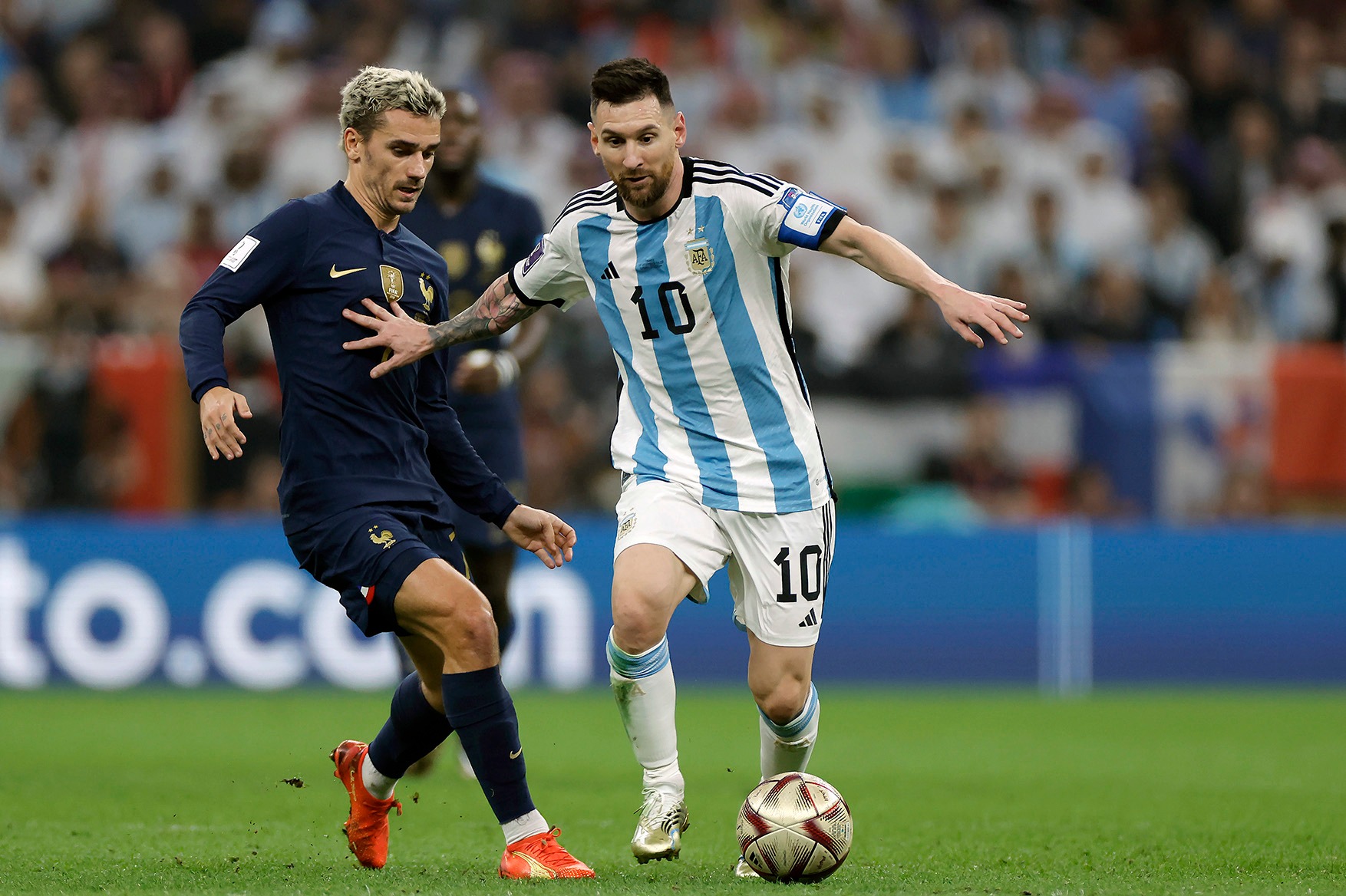
 Lionel Messi and Argentina will be looking to defend the Fifa World Cup title they won four years ago. (Photo: Tom Jenkins / Getty Images)
 Argentina
The plan
The holders arrive at the World Cup with a squad that knows each other almost by heart but perhaps not with its players in peak physical condition – several had injury setbacks at the end of a very demanding season with their clubs. If everyone is fit, the coach will field many of the same players who were crowned champions in Qatar, with the exception of Ángel Di María, who no longer plays for the national team.
Lionel Scaloni’s plan is to keep the 4-3-3 formation, with a solid defence featuring two centre-backs and two attacking fullbacks, plus dynamic midfielders with excellent passing. Lionel Messi leads the charge once more, supported by the formidable Julián Alvarez and Thiago Almada, who could be the breakout star. The squad remains about 75% the same as in 2022, but also includes some promising young players such as Nico Paz, who has been in excellent form at Como. They will also have established stars like Lautaro Martínez, who aims to be in peak condition for this World Cup: something he couldn’t achieve in Qatar.
/file/attachments/orphans/1245722407_722146.jpg "Argentina won their third overall Fifa World Cup in Qatar four years ago. (Photo: Richard Sellers / Getty Images)")
“It will be a very complex and difficult World Cup. We have to prepare the players because what’s coming is going to be tough; you can’t always win,” said Scaloni, who has a lot of confidence in the group, but also knows the difficulty of trying to replicate the success of his brilliant eight-year cycle (which has already yielded three major trophies). “This shirt is demanding. The fans want to see a team that plays good football on the pitch. From there, we know that the best team doesn’t always win,” said the coach who led Argentina to their third star.
Qualifying was a breeze, Argentina finishing top of the Conmebol section, nine points ahead of second-placed Ecuador. It also included a first-ever World Cup qualifying win in Brazil.
The coach
Lionel Scaloni became a world champion coach in 2022 and has also won two Copa América titles. Despite lacking the prestige of coaches such as César Luis Menotti or Carlos Bilardo, he quickly became the most successful coach in Argentina’s history and a beloved figure thanks to his humble personality and close relationship with the players. After serving as Jorge Sampaoli’s assistant during the 2018 World Cup, the president of the Argentinian federation, Claudio Tapia, gave him the chance to coach friendly matches and later confirmed him as head coach, even without previous experience. Scaloni built a strong team, earned Lionel Messi’s trust, and now leads a transition. His family lives in Mallorca, and he often visits his hometown of Pujato in Santa Fe.
/file/attachments/orphans/1451182241_378806.jpg "Argentina coach Lionel Scaloni will be under extra scrutiny with the team being defending champions. (Photo: Marvin Ibo Guengoer – GES Sportfoto / Getty Images)")
Star player
Without a doubt, the best player in the world and the team’s star is Lionel Messi. Even though he is currently playing in a league that is not considered as elite as others, the No 10 and captain remains the man everyone looks to. The difference now is that the team has the confidence to perform well even without him. Messi is the symbol of the squad: everyone plays for him and sees him as an idol, from players such as Rodrigo De Paul and Cristian Romero to younger talents such as Nico Paz. This is a record sixth consecutive World Cup for the 38-year-old and, as always, he will celebrate his birthday during the competition.
One to watch
Como’s Nico Paz, highly praised by his club manager, Cesc Fàbregas, is one of the most talented youngsters on show. He is one of the prospects that the federation followed carefully despite being born in Tenerife, eventually convincing him to represent Argentina. After developing in Real Madrid academy, the son of the former centre-back Pablo Paz won his first cap in 2024. “I was born in Spain. I love both countries, but in the end I chose Argentina, the country that represents me the most, because of its people and the way football is lived there,” the midfielder said.
/file/attachments/orphans/2280807722_219366.jpg "Nico Paz of Argentina. (Photo: Omar Vega / Getty Images)")
Unsung hero
Thiago Almada is already a world champion, but his participation in Qatar was almost symbolic: just a handful of minutes. Now, the 25-year-old born in the same humble Buenos Aires neighbourhood as Carlos Tevez (Fuerte Apache) will have a leading role and will surely be one of Argentina’s standout players. Despite his inconsistent recent form at Atlético Madrid, the Vélez Sarsfield graduate could be the big surprise for Argentinian supporters. Skilful, excellent in one-on-one situations, and with a powerful shot, he will probably take Ángel Di María’s place.
What to expect from fans at games
Argentina fans stood out in Qatar and will do so again in 2026, first in Dallas and Kansas City, and most likely later in Miami. There is a strong connection with the team, especially after winning the World Cup. With Argentina, there will always be a great atmosphere, entertainment and full stadiums. Although some organised fan groups may travel, violence is unlikely because they know the United States is very strict about security.
Relations with the US/Trump?
After Lionel Messi appeared at the White House when Donald Trump invited Inter Miami as MLS champions in March, you could say Argentina has Trump’s support. This is even more relevant considering that Argentina’s president, Javier Milei, a frequent critic of the football federation, is one of Trump’s closest allies. “We must create the century of the Americas: Make Americas Great Again, from Alaska to Tierra del Fuego,” Milei said in February. Argentina players usually avoid getting involved in political matters.
Algeria
The plan
Algeria are one of this World Cup’s great unknowns. On paper, this team has an impressive record of 20 wins, four draws and three defeats from 27 matches at the time of writing, with 66 goals scored under Vladimir Petkovic. The problem with that record is that it has been achieved against generally poor quality of opposition. Algeria’s World Cup qualifying campaign was a cakewalk, with Guinea and Mozambique – both considered Pot C sides on the continent – being their sternest tests.
The most reliable gauge of this team’s true level was the 2025 Africa Cup of Nations, where they produced some of the tournament’s most compelling football. The Fennecs toyed with various formations, playing a classic flat four, reinforcing defence with five at the back and even a 4-3-3 with two full-backs, Rayan Aït-Nouri and Jaouen Hadjam, on the left flank. They pressed intensely, dominated possession statistics, patiently built from goal kicks, and fluidly progressed the ball through defensive lines.
Then came Nigeria in the quarterfinals and everything unravelled. Petkovic’s starting lineup was off, his adjustments arrived far too late, and the inconsistent officiating added another layer of misfortune to an evening where nearly every Algerian player underperformed. The lingering question is whether that collapse was an outlier or a warning sign of how this side responds when the stakes are higher against top opposition. The fact that we don’t have an answer to that question is the main reason Algeria will arrive at the World Cup an unproven commodity.
We are pretty sure that Petkovic will lean on his players’ technical quality, play attractive football, but leave gaps behind the defence. What we don’t know is which players will be called upon for half the starting positions, as well as this team’s ability to perform under pressure.
/file/attachments/orphans/2278944303_489979.jpg "Algeria head coach Vladimir Petković. (Photo: Rene Nijhuis / MB Media / Getty Images)")
The coach
After Algeria suffered a humiliating group stage exit at the 2023 Africa Cup of Nations, Djamel Belmadi, the endearing hothead who had guided Algeria to continental glory in 2019, was unceremoniously shown the door for Vladimir Petkovic, provoking a noxious split in the fanbase between Belmadi loyalists and detractors. Little was known about his Swiss successor beyond his eye-watering salary, but Petkovic wisely surfed through the toxicity with his calm temperament proving to be precisely what the situation demanded.
He spent the first few months in the job smiling, shaking hands and offering platitudes. Yet, that was over two years ago, and while it was acceptable during a transition period, his lack of charisma has become irritating to some. The one unanimous bright spot among his players and the broader Algerian community is his staff appointments. Both assistant coach Davide Morandi and physio Paolo Rongoni enjoy widespread popularity and have impressed in their two years on the bench.
Star player
At the ripe old age of 35, Riyad Mahrez remains Algeria’s star. The 2016 PFA Player of the Year will captain the Fennecs, but he no longer has the legs to play 90 minutes of end-to-end football. During the 2025 Africa Cup of Nations, Mahrez was usually substituted after the hour mark for the younger, more dynamic Feyenoord winger Anis Hadj Moussa. Nonetheless, he remains capable of conjuring spontaneous moments of magic, particularly early in the match. His younger teammates look up to him, understanding they are playing alongside one of Algeria’s greatest ever footballers.
/file/attachments/orphans/2279832415_382542.jpg "Riyad Mahrez remains the Algerian talisman. (Photo: Dean Mouhtaropoulos / Getty Images)")
One to watch
Ibrahim Maza is the quintessential modern attacking midfielder. At just 20, he drifts into pockets of space, receives on the half-turn and progresses the ball with a maturity that belies his age. His low centre of gravity and powerful lower body let him ride challenges with ease, and his end product, both in terms of passing and dribbling, is already at a high level. Comparisons to Florian Wirtz have followed him to Leverkusen, though Maza has arguably translated his talent to the international stage faster than Wirtz settled at Liverpool. He was one of the standout players in the 2025 Africa Cup of Nations group stages, and the World Cup presents the perfect stage for him to introduce himself to a global audience.
Unsung hero
Hicham Boudaoui is not Algeria’s best player, but he could be their most important. If Mahrez, Maza or Aït-Nour pick up niggles, the sky would not fall in as there are ready-made replacements who could slot in seamlessly. Boudaoui, however, offers something that no other Algerian midfielder has: running. The Nice man plays the box-to-box role immaculately, breaking up play before making lung-bursting runs into the opponent’s box. He usually averages between 11km and 12km per match and will be a key, tireless player in the Algerian midfield this summer.
/file/attachments/orphans/2244647269_834056.jpg "Midfielder Hicham Boudaou will be key for Algeria’s World Cup ambitions. (Photo: Xavier Laine / Getty Images)")
What to expect from fans at games?
Most Algerian fans at the World Cup will be from the North American or European diaspora. They’ll be equipped with darbukas and trumpets, so you can expect them to make a healthy amount of noise, especially as they sing their famous, “1,2,3, viva l’Algerie” chant. Older fans will be particularly looking forward to the group stage match versus Austria in an attempt to avenge the Shame of Gijon, when West Germany and Austria colluded to eliminate Algeria at the 1982 World Cup in Spain.
Relations with the US/Trump?
Algeria was a pillar of the non-aligned movement after independence, opting to maintain relations with both the East and West during the Cold War. Recently the bilateral relationship has blown hot and cold. While the United States and Algeria have expanded cooperation in the fields of energy and agriculture, there is still no American ambassador in Algeria as the Trump administration is attempting to put pressure on Algeria and the Polisario Front to accept the Moroccan autonomy plan in the Western Sahara. At the fan level, Algerians – like most other Africans – were subjected to the visa bond programme which stipulates they pay a $15,000 deposit to secure a valid tourist visa. That was waived in May for those with a match ticket. According to the local embassy, very few Algerians have completed the application process to travel to the World Cup.
Austria
The Plan
When Austria were briefly put under pressure during qualifying by a 1-0 defeat away to Romania last year, the home side’s late coach Mircea Lucescu offered a pointed assessment: “Austria have been playing with the same team for years. That can be an advantage, but also a disadvantage, because opponents now know exactly how they play.” Austria’s coach, Ralf Rangnick, was asked about it later and did not sound especially amused.
There was some truth in it. Austria’s plan has been remarkably stable for years. Personnel have shifted here and there, but the spine has barely changed: Christoph Baumgartner and Marcel Sabitzer in attacking roles, Nicolas Seiwald and Xaver Schlager in central midfield, and a defence built around Philipp Lienhart, Konrad Laimer and Stefan Posch. Continuity is one of their strengths.
/file/attachments/orphans/2278616896_809197.jpg "Head coach of Austria, Ralf Rangnick, brings experience and a clear playing philosophy. (Photo: Christian Bruna / Getty Images)")
The core principles, though, remain press and stress. Austria want to stress the opponent, force the pace of the game, win the ball back quickly and turn mistakes into chances. A few years ago that felt fresh and modern; now, high pressing and aggressive counter-pressing are hardly revolutionary, and if the structure slips even slightly, the approach can expose a team badly. Austria, however, almost never loses that balance. They have absorbed Rangnick’s ideas to the point of reflex.
“We have a very ball-oriented approach,” Rangnick said in one interview. “Where the ball is, we create overloads. We sprint at the opponent, close off his passing lanes and force errors and turnovers. And when we have the ball, backward or sideways passes are not our preferred option. We want to play forward.”
Austria knows exactly what they are. More importantly, the players know each other very well. This is a side built less on stardom than on familiarity, trust and collective movement. The players have been together for years, the hierarchy is flat, and they often describe the squad as a family. In football that word is thrown around lightly but, with Austria, it rings true.
The coach
It is not especially easy for a German to win Austrian hearts. Ralf Rangnick has managed it anyway. The 67-year-old has restored something close to footballing pride in Austria, after years of inflated expectations. Long an influential figure in German-speaking football, he made his biggest mark with Red Bull Leipzig, where his ideas helped shape the modern game, even if his spell at Manchester United made less of an impact. Rangnick’s authority lies in his directness: no sugar-coating, no empty phrasing, praise when it is deserved and criticism when it is needed. That can create friction, especially when he challenges long-settled structures, but his results speak loudly. Before Austria’s first World Cup match, he said football “gives the whole country a lift” and added: “We want to enjoy every single game properly.”
Star player
Not the easiest call – and no, that is not because Austria are overflowing with star names. Right now, though, the most important one is probably Konrad Laimer, above all because he plays such a central role for Bayern Munich, still one of the strongest sides on the continent. Laimer is every coach’s dream: he has huge presence, covers ground relentlessly and brings almost everything top-level football demands. What makes him stand out most, though, is his versatility. He can play at left-back, right-back or in central midfield, and do all three at the highest level. His awareness, passing quality, pace and strength in the tackle make him arguably Austria’s most sought-after footballer at the moment.
/file/attachments/orphans/2277432742_701442.jpg "Konrad Laimer brings Bundesliga pedigree to the Austrian team. He plays for Bayern Munich. (Photo: Reinaldo Coddou H / Getty Images)")
One to watch
After years of uncertainty, the news in spring was striking: Paul Wanner had made his choice, and he had picked Austria over Germany. Born in Austria to an Austrian mother and a German father, and holding dual nationality, Wanner had long been regarded as one of the brightest young talents around. The reasons are obvious on the pitch: a superb left foot, vision, precision in his passing and real pace with the ball. Developed in Bayern’s academy, he moved to PSV in 2025, where Peter Bosz reshaped him into a No 6 and he won the title straight away. It is unlikely to be the last of his career.
Unsung hero
Nicolas Seiwald rarely attracts the same attention as Austria’s more eye-catching midfielders, but he may be one of the team’s most important players. In Rangnick’s system, he does much of the unseen work: closing spaces, sustaining the press, winning second balls and giving the side its structure. It said plenty that, against South Korea in March, he was left out of Rangnick’s starting line-up for the first time in three-and-a-half years. He is neat and disciplined on the ball rather than flashy, though he did mark the friendly against Ghana with his first goal for Austria. Seiwald is the kind of player every coach trusts and every team needs.
/file/attachments/orphans/2278767932_294338.jpg "Nicolas Seiwald of Austria. (Photo: Severin Aichbauer / SEPA.Media / Getty Images)")
What to expect from fans at games?
The national team has clearly broadened its fanbase in recent years. Even for a qualifier in Cyprus, 1,700 supporters travelled, which is unusual by Austrian standards. Demand for US tickets has reportedly been high as well. Austria’s fans are generally welcome visitors: only a small minority come from organised club ultra scenes, the crowd is mixed, cheerful and fond of a drink, and language barriers are often ignored. Expect lederhosen, colourful hats and homemade shirts – and a support determined to stay as long as possible.
Relations with the US/Trump?
Statistically, Trump was not entirely wrong when he once described Austria as a kind of “forest city”. Nearly 48% of the country is covered by forest, with around four million hectares of woodland. Within the national team, the tone regarding politics has been cautious. Rangnick criticised Trump back in 2017, but the squad have stayed largely quiet, while ÖFB president Josef Pröll has repeatedly pushed back against boycott talk around the tournament. Perhaps Austria’s approach is best summed up by an old saying: as you shout into the forest, so the echo comes back.
Jordan
The plan
A big summer ahead, as Jordan makes its first-ever World Cup appearance after nine previous unsuccessful attempts. The closest the national team came before was during the qualifiers for 2014, when they reached the intercontinental play-off but lost 5-0 on aggregate to Uruguay.
But this time the story was different. Jordan topped the group in the second round of the Asian qualifiers, collecting 13 points from four wins, one draw and one defeat. They then progressed to the third round, finishing second in Group B behind South Korea to secure direct qualification with a match to spare following a 3-0 victory over Oman. The forward Ali Olwan was the team’s top scorer in the qualifiers with nine goals.
The head coach, Jamal Sellami of Morocco, uses a 3-4-3 formation. Goalkeeper Yazid Abu Laila anchors the side, while the FC Seoul defender Yazan Al-Arab leads the back line alongside Abdullah Nasib and Mohammad Abu Al-Nadi. In midfield, Nizar Al-Rashdan and Nour Al-Rawabdeh provide stability, supported by dynamic wing-backs Issam Al-Samiri on the right and Mohannad Abu Taha on the left.
Sellami’s approach focuses on quick transitions to exploit the pace of star winger Mousa Al-Taamari, who impressed with French club Rennes this season. He is supported by Ali Olwan and experienced forward Mahmoud Al-Mardi. However, Jordan will miss key striker Yazan Al-Naimat, who suffered an ACL injury last December.
While debut nerves may be a factor, Al-Tamari remains confident: “Jordanian players are known for determination and resilience. We do not allow anyone to surpass us.” In North America Jordan will come up against Argentina, Austria and Algeria, and Sellami told Fifa.com: “Facing Messi is a unique experience. This represents a great challenge for our players, and we have our specific set-up for each stage because before the Argentina match, we have two other very important matches. The match against Messi will require special preparation.”
/file/attachments/orphans/2268812826_224547.jpg "Coach Jamal Sellami of Jordan. (Photo: Gerrit van Keulen / Soccrates Images / Getty Images)")
The coach
Jamal Sellami took charge in August 2024, succeeding his compatriot Hussein Ammouta. He quickly made his mark. Under his guidance, the team reached the final of the 2025 Arab Cup, narrowly losing to Morocco on penalties, and to this first World Cup. He previously represented Morocco as a player at the 1998 World Cup, earning 38 international caps and scoring two goals. He moved into coaching in 2011, with one of his notable achievements being guiding Morocco to the African Nations Championship title in 2018. He says of his team: “Ambition, desire and passion are essential. We overcame difficulties, but the focus always remained on the common goal.”
Star player
Known as the “Jordanian Messi”, Mousa Al-Tamari is determined to carve out his own legacy on the World Cup stage. He built his reputation in European football, notably winning the Cypriot league’s Best Player award with APOEL during the 2018-2019 season, leading them to the title.
He moved to OH Leuven in Belgium the following year before joining Montpellier in France, and currently plays for Rennes. He made his Jordan debut in 2016 and by mid-May had 90 caps and 24 goals.
/file/attachments/orphans/2279163148_681222.jpg "Mousa Al-Tamari is highly rated and will be key for Jordan. (Photo: Sona Maleterova / Getty Images)")
One to watch
With Yazan Al-Naimat sidelined due to injury, 20-year-old striker Ibrahim Sabra could be handed a major opportunity. Known for his exceptional physical strength honed through track and field athletics, he excels in aerial duels. He began his career with Al-Wehdat in Jordan before moving to Turkish side Göztepe last summer, where he scored a spectacular overhead kick against Besiktas. Midway through the season, he was loaned to Lokomotiva Zagreb in Croatia.
Unsung hero
Midfielder Nizar Al-Rashdan plays a crucial yet often understated role in Jordan’s midfield. Combining attacking intent with defensive discipline, he has delivered some decisive moments, including the winning goal against Iraq in the round of 16 at the 2023 Asian Cup (3-2), and another winner against Saudi Arabia in the semi-finals of the 2025 Arab Cup. Currently playing for Qatar SC, Al-Rashdan has gained valuable regional experience, including a stint with UAE Pro League side Emirates Club alongside Spanish legend Andrés Iniesta.
What to expect from fans at games?
Sellami says Jordan’s supporters are the team’s “12th player”, a reputation they reinforced during the 2023 Asian Cup where Jordan reached the final before losing 3-1 to Qatar. The Jordanian community in the United States is organising campaigns to support the team, and many are expected to travel despite visa delays linked to the US-Iran conflict. Known for their passionate chants, Jordanian fans traditionally wear the red-and-white keffiyeh.
Relations with the US/Trump?
Jordan’s strong historical ties with the US have been reinforced during the presidency of Donald Trump, who has publicly expressed admiration for King Abdullah II on multiple occasions. But Jordanian fans have voiced concerns over the high cost of World Cup tickets and transportation, especially compared with the smooth and memorable experience many enjoyed while attending the 2022 tournament in Qatar. DM