



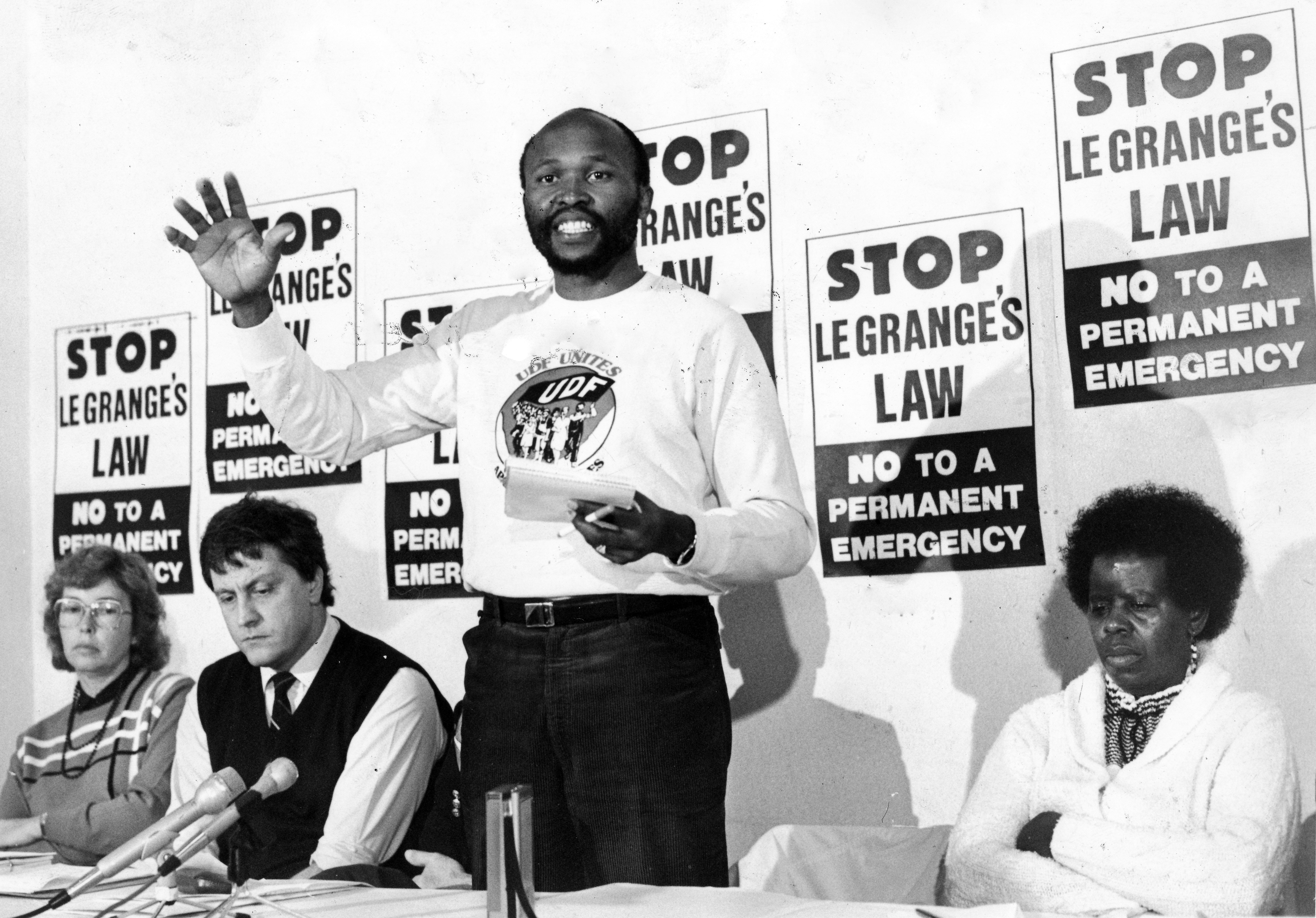
 Murphy Morobe addresses a press conference in 1986. (Photo by Gallo Images/City Press)
Murphy Morobe’s life reads almost like a personal reflection of South Africa’s struggle to end apartheid and its subsequent reconstruction after 1992. I recently spoke with him about the impact on him personally.
Morobe explained that he began developing a political consciousness in earnest once he had transferred to Morris Isaacson High School for his final two years of secondary schooling.
The school’s headmaster, LM Mathabathe, like its young science master, Fanyana Mazibuko, together with several other instructors, had wielded real influence over the students, helping to guide their political thinking in a school where ideas could be discussed – carefully, but well beyond the “Bantu Education” syllabus.
As Mazibuko described the school’s ethos to the Truth and Reconciliation Commission years later: “Morris Isaacson was a highly disciplined school, almost military in its discipline. The other side of Morris Isaacson is that it was politically aware. In my arrival at Morris Isaacson, a number of things happened which indicated this. Examples of this political awareness and the leadership of the principal as a politically aware person is firstly the [Abram] Tiro case.
“In the Tiro case, the principal decided to employ a person who had been expelled from a university … against the wishes of the Department of Education.
“And secondly, there was the allowing by the principal of the formation of several organisations on the premises, including, for example, the formation of the organisation which was first called the Azanian People’s Writers Association, but later changed to the Medupi Writers Association.”
In our conversation, Morobe offered insights into his evolution as a leader in the student movement in 1976, while taking care not to portray himself as the leader, but as one of many as part of a larger collective.
As he explained: “My story starts with the formation of the South African Students Movement [SASM] in 1972 … when I was first exposed to the teachings of black consciousness [BC]. The main focus of the BC movement was on conscientisation… The main proponents of BC were people like Steve Biko, and the SASM was the high school wing of Saso – the South African Students’ Organisation [the university-level body]…”
/file/attachments/2993/08ED_524890_202953.jpg "Murphy Morobe while he was UDF acting publicity secretary. (Photo by Gallo Images/City Press)")
Morobe added that much politically sensitive literature was banned by the government and so he and his fellow students had no easy access to it, but it did come to them by way of the SASM. He and his friends were intellectually curious, and so they also became exposed to the writers in the Heinemann African Writers Series.
In terms of the organisation of the SASM, Morobe noted that its “first executive leaders were banned, so, in 1974, together with Amos Masondo, Billy Masetlha and others, we established SASM branches in different schools. In some schools the principals were much stricter, but in some, the principals allowed us to hold meetings in school halls to establish branches. Schools like Naledi, Madibane, Orlando and Morris Isaacson had stronger branches. People like Tsietsi Mashinini were in the SASM branch at Morris Isaacson [with me]. We were in a struggle, not politics.”
He went on: “Our own consciousness was aroused as a result of events like the 1973 dock workers’ strike in Durban, the fall of the Portuguese dictatorship and Portugal’s loss of control over its African territories, which inspired us even more. Then there was the pro-Frelimo rally. These were the stepping stones of rising political consciousness.”
The SASM’s goal “was to be responsive to school-level issues. By 1975, the Afrikaans language issue [to teach mathematics and the sciences in Afrikaans in African schools] was gathering momentum and at an SASM conference it was put on the agenda for a programme of action… Then, three days before the 16th, Tsietsi Mashinini, Seth Mazibuko, Sibongile Kabela [and I] decided we needed to take some drastic action. And that action was a march of all the schools. It was one of the first mass activities.”
Morobe pauses for a moment, and so I ask: Were you in the march itself? In the front? In the middle? How did you position yourself?
He responded: “We decided that speed would be our best tactic to pull it off successfully. Each high school would mobilise the other [neighbouring] secondary schools… We had SASM members in each of those schools. Getting people to come out over Afrikaans did not take major effort.
“My biggest surprise was the police had only caught rumours. When we went out into the streets on the morning of the 16th, the signal was to sing Nkosi Sikelel’ iAfrika instead of the Lord’s Prayer [as was usual for the opening of schools], and so we took out our placards and banners hidden in our school bags.
“We had to lead the students out of the school, and as we moved from school to school, the march became bigger and bigger. We were trying to avoid primary schoolers from joining, but the township was the township and that is how [the schoolboy] Hector Pieterson ended up there. The police came up and tried to disperse us. And the rest is history.”
/file/attachments/2993/08ED_491434_583994.jpg "Murphy Morobe during the launch of the Change Starts Now election manifesto at Kliptown Youth Centre on February 19, 2024 in Soweto, South Africa. (Photo: Fani Mahuntsi/Gallo Images)")
There was a period of time when you were arrested, incarcerated and closely monitored by police. But then eventually you moved on to management and finance. Did the events of June 16th change how you saw your own future?
“School was always there, but the primary thing in my mind was intensifying the struggle that would take the country in a different direction… June 16th gave the opportunity to free the minds of black people to be the masters of our own future. The desire to become agents of change became very strong.”
Morobe explained that in the face of intensifying police pressure, he left South Africa to go to neighbouring Eswatini (then Swaziland) and make contact with the MK underground there. This was followed by an inevitable cycle of arrests and trials such as the Soweto 11 trial under the Terrorism Act that landed him on Robben Island for three years.
“Robben Island was feared, but once having been there, I came out with the feeling it was the best school ever for political education, shaping my behaviour. The island was a great school of political education. The others would write pamphlets and some studied with Unisa and shared [their studies].”
Thereafter he began a period of trade union organising with the General and Allied Workers Union, as he realised union activity would be the sharp edge of the struggle against apartheid. Those union efforts led him to the early days of the United Democratic Front (UDF), something “that set the stage for my political activism until Nelson Mandela’s release”.
He added that he had come to realise his most important contributions for the future of the new South Africa would be to make new organisations and institutions function effectively. In 1994 he established the provincial legislature for the new province now called Gauteng and then became the first secretary of that legislature.
The new Constitution called for new institutions such as the financial and fiscal commission, and although he was initially reluctant to tackle the task, he said that when you get a summons from Nelson Mandela, you really have no choice. Before that, while still at the UDF, he had taken a job with a manufacturing company, something that gave him some real exposure to the reality of the corporate sector.
Morobe explained: “The important thing in all [my] roles was to know what I didn’t know. I should be able to find the kinds of resources to deliver on the mission to which I was appointed.”
He remains proud that he was able to lead a body successfully managed by consensus. Thereafter, he was asked to join the Presidency as its head of communications from 2004 to 2006. He felt it was a heady time to be in South Africa’s government and there was a palpable sense that everything was possible. In that, perhaps, one could sense a quiet sadness that such may no longer be the case. DM
This story first appeared in our weekly DM168 newspaper, available countrywide for R35.
/file/attachments/2993/DM-120626_491550.jpg)
Comments
Scroll down to load comments...