




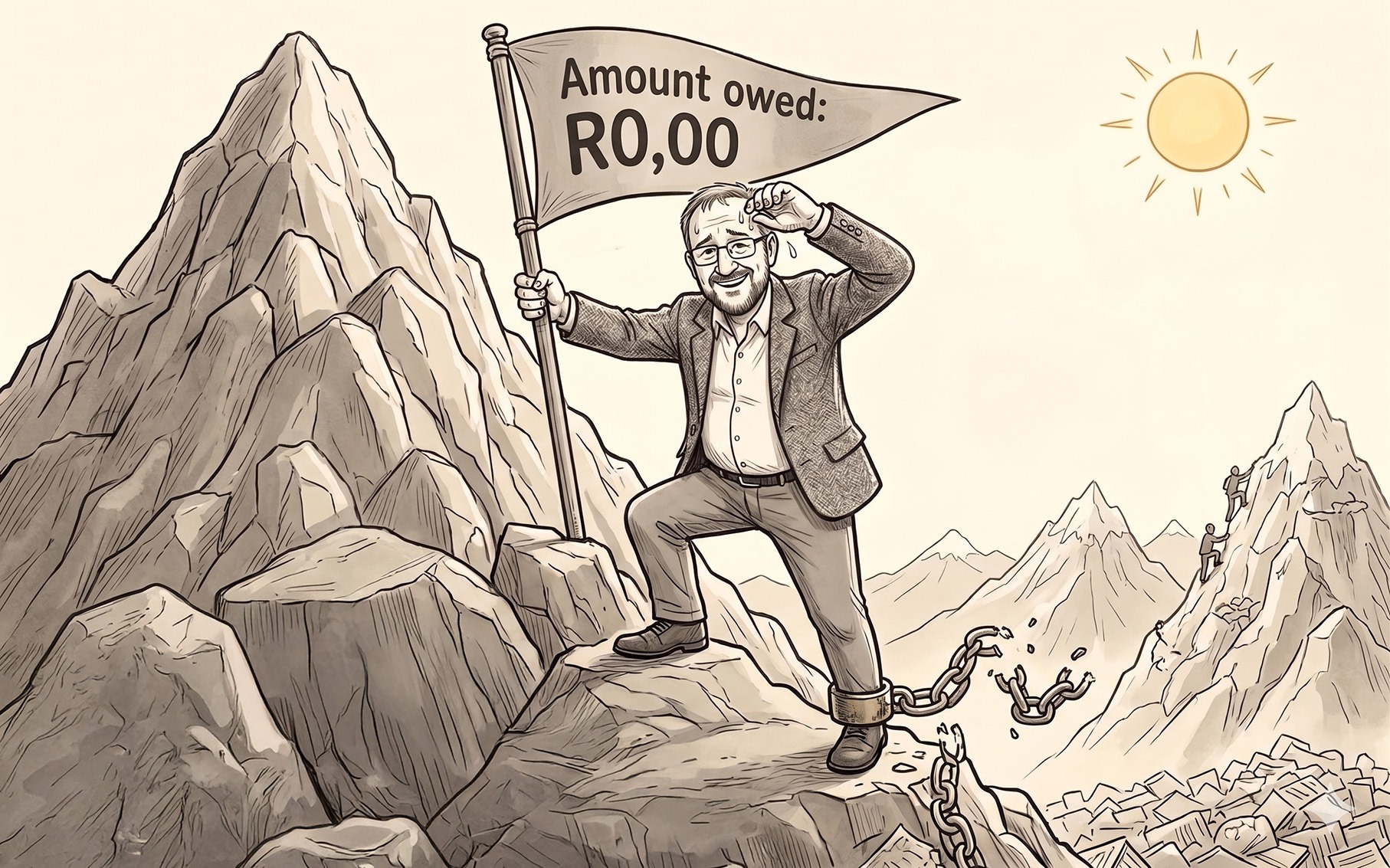
 Illustrative image: (Sources generated with Google Gemini flash Image 2.5)
How do you get out of debt?
Slowly at first, I would suggest. And never suddenly.
It’s not often that we get to see how people actually do it. But South Africa, and National Treasury, are on track to give us all a really good example of how your life can improve as you start to get on top of what you owe.
Over the past month or so the three big American ratings agencies, Fitch, Moody’s and S&P Global, have upgraded either our outlook or our rating.
The main reason is that the government has been able to do something that is very hard to do: spend less than it received as income.
It can’t be easy. So many in our country need so much that I bet they’ve faced all sorts of demands to use the money on more social spending. But somehow it has held the line.
It is one of the most crucial debates of our time. While obviously we need to spend a lot more on health and education, and all sorts of other things, I have never really understood how people can be so comfortable increasing the debt their children will have to pay back.
If we don’t get on top of it now there will be no money for services for my children in the future.
So when gold and platinum prices suddenly jumped, and more money started to come in as royalties, along with higher-than-expected revenue from other sources, well, Treasury did what we all should do.
Which is to put every single windfall we get into paying back our debt.
The net result of this is that as you pay back your debt, as SA Inc lowers the amount it owes, it becomes easier to borrow more. More importantly, it’s cheaper.
All of this seems to be leading to one of those happiest of financial experiences, the start of a virtuous circle where, as we pay back some debt, the rest of our debt becomes easier to pay back.
In the end, we will end up winning back more and more control of our finances.
As Stats SA has explained, debt-servicing costs have been rising significantly over the past few years.
Some countries have become like so many people, in that paying back debt consumes pretty much all of your income. There are bitter comments about the SMSes that ping our phones on the first of the month, as people to whom we owe money take it from our salaries.
I’m no expert but it seems to me the real trick is control. You want to be in control of your debt.
Some debt is obviously good. If you want to own a house (unless you’re a surprisingly sensible lottery winner) you will most likely need a mortgage. And after a while you can use the lower interest rates on the mortgage to fund a car or even your kids’ education if you have to.
But it seems that so often our debt gets out of control very early on.
The Eighty20 group has explained how younger people tend to get into debt almost before they work. And you can imagine how tough it must be to get out of it.
The Lewis Group, which has specialised in selling household items on hire purchase for generations, reported a little while ago that its debtor’s book grew in its last financial year by 15.2%.
One of the things I find scary is how easy it still is to get yourself deeper into debt. And it can happen so easily.
If you want a new top-of-the-range phone, something a little better than your average iCult product, you will be offered something that rings, beeps, sings and can be folded up.
I used to consider myself an early adopter but, despite these foldable phones being around for several years now, I still cannot work out what the benefit is. Folding an electronic screen seems to be the height of asking for trouble.
And, unless you are a slightly less sensible lottery winner (or one of the first Capitec shareholders), you won’t buy one over two years, but over four!
Can you imagine anything sillier? These phones will be obsolete in about two years, imagine still paying for it after three!
I’m always amazed that you can buy the smallest things, literally dog food, on an instalment plan.
While the road to financial ruin is incredibly broad, the road to financial control is not that rocky. It starts, as you probably know, by literally doing what our government is doing.
Buy only what you need and spend less than you receive.
And don’t think about how you feel about a product now, think about where buying it will get you in five years.
Most of the older financially secure people I know have older cars, which they’ve been driving for years. They don’t scrimp but they don’t splash out either. Most impressively, they don’t worry.
And if the government keeps going in this direction, the lack of financial worry will be a wonderful gift for our children. And those who come after them. DM
AFTER THE BELL
Mapping a new mindset — climbing our way out of financial debt
The road to financial ruin is incredibly broad, but the road to financial control is not that rocky. And the government is leading by example.
Comments
Scroll down to load comments...