



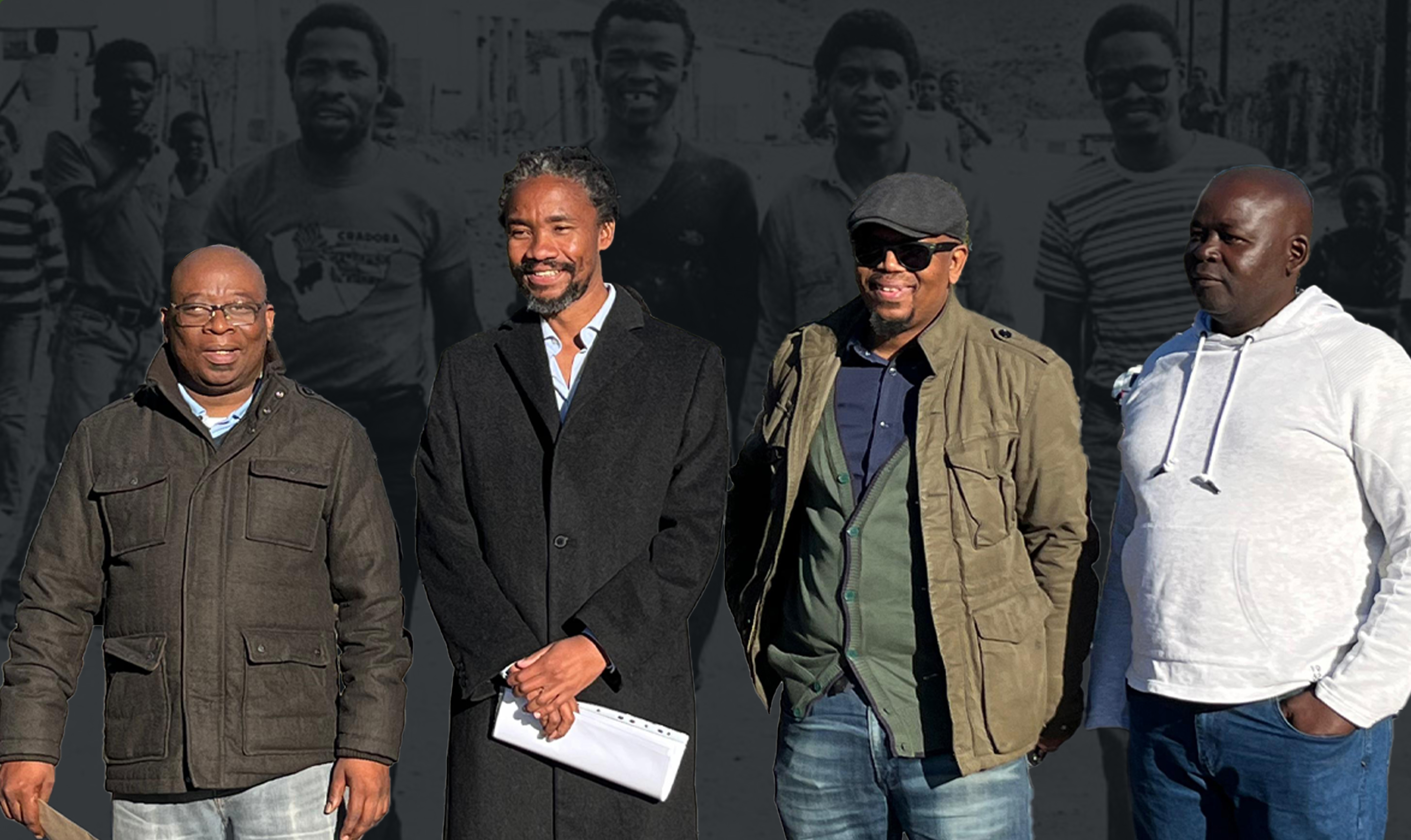
 Illustrative image: The Cradock Four: Fort Calata, Matthew Goniwe, Sparrow Mkonto and Sicelo Mhlauli were murdered in 1985 by the apartheid police. (Photo: Karin Brulliard / The Washington Post via Getty Images) | The sons of the Cradock Four, from left: Ntsika Mhlauli, Nyaniso Goniwe, Lukhanyo Calata and Lonwabo Mkonto. (Photo: Supplied)
South Africa’s (SA’s) former acting Secretary of Defence, Dr Thobekile Gamede, has been ordered to appear before the Gqeberha High Court to explain why she should not be held in contempt of court for failing to declassify documents relating to the murders of the Cradock Four on 27 June 1985.
The Cradock Four were anti-apartheid activists Fort Calata, Sicelo Mhlauli, Sparrow Mkonto and Matthew Goniwe.
/file/dailymaverick/wp-content/uploads/2025/10/MC-Craig-Williamson_4.jpg "The graves of Matthew Goniwe, Fort Calata, Sparrow Mkhonto and Sicelo Mhlauli in Cradock in the Eastern Cape. (Photo: Gallo Images / Oryx Media Archive)")
They were returning to Cradock from Gqeberha (known then as Port Elizabeth) on 27 June 1985 when they were arrested at a roadblock manned by the Security Branch, assaulted and murdered.
Previous inquests
There have been two previous inquests into their deaths. The first, in 1987, concluded that the men had been killed by “unknown persons”. No one was prosecuted.
The second, in 1993, presided over by former Eastern Cape Judge President Neville Zietsman, found that the police were responsible for their deaths. Again, no individuals were named, and no prosecutions followed.
Third inquest
The third inquest has been described as the final effort by the families of the deceased to establish the truth of what had happened. Most of the apartheid security and defence operatives who were identified as being involved in the deaths of the four men are now also dead.
This latest inquest started in 2025 but has been hampered by delays. One of the issues is the ongoing refusal by the Department of Defence to provide the families with documentation relating to the Cradock Four.
Last week, Gamede was ordered by Judge Thami Bheshe to “unconditionally produce a set of documents” in unredacted form, in hard copy and electronic format, within five court days of her order. This follows an order given by Bheshe in March that the department of defence must declassify the Cradock Four documents by mid-April which they did not do.
The court also declared that the classification of the documents was unlawful and of no force and effect.
But so far, the Department of Defence has refused to do so. Now the court has ordered that Gamede come to explain why she should not be held in contempt of court. A date for this appearance must still be determined.
The inquest will resume on 6 July.
‘National security at risk’
Advocate Howard Varney, counsel for the Cradock Four families, argued in court that the continued classification of the documentation was “manifestly inconsistent with South Africa’s new constitutional values”.
Since the court order, the new Secretary of Defence Basil Mthimkulu, in his explanatory affidavit dated 11 June 2026, said that Gamede could not provide nor declassify the documents, that runs into thousands of pages, as this would place SA’s national security at risk. The documents would mostly cover the records on the four men held by the Department of Defence for the period 1982 to 1987.
Varney points out that “no explanation was given”.
/file/dailymaverick/wp-content/uploads/2025/10/DSC_1289-copy.jpg "Widows of two of the Cradock Four, Nomonde Calata and Nombuyiselo Mhlauli, greet advocate Howard Varney at the Gqeberha High Court on Monday morning. (Photo: Deon Ferreira)")
Instead, Mthimkulu offered controlled access to a limited number of individuals with security conditions to view the documentation and an opportunity to then apply for redactions to be removed with five days’ notice.
“It is not clear what would happen thereafter,” Varney said.
The families of the Cradock Four have sought disclosure of these documents since 2021, when their private investigator, Brigadier Clifford Marion, first applied for the documents in terms of the Promotion of Access to Information Act. But they were only given limited access to inspect a portion of declassified documentation.
Varney said so far the department has used “every avenue to avoid disclosing apartheid era documentation”, adding that the officials’ conduct is “nothing less than contemptuous”.
/file/dailymaverick/wp-content/uploads/2021/07/Cradock-four.jpg "The Cradock Four. (Photo: Supplied)")
But then the explanatory affidavit filed by Mthimkulu went further, stating that Gamede was not in a position to declassify the documentation.
Even after the National Prosecuting Authority sent a subpoena for the documentation to provide the documentation or appear before the judge, in February this year, no documents were forthcoming.
The Deputy Minister of Defence himself, Bantu Holomisa, testified before the inquest stating that he had leaked one of the classified documents, the permanent removal ‘signal’, to the New Nation newspaper in May 1992.
/file/dailymaverick/wp-content/uploads/2025/10/DSC_1494-copy.jpg "Deputy Minister of Defence Bantu Holomisa took to the stand at the Gqeberha High Court during the inquest into the murders of the Cradock Four on 14 October 2025. Holomisa was instrumental into bringing to light the 'signal' wherein state agents planned the arrest and murder of the four political activists. (Photo: Deon Ferreira)")
This is what he told the court: “My role in facilitating the publication of the ‘signal’ was deliberate. Given my access to the material and my direct involvement in political negotiations, I was uniquely placed to ensure that the truth about the ‘signal’, and the state’s responsibility, came to light.”
He also stated in his affidavit before the inquest court: “Despite this overwhelming body of evidence, justice has not been done. The principal perpetrators of these crimes have evaded accountability. I submit this affidavit to assist in exposing the truth and advancing the cause of justice for the victims and their families.
“The evidence I have provided herein demonstrates that the deaths of the Cradock Four formed part of a deliberate and systemic state policy of elimination of political opponents. The highest structures of the apartheid government were involved in authorising these killings.”
Apartheid legislation
Varney argued before the court that the documents were classified in terms of an original decision taken in the 1980s, using legal instruments that no longer exist and “for purposes that are no longer justifiable”.
He said there was no evidence before the court that the documents were reclassified in terms of the Minimum Information Security Standards (MISS) that replaced the apartheid legislation. He said MISS, in any event, did not permit the blanket classification of documentation that has happened in this case.
The Department of Defence’s legal team however argues that the documentation remained classified under MISS but insists, according to Mthimkulu’s affidavit, that the information in the disputed documents will threaten national security.
“The mind boggles,” Varney said, “as to how documentation drawn up to deal with threats to the apartheid regime in the 1980s could prejudice South Africa’s security more than four decades later. It suggests that that decisionmakers within the Department of Defence have reason to frustrate the search for the truth in South Africa’s dark past,” he said.
‘Will hamper intelligence gathering’
A second reason provided by the Department of Defence is that declassifying the documents will compromise the South African National Defence Force’s intelligence-gathering methods and operational capabilities.
This, Varney said, cannot be taken seriously. “It cannot be that democratic South Africa, some 40 years later, is employing the same sensitive and likely illegal methods that propped up an abusive and illegitimate regime,” he added. “The only conclusion to be drawn in these cirumstances,” Varney added, “is that the Department of Defence is improperly protecting the erstwhile South African Defence Force and its members from scrutiny.”
Hoping for truth
Calata’s daughter, Dorothy said: “‘Listening to the court hearing, I had mixed emotions. When Judge Beshe’s order came, she gave us families hope that the truth will finally be heard by us as families and by this nation. This judgment says to us, the time for ‘our truth’ has come. We have renewed hope in Justice.”
Her brother Lukhanyo, who also recently testified about his father’s death before the Khampepe Commission, remarked: “It is sad that once again we had to resort to a legal judgment to help us access documents. However, the order shows that ultimately the court is helping us hold those who denied us truth and justice to account,” he added. DM
Comments
Scroll down to load comments...