




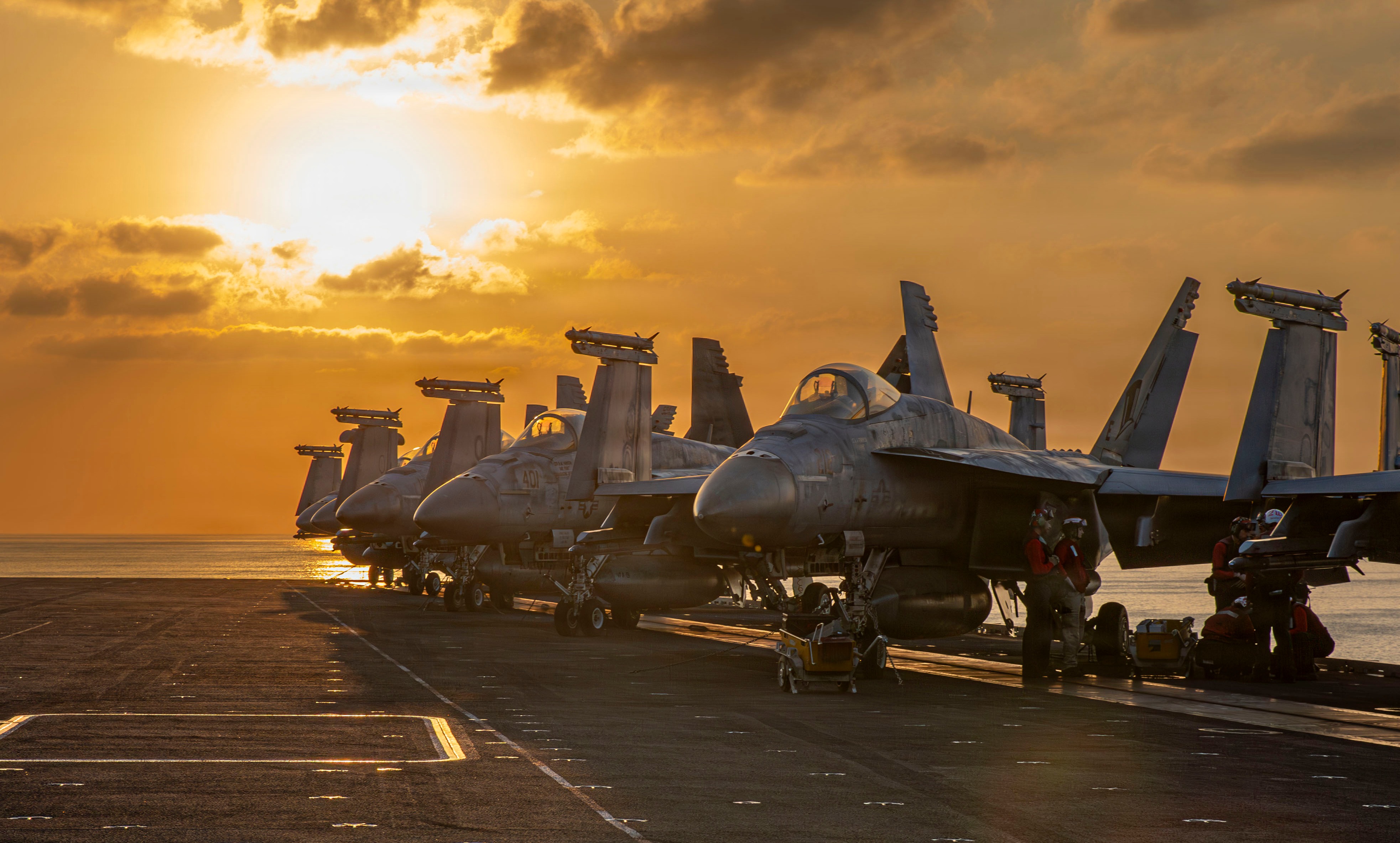
 US Navy aircraft on the flight deck of the aircraft carrier USS Abraham Lincoln on 2 March in support of the US war on Iran. (Photo: US.Navy via Getty Images)
The announcement at the weekend that peace is at hand in the Persian Gulf — or at least a memorandum of understanding is to be signed on Friday between representatives of the US and Iran that will stipulate the Strait of Hormuz will be reopened, the US blockade of Iranian ports will end, and petro-shipments can resume for the rest of the world — can give some modest hope that sanity will prevail.
However, left undetermined and subject to further tedious, hard negotiations (with the attendant possibilities of angry breakdowns in such talks) are all those complex, awkward, prickly bits that have now been booted further down the road.
These include ongoing hostilities between Israel and Hezbollah, the ultimate fate of Iranian funds held in escrow in the US, the continuation or ending of sanctions against the Iranian economy, Iranian ballistic missile development and deployment, and, crucially, the fate of enriched fissile materials — the so-called nuclear dust — and any new efforts to enrich uranium to weapons grade.
At a minimum, though, on the basis of this announcement and those things left out, it is far too early to declare, as US President Donald Trump tried to do on the day of his 80th birthday, that peace is about to rain down upon the Middle East.
Rain, in fact, did come down in Washington on Sunday, delaying the start of Trump’s highly touted but morally suspect Ultimate Fighting Championship human cockfighting (the late Senator John McCain’s term) extravaganza on the White House grounds.
/file/attachments/2993/14069013_792173.jpg "Cage fighting on the South Lawn of the White House on 15 June. (Photo: Jacquelyn Martin / EPA)")
Importantly, the primary, proximate cause of the conflict — enriched uranium — remains unsettled. Meanwhile, the debate is about to begin over who won and who lost in this conflict.
Certainly, the implicit and explicit war aims of the US — that Iran never has a nuclear weapons capability, regime change in Tehran, and the promise that “help is on the way” to Iranian protesters against a brutal government — all remain unfulfilled. History will render its judgments over the US’s (and Iran’s and Israel’s) successes or failures in the current hostilities.
Meanwhile, the Iranians have discovered and effectively embraced one overwhelming strategic advantage. That is a demonstrated ability to block the flow of one-fifth of the world’s petroleum and natural gas shipments from the Persian Gulf nations, affecting all manner of trade and industrial processes globally.
If such outcomes, in whole or in part, have been a failure of the US to enforce its desires upon Iran, does it also mean it was an actual defeat of the US? And, if so, is this something that will further propel the decline of the US as it confronts other ongoing strategic challenges? Can the country recover from such an embarrassing failure?
A paradoxical idea
Contemplating just such an outcome, the historian Phillips O’Brien has posed the paradoxical idea that losing an international conflict may actually be something that, in the longer run, becomes a successful outcome, despite horrific costs in human life and infrastructure. As O’Brien writes, “Losing wars is not always a bad thing. Sometimes it can be the best thing possible. The Germans and Japanese governments losing World War II was by far the best thing for the German and Japanese people.
“Losing these wars discredited German and Japanese leaderships that were murderous and to a large degree strategically incompetent. It forced many of their people to come to terms with the behavior of their nations, and ushered in new periods with very different policies and expectations. Indeed, defeat led to periods of extraordinary wealth, health and stability for the Japanese and (West) German populations as they focussed their minds on economic rebirth and tried to make new societies.
“The same could be said about France and the Franco-Prussian War. Defeat to the Prussians, a bitter pill for the French if there ever was one, exposed to the French people the incompetence of the ostentatious and pretentious regime of Napoleon III. Defeat led to the creation of the French Third Republic and ushered in a period of stability and growth which contributed to France being on the victorious side of World War I.”
We can extend this argument to recall the impact of the US’s loss in the Vietnam War as it and the South Vietnamese regime fell to the North Vietnamese and their local fighters, the Viet Cong. While the cost was immense in dollar terms and in human life as well (orders of magnitude more among the Vietnamese than among the Americans who sustained nearly 60,000 fatalities), at least for Americans; the final years of the fighting — together with the Watergate scandal — led to the removal of a duplicitous president and helped restore a sense of civic virtue to US life — just in time for the bicentennial of the nation’s establishment.
/file/dailymaverick/wp-content/uploads/2023/12/US-Huey-helicopter-spraying-Agent-Orange-in-Vietnam-1.jpg "A US military helicopter spraying Agent Orange over Vietnam during the Vietnam War. (Photo: US Army / Wikimedia Commons)")
Of course, in contrast to the thrust of O’Brien’s examples — Japan, Germany, and France — the US defeat in Vietnam, as well as the looming one in the Persian Gulf, never included physical destruction visited upon the nation itself. But, like postwar Germany and Japan, as well as post-1870 France, the US gained a second chance. Looking ahead, perhaps there may be a holding to account of the incompetent political leadership that dragged the nation into this war of choice. After all, the midterm elections coming in a few months could be a good place to start.
Possibilities for Russia
O’Brien’s paradox also offers a potential insight into the possibilities inherent for a Russia that, probably soon enough, will be forced to confront the human and material costs of its national calamity of a “special military operation” waged against Ukraine. Such a possibility may even open a space in Russia’s public and political life for a more reformist regime to succeed the authoritarian, kleptocratic one now in place under Vladimir Putin.
/file/attachments/2992/13978828_745127.jpg)
The same might even be said of Israeli Prime Minister Benjamin Netanyahu’s coalition, which has pursued its own actions against Iran and Hezbollah in Lebanon. As that country’s international support has crumbled as part of the cost of this conflict, the successful failure of its actions might conceivably force Netanyahu from his office when the next election is held later this year.
Of course, this relative snatching of a kind of victory from the jaws of failure depends significantly on the quality of leadership that emerges. Both Germany and Japan were lucky with Konrad Adenauer and Shigeru Yoshida, respectively. Will the US, Russia, and Israel be so blessed? That is an open question, to say the least. DM
Comments
Scroll down to load comments...