




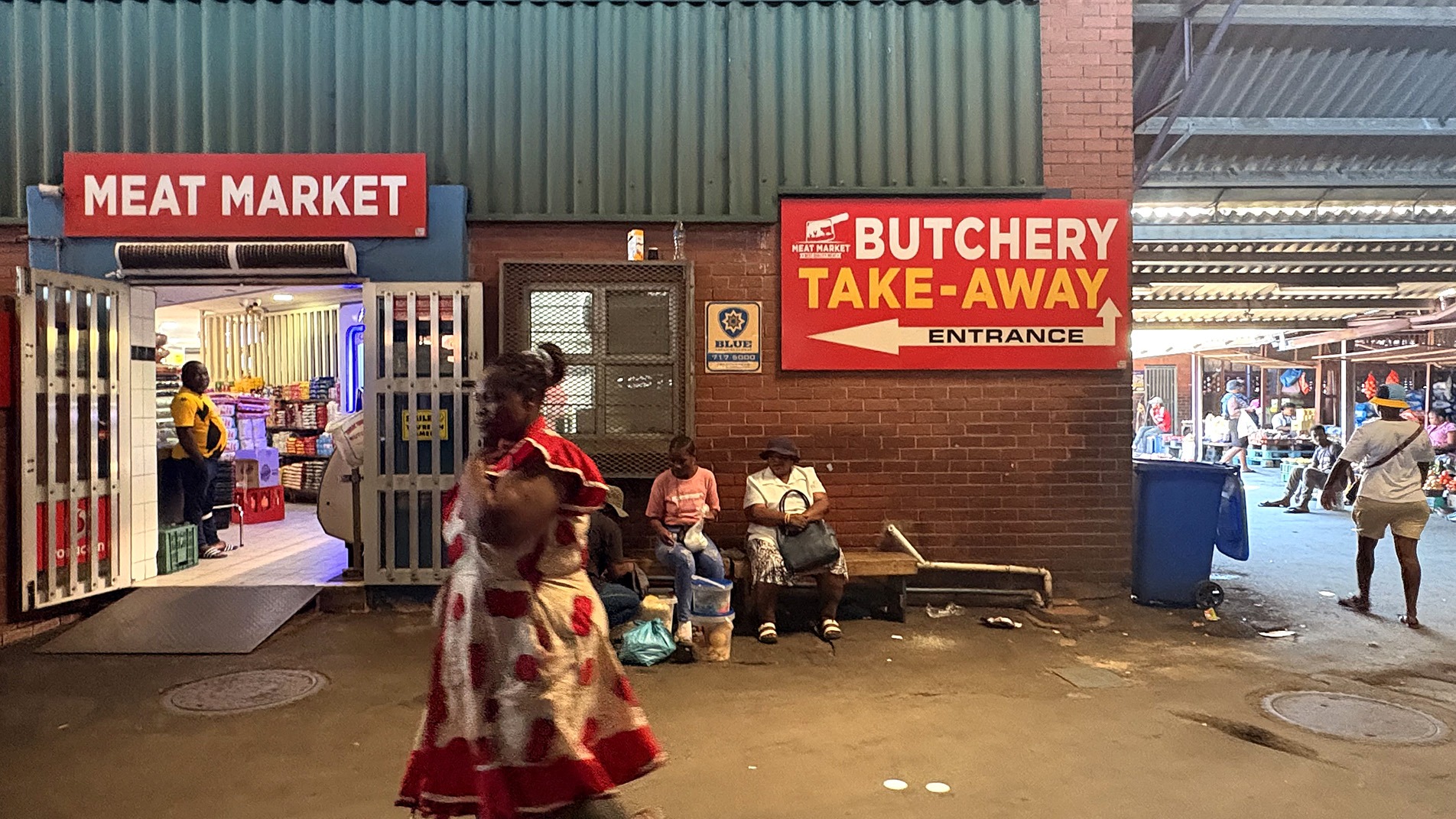
 Warwick Junction in Durban’s inner city isn’t where the well-heeled come to window shop. But these traders serve countless pedestrians daily and operate in an urban heat island
where conditions may be 5°C to 10°C hotter than those measured at the city’s weather stations. (Photo: Leonie Joubert)
Warwick Junction in Durban’s inner city isn’t where the well-heeled come to window shop. But these traders serve countless pedestrians daily and operate in an urban heat island
where conditions may be 5°C to 10°C hotter than those measured at the city’s weather stations. (Photo: Leonie Joubert)No work, no pay.
No one knows this better than Sizeni Dlamini. She’s been selling second-hand clothes and shoes from her patch at Warwick Junction, beneath an overpass in Durban’s inner city, for 16 years. If it rains, passers-by dash through the usually bustling market. Who’s going to stop to browse soggy clothing, and probably get soaked through?
Same in the heat.
“People just pass by,” the 55-year-old says. “They don’t have time to stand in the sun and choose clothes. It would be much better if we had shelter.”
/file/attachments/orphans/2IMG_5313_324403.jpg "Like most informal traders, it’s a hand-to-mouth existence, but it serves Sizeni Dlamini well. If she makes R300 from a day’s trade at her second-hand clothing and shoe stand, she’ll dip into it to buy basic groceries like mealie meal or rice on her way home later. A bit more, and she’ll add a few more things to the food basket. More still, and she’ll have cash to replenish her stock. (Photo: Leonie Joubert)")
Call her what you will — a micro-business, entrepreneur, street trader — but Dlamini’s isn’t the kind where she can shut up shop when it’s a scorcher, even if trade is down.
The recent summer was pretty grim, even for someone like her, whose body is acclimatised to the notoriously muggy East Coast weather where the warm Indian Ocean puts plenty of water vapour into the air, pushing up the discomfort levels and health risks on hotter days.
“It was really bad,” she muses.
Durban didn’t experience formal heatwave conditions this summer, according to weather records – for that, the city would need to register temperatures of 34°C or higher for three days or more – but people were nevertheless exposed to dangerously hot weather at times. The most sweltering day came in early autumn: the Ballito weather station, about 50km north of the inner city, registered a maximum of 33°C on 20 March. With the humidity reaching 62%, the felt temperature would have been 45°C, well into the range for someone developing symptoms of heat exhaustion.
/file/attachments/orphans/3bStoryArkDMRedAlertDbnvsCT_761840.jpeg)
But densely built up inner city areas like Warwick Junction are heavily tarred, paved and concreted over. Surfaces like these trap heat, making conditions in so-called urban heat islands 5°C to 10°C hotter than a city’s leafier outskirts.
Women feel the heat more acutely than men, and are more likely to be hurt by income loss because of it. It’s partly their bodies’ make-up – women don’t shed heat through sweating as efficiently as men do, so will experience health impacts at a lower threshold— but also because many work in lower-paying and informal heat-exposed jobs, such as farming, street trading, garment making, or care work, according to the US-based non-profit HERA. The organisation recognises the greater risk that lower-income and self-employed women face because of extreme heat, both to their health, and their income, and works in various mostly Global South contexts to help women be more heat resilient.
/file/attachments/orphans/3cStoryArkDMRedAlertdryvsfelt_healthriskguidev3_174235.jpeg)
The first line of defence for traders who are exposed to the elements in this way, according to professor Rajen Naidoo, Head of Occupational Medicine and Environmental Health at the University of KwaZulu-Natal, is to put in heat-buffering solutions – think in terms of shelter, water and rest, he says.
Once that’s done, though, a novel form of income protection might be something that could encourage women to shut up shop during the worst of a heat event, without fear of their families going hungry.
Bathroom breaks
“This is the piss wall,” says Patrick Ndlovu, cheeks dimpling with humour as he points out the face-brick wall with its makeshift urinal along a stretch of pavement not far from the stall holders.
Hand-sprayed lettering barks a command to passers-by in isiZulu. The sentence is poetic and gritty: two layers of paint, florid green over black; some E.E. Cummings flare, it doesn’t bother with capital letters.
/file/attachments/orphans/4aIMG_5284_683484.jpg "The market’s municipal toilet block has been broken for six years, leaving stall holders andnpassing customers to go al fresco when their bladders call. Urban renewal non-profit Asiye eTafuleni has put in low-cost outdoor urinals for the men and a walk-in booth so that women can have a private nook to relieve themselves over a bucket. (Photo: Leonie Joubert)")
/file/attachments/orphans/4bScreenshot2026-06-04at125634_966495.jpg "The women's walk-in booth. (Photo: Leonie Joubert)")
There’s no polite way to tell the urinal’s users that this is no place for solids.
“If you defecate here,” Ndlovu translates delicately, “if caught, you will be compelled to take it away.”
The wall is topped with coils of barbed wire and some medieval-looking spikes overlooking a riot of off-duty minibus taxis getting soaped down on the pavement.
At first glance, these facilities look pretty grim. The air is thick with the smell of urine being alchemised into vapour in the mid-morning heat. The two 25-litre water containers — each with a shoulder cut away to create a pee bucket — are working overtime. One’s overflowing, the other’s getting there. But it’s better than it used to be, according to Ndlovu, who is the co-founder of the urban renewal non-profit Asiye eTafuleni. The organisation has been working here for nearly two decades, supporting informal traders to know their rights and legitimise their place in the city’s economy.
At a practical level, that means sorting out the lavatory situation.
Warwick Junction’s broken-down municipal toilet block has been barred and bolted for six years, with the City giving no indication of why it hasn’t been repaired, or if it will be. For the many thousands of people who pass through this rabbit warren daily, or ply their trade in and around the market, this means that when their bladders call, they have little option but to go al fresco.
This is easier said than done if you’re a woman, which matters during summer. Many women traders say they hold back on drinking water during the day because they don’t want to deal with the inevitable consequences.
This will lead to dehydration. When her body is heat stressed, it puts extra strain on a woman’s kidneys, her body’s clean-up system, which now will be overloaded with salts and toxins but with too little water to do the job. The upshot: higher risk of urinary tract infection, but also longer-term kidney damage.
In principle, a key solution to a heat-resilient trading community here is simple: get clean drinking water coming in, and black water flushing out. In a sentence: restore the municipal ablution block.
/file/attachments/orphans/8IMG_5427_466969.jpg "Barrowman Nkosithandile Zanemvula has been ferrying traders’ stock around Warwick Junction for nearly three decades. When his metal trolley hit a pothole and broke recently, he lost a fortnight’s income because he couldn’t afford the R50 repair job. Someone gave him the cash, though, and after few minutes of welding he was up and running again. Such is the precarity of life for the low-turnover self-employed person. (Photo: Leonie Joubert)")
/file/attachments/orphans/9IMG_5330_581961.jpg "Soft fruit perishes fast in the heat. And those selling cooked food need to ensure they buy only what they can sell in a day. Early warning systems and heat event forecasts can help traders plan their stock purchases to avoid spoilage and change their trading hours to be safe during the worst of a hot spell. (Photo: Leonie Joubert)")
The eThekwini Municipality did not respond to several requests for clarity on why the public amenities at Warwick Junction weren’t working, why they hadn’t been repaired, or if there were plans to do so.
Until such a time, Ndlovu and his team have been experimenting with low-cost outdoor urinals, knocked together with materials you can pick up at a local hardware store — PVC piping, plastic crates, buckets, shade cloth. Men, at least, have a discrete nook to relieve themselves. They’re asked to pay R2 for the convenience, but no sweat if they can’t, says Ndlovu.
But what about the women?
There’s a nondescript plywood walk-in booth near Dlamini’s clothing stall. It’s the size of an average wardrobe, and the only thing telling a passer-by that it’s the women’s facility is that universal sign on the door: a stick-figure illustration of a person in a dress.
This doesn’t have a comfortable sit-down loo with flushing water, or even a dry-toilet system. But it’s a private, dignified place for a woman to relieve herself over a small bucket, the contents of which she’ll toss down the nearest storm water drain.
The next step is to recruit what the Asiye eTafuleni team calls urine entrepreneurs — most likely people living rough in the neighbourhood who are keen to make a bit of cash – who will get a small fee to empty pee buckets into nearby stormwater drains.
It’s one small part of the shade-water-rest triage that can make these traders more heat-resilient in an ever hotter world.
‘Back in five minutes’
Besides drinking plenty of water during hot weather, traders like Dlamini should do one more thing that they’re not likely to: take a break.
No work, no pay, right?
But what if they have income protection insurance that paid out if conditions get hot enough – dangerous enough – that they needed to close their stalls for a few hours? Allowing them to stay safe without foregoing the food they need to put on the table that night.
HERA is piloting something like this in India, Sierra Leone, Pakistan, Thailand and the US, using philanthropic money, buy-in from local insurance companies, and small premiums paid by traders. Founder and CEO Kathy Baughman McLeod reckons it could work for Warwick Junction traders, too.
“Women in a market in Freetown, Sierra Leone, lose 60% of their income to heat,” says Baughman McLeod. “Whether that’s their own illness, if foot traffic is down, or (when their stock) has gone bad.”
In India, a version of this insurance package has been rolled out across 500,000 women in heat-exposed low-paid jobs. Each woman’s monthly premium is $8 – roughly the equivalent of a day’s earnings, which for Dlamini might round off to R200 – but each woman only contributes $3.50. The remaining $4.50 is topped up from the philanthropic fund.
The cover guarantees to pay members out the equivalent of a day’s earnings for every day where conditions are hot enough to be recognised as dangerous. It’s an index-based insurance – parametric insurance, in industry-speak – meaning the payout is based on a heat event occurring, not an assessment of damaged caused during the event, be it to the trader’s stock or their health.
What constitutes an event serious enough to warrant payout? It’s site specific, based on a triangulation of the best weather data available in an area, which is correlated to known heat-health risks.
For traders like those in Durban, this could be calculated using the city’s own weather station data – it has several – or data from the national South African Weather Service, along with satellite imagery. Given that Warwick traders operate in an urban heat island, the trigger temperature for a payout would also need to factor this in, too. Ideally, rudimentary on-site temperature and humidity data capture at the market complex.
Some of the HERA pilot initiatives also draw on biometric data from traders themselves, who use digital fitness trackers which allow a correlation between the physical markers of women’s heat stress with the weather data.
Once the trigger temperature is met, payout is guaranteed within 10 days or less. No site inspections, no damage assessments.
In one case in India from 2024, once the temperature reached 38°C, members got cash support from the philanthropic fund. Once the temperature climbed to 41°C, the insurance payout kicked in.
At this stage, the trigger is based solely on temperature, and doesn’t include humidity that affects health risks.
/file/attachments/orphans/3aStoryArkDMRedAlertHeatWave_396598.jpeg)
“Triggers are different in different geographies, and data sources dictate that,” explains Baughman McLeod. “Humidity and nighttime temperatures would ideally be in every product, but that’s not the case due to data limitations.”
The women also get early warning ahead of a probable event, which allows them to plan stock purchases, make alternate childcare arrangements, and change their operating hours, for instance.
“But we want to go to forecast-based payouts,” says Baughman McLeod. “If we know it’s going to be hot and humid, and trigger (temperatures) are predicted for, say, five days from now, then half or all of the payout (will be made) in advance. The trigger is the forecast, not the actual event.”
Making a plan
The income insurance isn’t designed to be a silver bullet, according to Baughman McLeod.
The community should think in terms of reducing their overall risk first – the infrastructure that would allow for the shelter-water-rest triage, most of which needs to come from the municipality in Durban’s case – after which the insurance can be an additional safety net.
The eThekwini Municipality says it recognises heat stress as a pressing issue. It has various climate-focused plans, strategies and working groups in place, and has a range of partnerships such as with the World Resources Institute and the C40 Cool Cities network which aim to coordinate climate responses. However, it’s unclear what the timelines are for these solutions materialising in this part of the inner city.
/file/attachments/orphans/5IMG_5358_100819.jpg "Thandazile Nyathi’s kerbside takeaway caters mostly for the passing lunch crowd, serving shisanyama – braaied beef – and chicken, with plenty of vegetable sides and phuthu. Her workaround for not having a fridge: buy only what she’s likely to sell in a day. On hot days, custom is usually down. (Photo: Leonie Joubert)")
Until the City comes to the party, the old South African maxim ’n boer maak ’n plan (a farmer makes a plan) is alive and well among these stallholders. Thandazile Nyathi sells beef and chicken braaied over open coals at her stand not far from Dlamini’s stall. The meat is dressed with BBQ sauce, shisanyama spice, plain salt, curry, you name it. Loads of sides – rice, phuthu (a stiff porridge from maize meal), beans, spinach, samp, cabbage.
She trades from a makeshift shelter on a pavement where taxis roar past nearby. Her workaround for not having a fridge?
“You buy your food in the morning, and sell it all in one day,” she says.
/file/attachments/orphans/6IMG_5503_962241.jpg "Between her beach brollies and a makeshift water sprinkler, fruit trader Nomusa Luthuli protects herself and her stock from the sun and heat which can pummel the delicate plumbs she sells. Having access to weather forecasts could help traders plan their stock purchases better. (Photo: Leonie Joubert)")
Nomusa Luthuli has some beach brollies that she puts up over her fruit stand when the sun gets hot and high. Soft fruits, like today’s plums, go pap quickly in the heat. Her solution: a repurposed cool drink bottle, with a few holes punctured along one side, which makes a sprinkler system. A few squirts every now and then to cool things down, and her stock will probably have a longer shelf life.
This morning is still relatively forgiving, though, and while Sizeni Dlamini chats about her life as an entrepreneur in this gritty part of Durban, another trader wanders over. She’s got a printed-out photograph of a stall holder who used to trade down the block from here, but who died recently. Some of his friends are doing a whip-around, collecting cash for his funeral. Dlamini clucks at his passing. Yes, she knew him. Not well, but he’d been here for years. Like so many of them, part of the furniture. It’s small change, mostly, but the collection hat clinks with people’s contributions. DM
This article is from Story Ark – tales from southern Africa’s climate tipping points, an award-winning collaboration with the Stellenbosch University School for Climate Studies, Henry Nxumalo Foundation, and the Pulitzer Center.


Comments
Scroll down to load comments...