




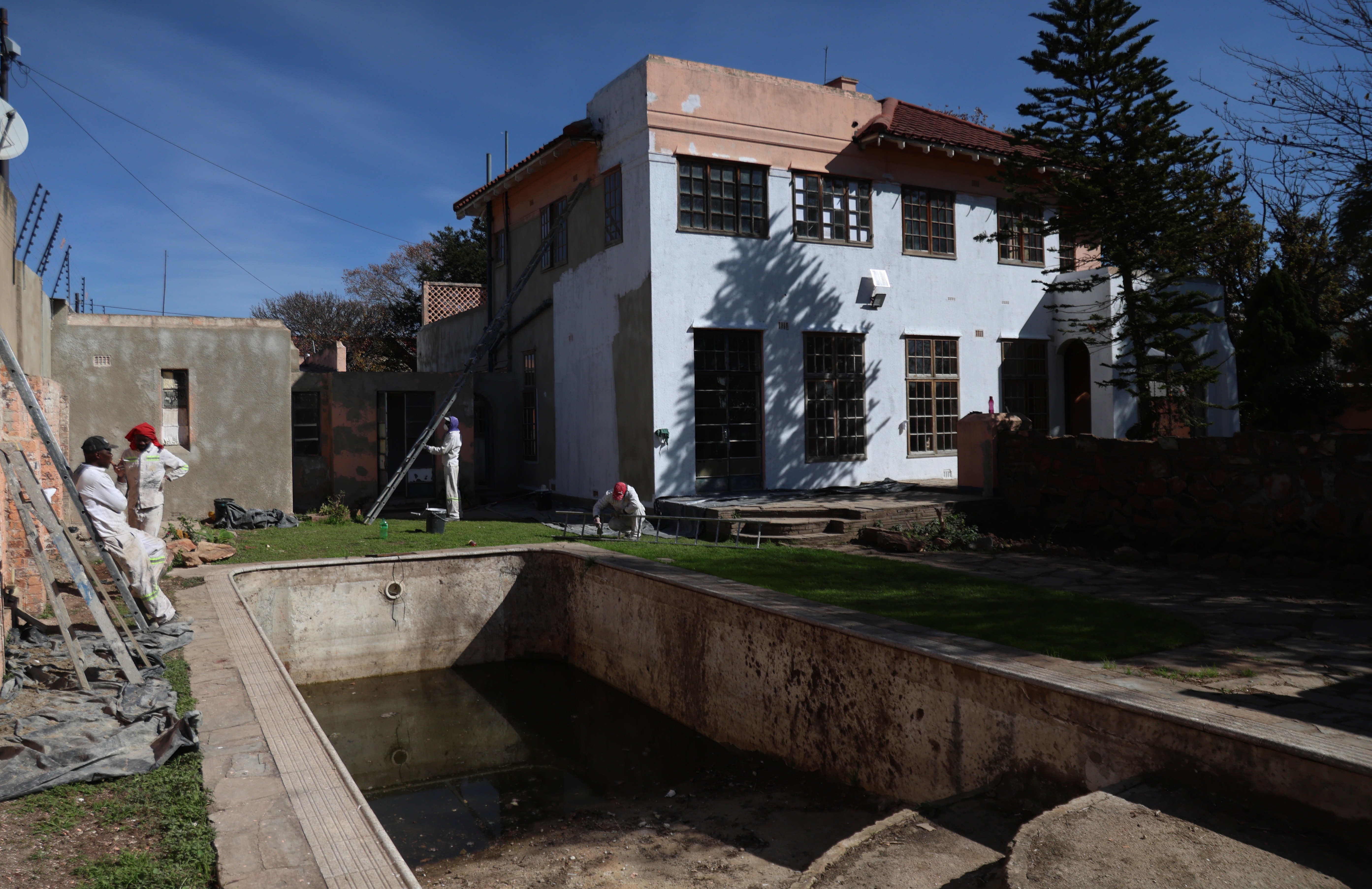
 Construction workers spruce up one of the houses purchased recently by Jeppe High School for Boys in Kensington, Johannesburg. (Photo: Felix Dlangamandla)
Rather than retreating behind higher walls, Jeppe High School for Boys in Johannesburg, has spent recent years buying neighbouring properties, expanding its educational footprint, restoring neglected buildings, cleaning surrounding streets and helping drive a broader community revival effort in Kensington and parts of neighbouring Malvern.
Principal Brendan Gittins, himself a Jeppe old boy, says the 136-year-old school believes it cannot thrive if the surrounding neighbourhood continues to decline.
“The area is the gateway to the city and cannot be allowed to fall into disrepair,” he said.
For Gittins, protecting Kensington is also about preserving one of Johannesburg’s most historic suburbs and preventing the loss of its architectural and cultural heritage.
“Kensington has lots of heritage houses, Randlord houses, and we must preserve our heritage,” he said.
Founded in 1897, Kensington developed as one of Johannesburg’s earliest residential suburbs and remains known for its distinctive ridge-top setting, historic architecture and collection of heritage homes dating back to the mining boom years.
/file/attachments/orphans/WFD_4478_979715.jpg "The entrance to Jeppe High School for Boys in Kensington, Johannesburg. (Photo: Felix Dlangamandla)")
Situated on Johannesburg’s eastern approach to the inner city, Kensington and neighbouring Malvern are increasingly having to battle urban decline, illegal dumping, abandoned properties and the conversion of older homes into overcrowded multi-tenanted accommodation.
Gittins said many once-elegant homes have fallen into neglect as elderly residents died, moved away or sold properties, which have later deteriorated.
But instead of isolating itself from the suburb, the school had chosen another route.
“We could build high walls around the school and keep crime and grime out, but we have chosen to embrace the surrounding communities,” he said.
Building an educational node
Working alongside the Jeppe Old Boys Association and other supporters, the school has been able to acquire neighbouring properties as part of an ambitious precinct expansion programme designed to strengthen both the school and the surrounding area.
The acquisitions form part of what Gittins hopes will eventually become an educational node stretching across Kensington and parts of Malvern.
Rather than operating as a single institution in isolation, Jeppe aims to eventually create a network of schools and educational facilities that support one another, from primary schools to high schools, boarding facilities and specialised learning centres.
The school has purchased several neighbouring properties as they have become vacant, including two properties in Good Hope Street acquired recently, which will be used as boarding houses.
/file/attachments/orphans/WFD_4466_689944.jpg "A construction worker at one of the houses in the neighbourhood purchased by the school. (Photo: Felix Dlangamandla)")
Gittins acknowledged there are also practical reasons for investing heavily in the surrounding area.
“We are doing this for selfish reasons as well. We want to attract the best staff, and for that, they have to feel safe,” he said.
Staff accommodation has become part of that strategy.
“We offer accommodation as an incentive. About 30% of staff live on the school property because there is 24-hour activity with the boarders.”
Gittins said the school also wants parents, prospective pupils and visiting schools to have a positive experience when arriving at Jeppe.
“We also don’t want people to have to drive through a bad neighbourhood to get to our proud school.”
/file/attachments/orphans/WFD_4429_552011.jpg "Principal Brendan Gittins walks up the staircase in one of the houses purchased by the school. (Photo: Felix Dlangamandla)")
The school believes that constant activity around the campus helps create stability and discourages further decline in the surrounding streets.
This has had a positive impact on all aspects of the school as well.
Before the rejuvenation programme, matric pass rates stood at about 85%, with bachelor passes at 48%.
The school now records a 100% matric pass rate, while bachelor passes have increased to about 85%.
Demand for boarding has also surged. Applications for approximately 200 boarding places have increased from about 200 applications to around 2,300 applications.
School fee collection rates have increased from 66% to 88%.
Gittins said strong academic performance remained central to the school’s mission, but educational success could not be separated from the condition of the surrounding community.
The power of the old boys’ network
The Jeppe Old Boys Association has played a key role in the school’s success.
Former pupils have helped fund major capital projects, supported infrastructure improvements, provided mentorship and assisted with long-term strategic planning.
The old boys have also played a significant role in property acquisitions and the broader precinct development programme.
Representing the association, Janet de Bie said former pupils are contributing far more than financial support, providing expertise, mentorship and strategic guidance to projects ranging from infrastructure upgrades to precinct development.
/file/attachments/orphans/WFD_4507_708701.jpg "Belinda Ruckard and Janet De Bie, who represent the Jeppe Old Boys Association. (Photo: Felix Dlangamandla)")
“The strength of Jeppe has always been the willingness of old boys to give back to the school and the community that helped shape them,” she said.
De Bie said the association is committed to ensuring talented learners are not excluded because of financial circumstances, and to helping secure the long-term future of both the school and the surrounding community.
Supporting neighbouring schools
The initiative extends far beyond Jeppe’s own learners.
Gittins said the school, through the EduSafe initiative started by former Jeppe pupil Rob Katzen, is increasingly trying to support surrounding government schools facing financial and infrastructure pressures.
“We are hoping to spread the message to other nearby government schools which are struggling. We started with Sandringham and Sandown and will be moving to Northview High. We will offer them support and send teachers to offer advice,” he said.
Locally, Jeppe already works informally with a number of neighbouring schools, including Glenoaks Remedial School, Kensington Secondary, Jules High and Denver High through sports, shared activities and outreach programmes.
These initiatives include football festivals, access to extracurricular activities and the use of Jeppe’s sports grounds and facilities.
“We donate kits and uniforms and offer our premises for some extramurals.”
Cleaning up beyond the school gates
The school’s commitment also extends beyond its own boundaries thanks to what has become known as the Jeppe Clean-Up Crew.
The school employs four full-time workers dedicated to cleaning streets and pavements surrounding the property, while volunteers regularly restore parks, pavements and church grounds around the precinct.
“We have four full-time staff cleaning up around the school, all the pavements, and we have engaged our neighbours to also keep their pavements clear,” Gittins said.
The initiative has recently expanded through a partnership with Better Kensington, a newly established resident-led organisation working to restore and preserve the suburb.
Gitten’s wife, Charné, is a trustee showing close cooperation between the two initiatives.
/file/attachments/orphans/WFD_4526_938148.jpg "Charné Gittins spearheads the Jeppe Clean-Up Crew. (Photo: Felix Dlangamandla)")
Mark Press of Better Kensington welcomed the school’s growing involvement in community clean-up initiatives.
“It is hugely important that Jeppe and the headmaster’s wife are involved in our clean-up initiatives,” he said.
“Jeppe’s participation will make a significant contribution to the upper parts of Kensington and strengthen the work already being done by residents and community organisations to restore the suburb.”
Gittins said the rejuvenation effort is already extending beyond the immediate school precinct and into neighbouring Malvern.
Residents and property owners along Marshall Street, one of the school’s borders, have joined the initiative and are helping maintain areas already improved by the school.
“We have engaged residents in streets and they have bought into our cleaning project. Property owners, residents and a church on Marshall Street are helping maintain the plants we have put in and are assisting in keeping the street clean,” he said.
The school now plans to involve pupils directly in future clean-up campaigns as part of their service obligations.
The latest campaign saw about 48 Jeppe educators, together with family members, pupils and local children, participate in a large-scale clean-up of Marshall Street Park opposite the school.
The initiative also created secure off-street parking for parents attending weekend sports fixtures, with proceeds from parking fees being reinvested into future community projects.
Preserving history
Gittins said the effort to preserve Kensington’s historic character is reflected within the school itself.
Founded in 1890, Jeppe has become part of Johannesburg’s educational and architectural heritage and includes a number of buildings, memorials and landmarks linked to both the school and the city’s development.
To showcase that history, the school launched the Jeppe Heritage Route in 2024, a walking trail through the campus highlighting sites of historical significance.
The route includes the War Memorial, Centenary House, the historic Oribi boarding house, the Jeppe Koppie, the Summer House, former stables, Memorial Hall and Payne Hall.
The trail was developed to help pupils, visitors and alumni better understand the school’s history and its contribution to Johannesburg over more than a century.
/file/attachments/orphans/WFD_4396_951441.jpg "Learners during their break time at Jeppe High School for Boys. (Photo: Felix Dlangamandla)")
/file/attachments/orphans/WFD_4394_712770.jpg "Jeppe High School for Boys has launched a heritage walking tour, emphasising its place in the history of Kensington. (Photo: Felix Dlangamandla)")
Gittins said preserving both Kensington’s heritage and the school’s own history forms part of a broader commitment to protecting the area’s identity.
“It is not only important for the area but for the whole of Johannesburg,” he said.
He believes schools can no longer afford to separate themselves from the condition of the neighbourhoods around them.
“We have hope. It is possible to reclaim the neighbourhood. We cannot wait for government to sort this out. We cannot be bystanders. We are partners,” he said.
Through its growing educational node – linking schools, residents, churches, alumni and community organisations – the school hopes to demonstrate that educational renewal and urban renewal can go hand in hand.
“If we don’t take the leading role within 10 years the area will collapse,” he said. DM
Comments
Scroll down to load comments...