



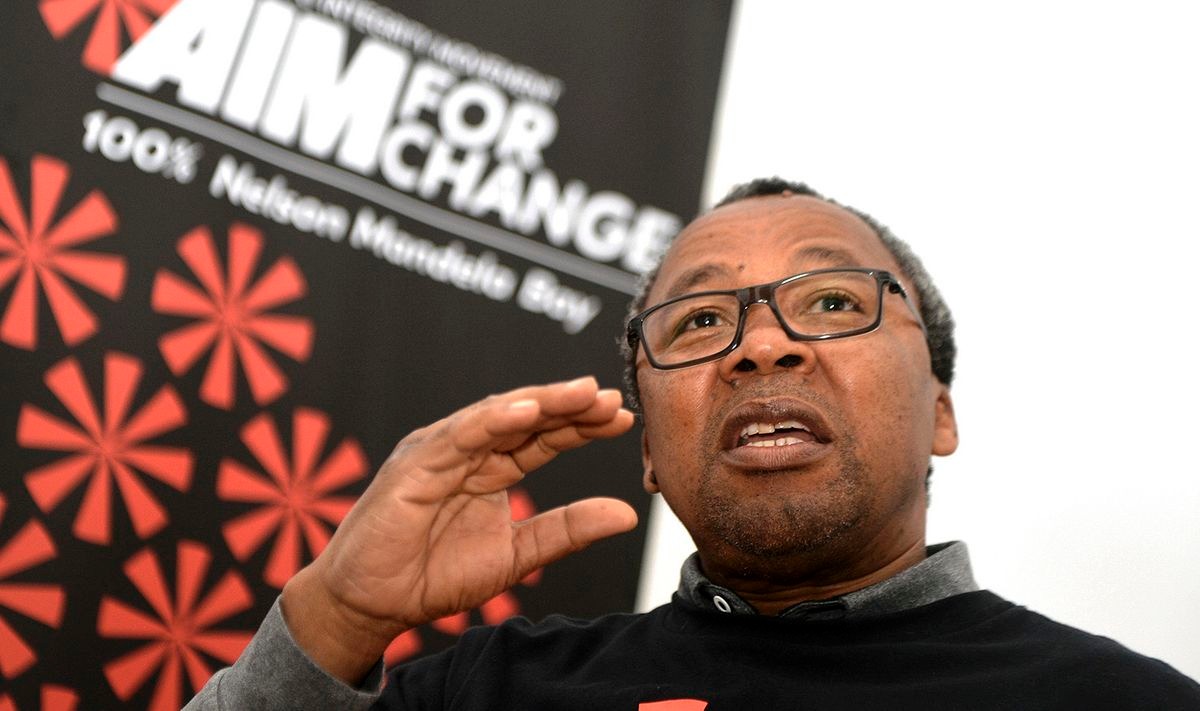
 Abantu Integrity Movement’s founder and Nelson Mandela Bay councillor Khusta Jack. (Photo: Deon Ferreira)
In 1976, political activist, Nelson Mandela Bay councillor and businessperson Khusta Jack was at the forefront of school protests in what was then known as Port Elizabeth. “I was here for about a year when we started our protest action,” he said.
Having grown up on a farm outside Humansdorp, Jack was barred by the apartheid-era dompas (passbook) legislation from accessing the city for education purposes, so he could not go to high school. “Also, I only started primary school at 10, so I was falling behind.”
By 19, he had only just started high school. “The education protests were my first formal political campaign. I had to learn everything very quickly,” he said. “It was the moment I got into politics. “At the time, the debate in the city was about the homelands. In the beginning, I thought that the homelands were just fine. I saw black people from the homelands who were wearing shoes and driving nice cars, and I thought that was good.”
After arriving in the city, Jack then heard about the ANC. “I always had this sense of justice – I wanted to do what was right. So when we saw the uprising in Soweto that exploded with the June 16 shooting, we started to organise.”
Jack said that apart from protesting against the enforced use of Afrikaans as a teaching medium, they were also protesting against the exclusion of students from schools because of dompas legislation. But, he said, the police always seemed to have the upper hand.
“Every time we started something, the police stopped us. We were disrupted very often and people were arrested. Those who were known instigators at the schools were taken by the police. We would try to march, but it would soon fizzle out when the police acted against us. Many leaders had to leave the country or were taken by the police.
“The biggest shock for us was the arrest of 38 schoolchildren at Kwazakhele. Mike Xego was one of them. He was known even then to be at the front line. They were all sent to Robben Island very quickly.
“Then we started to lie low. But we received some messages of wisdom from the generation of the 1960s… The death of Steve Biko helped us build more resistance. By 1978, when Robert Sobukwe died, students from across South Africa all went to Graaff-Reinet [now renamed Robert Sobukwe town], where we met with other students. That was when we really started building momentum.”
/file/dailymaverick/wp-content/uploads/2024/07/AV_00003952.jpg "Pan Africanist Congress founder Robert Sobukwe in 1978. (Photo: Sowetan / Gallo Images)")
Jack added: “We lost years of schooling. Four years of my life I was fighting this and I was sent to jail.”
But he said that in about 1979 their resistance was well organised. “We formed Cosas [the Congress of South African Students], but our numbers remained low. By 1983, the numbers started climbing.”
Stolen future
During this time, Jack was arrested often and held at several police stations, where he was often assaulted. But he would tell himself that when freedom came, it would be worth it.
“The struggle of the 1976 generation achieved every goal we have set for ourselves,” he said. “The tragedy is that currently the government is reversing all of that and soon what we fought for may be lost. We fought for the transfer of power to the majority. Today’s leaders are fighting only for themselves and what power can bring them.
“What we fought for is now at risk of vanishing completely. We have criminally orientated leaders with no values.
“We were fighting for humanity, not for ourselves and our families. All of that has now been shunned. Today’s leaders are trying every trick in the book to stay in power for themselves. It is a pity, because when I was young, I was hoping that South Africa would be the paradise we envisaged. But now we are regressing at a terrible rate. The lack of employment opportunities for the youth will destroy this nation.”
Jack said he went to testify at the Truth and Reconciliation Commission about his involvement in the 1976 protests and what followed. “But I told the TRC that I was not calling for punishment against anybody. I told the police when they were torturing me that, as long as freedom came one day, I would pay the price. Being free would be my revenge.”
He said the new fight for young people is for economic freedom. “Leaders like Nhlanhla Mkhwanazi are already with us,” he said. Referring to March and March’s Jacinta Ngobese-Zuma, he said she is politically talented but misguided.
“Reckless mobilisation never works. You have to be clear about your goal. If they, for instance, can stick to fighting illegal immigration and hold the government accountable, that will work,” he said. DM
This story first appeared in our weekly DM168 newspaper, available countrywide for R35.
/file/attachments/2993/DM-120626_491550.jpg)
Comments
Scroll down to load comments...