



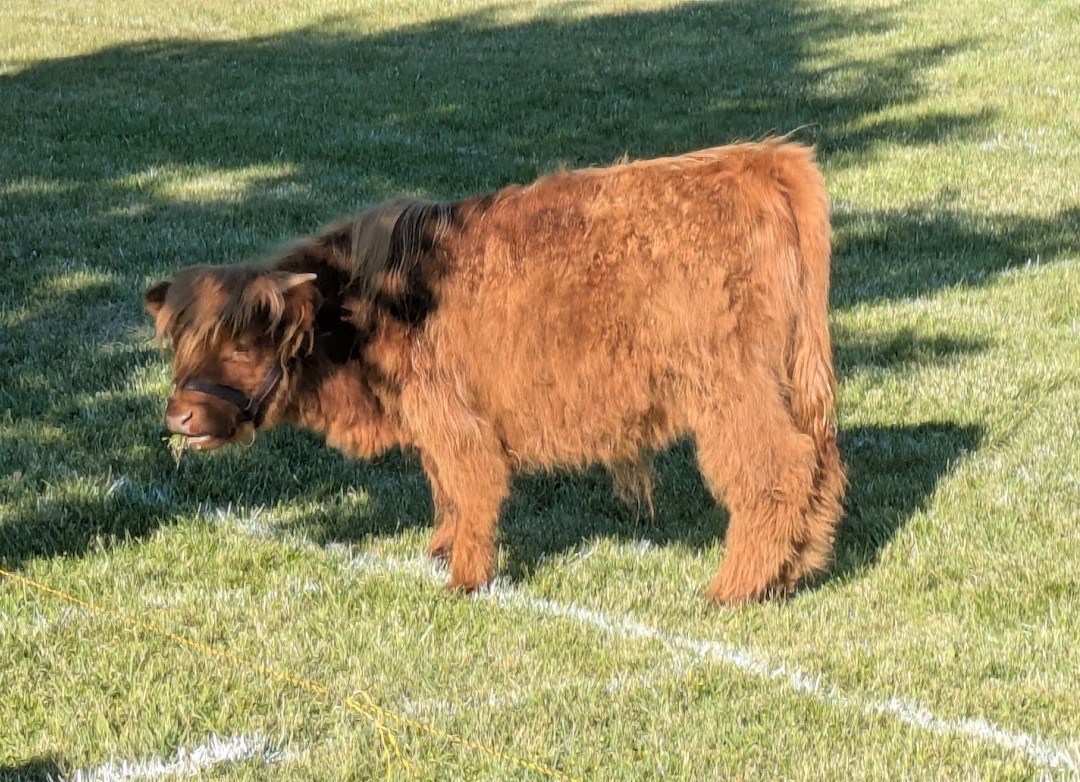
 Herbie stands right next to the bingo square the author purchased, but alas, he did not make a 'deposit'. (Photo: Glen Retief)
A livestock trailer. The central lawn of a city park, marked with a thousand spray-painted squares. At 6pm, the watching crowd catches its breath. One, two, and then a blond young man in jeans and a flannel shirt opens the trailer’s tailboard.
First to emerge is a slender woman with long brown hair, wearing cut-off denim shorts, a sleeveless T-shirt, Birkenstock sandals and sunglasses. She holds a rope. The blond man in cowboy gear also grabs the rope to help, but there is no need.
/file/attachments/orphans/herbiearrives_681046.jpg "Herbie the highland steer arrives in his livestock trailer. (Photo: Glen Retief)</p>
<p>")
Slow, placid, conspicuously unbothered by either the spectators or the band on the stage obligingly providing a drum roll, Herbie, a brown Highland steer, steps out and looks around. Then he starts to graze on the green grass, with his owner, Mariah Bell, no longer holding the rope, but now following him discreetly around.
/file/attachments/orphans/mariahbellleadingherbie_960582.jpg "Mariah Bell, owner of the Cuddle Corral petting zoo, leads her steer, Herbie, onto the bingo board. (Photo: Glen Retief)</p>
<p>")
Welcome to the quirky, all-American fundraising tradition of cow patty bingo.
For much of recorded history, humans have gambled on animal behaviour. Ancient Athens fielded a human epidemic of ortygomania, quail-madness, because of the runaway popularity of quail-tapping, where people would bet on a quail’s reaction to a human provocateur tapping its beak and pulling out its feathers. Hundreds of years later, on the opposite side of the world, Tang dynasty merchants and nobles gambled on pairs of large fighting crickets.
Cow patty bingo evolved out of similar betting games — snail racing, horse derbies, cockfighting — in the American Midwest in the 1980s. Today, hundreds of events are held every year across the country, hosted by churches, volunteer fire companies, and county fairs, benefiting small-town charities ranging from soup kitchens to breast cancer awareness.
I arrived in the scruffy, historic Pennsylvania railway town of Altoona on a sunny Wednesday afternoon in June. At Lena’s Cafe, where I ate a classic Italian-American lunch of rigatoni stuffed with ricotta, the server didn’t even know what cow patty bingo was. Not even the librarians at the central public library had heard of that afternoon’s event, although they were happy to direct me to their Pennsylvania Room, which contained several histories of local festivals.
A walking tuna fish
At Lakemont Park, however, a good hundred or so people stood around chatting or relaxing in deck chairs. On a concrete bandstand, four young men warmed up their electric guitars and drum kit — Tuna, a local folk and indie rock band, named for the town. A single pun for the day was clearly not enough, however, since they were soon joined by Al Tuna, a walking tuna fish who serves as mascot for the local minor league baseball team.
/file/attachments/orphans/tunabandsettingup_200811.jpg "Tuna, a rock band from Altoona, Pennsylvania, sets up on the stage. (Photo: Miracle League of Blair County)</p>
<p>")
/file/attachments/orphans/altunagreetsyounggirl_628841.jpg "Al Tuna, the official mascot of the Altoona Curve baseball team, greets a young girl at the cow patty bingo tournament. (Photo: Miracle League of Blair County)</p>
<p>")
Belly Busters food truck sold burgers and sandwiches. Casey’s Cafe peddled home-baked biscuits; Sugar Run, artisanal beer. Meanwhile, Sweet Slush provided exactly that: sugary ices to soften the early summer heat.
/file/attachments/orphans/spectators_179477.jpg "Spectators at the cow patty bingo competition in Altoona, Pennsylvania. In the background, Sugar Run Brewing Company served craft beers. (Photo: Miracle League of Blair County)</p>
<p>")
I started at the registration tent, where I bought two tickets — a blue, $10 one located near the centre of the board, as well as a $5 yellow one along the perimeter.
The game works exactly as the name suggests. A cow wanders around a field with squares on it. If you hold the square where it makes a “deposit”— the polite, preferred term here for bovine defecation — you win a grand prize: today, $2,000.
The other rules are all elaborations. If no one holds a ticket to the winning square, the judges count out clockwise in a predetermined sequence. If the dung falls on more than one square, the one with the most wins. And if the cow doesn’t poo after two hours, a kid throws a baseball onto the field.
/file/attachments/orphans/boardwithtickets_929040.jpg "A board displays all the purchased tickets and their associated bingo squares. (Photo: Glen Retief)</p>
<p>")
The Miracle League
Talking of baseball: the Miracle League is the beneficiary of the festivities. That, I soon learned, is no ordinary sports team. Rather, they build custom-designed, rubberised turf fields that accommodate wheelchairs and crutches. They also implement a buddy system, pairing young disabled baseball players with older, able-bodied ones, often professionals.
As their website puts it, in this way the league helps young disabled kids “achieve the dream” of being included in what most Americans call “our national pastime.”
/file/attachments/orphans/baseballplayerinwheelchair_686374.jpg "A Miracle League volunteer assists a baseball player in a wheelchair. (Photo: Miracle League of Blair County)</p>
<p>")
Joe Reed is a friendly, middle-aged guy wearing a red Miracle League polo shirt. He reminds me of my male golfing relatives: gruff, no-nonsense, committed in a wholesome way to community betterment. Reed is also currently the president of the Miracle League of Blair County.
“No, if that’s what you’re asking, I don’t have any disabled baseball players in my family,” said Reed when I enquired what got him interested. “I just grew up playing baseball. One day, a friend showed me one of the customised rubber fields and invited me to get involved. Then, when I got home, a magazine with a story about the Miracle League was waiting in my postbox, and I thought, this is meant to be.”
The Miracle League then instantly sold itself to him — a sentiment echoed by other volunteers, like Gary McGovern and Tobi Risposi.
Both McGovern and Risposi work in finance, the former as a planner, the latter as a marketer. Much like Reed, neither of them had any disabled family before joining the Miracle League. But it did not take more than one afternoon of cheering on local kids speeding their wheelchairs from first to fourth base to persuade them they wanted to join the mission.
In Risposi’s case, her son, a sports lover, picked Miracle League for his required community service before his bar mitzvah. Soon, the whole Risposi family was volunteering, and then, before long, Miracle League players were coming over for meals.
“So now,” Risposi explains, “I have more than a dozen disabled children.”
/file/attachments/orphans/pitchme_577147.jpg "Ready to hit a home run. (Photo: Miracle League of Blair County)</p>
<p>")
What seems to inspire Miracle League’s volunteers is a commitment to inclusion, a determination that the vagaries of able-bodiedness and turf pitch composition should not prevent any child from enjoying sports.
But how did they get to cow patty bingo? McGovern claimed credit for having come up with the idea.
“I attended something like this at a nearby show two decades ago,” he told me, “and so when we were trying to think of something new and different to do for the kids, my mind immediately spun back to that.”
Reed, for his part, gave all the credit to Phil Dubrow, manager of the local TV station.
“Phil’s a big supporter of ours, and so we gave him a list of out-of-the-box fundraising ideas. He took one look and pointed right at this. He said it was just odd and funny enough to attract lots of attention and participation, and boy, was he right!”
A lucrative event
That was three years ago. After corporate sponsorship, today the event nets around $8,000, by far the club’s most lucrative event. Donations come in both cash and kind. For example, Herbie usually entertains visitors at Mariah Bell’s petting zoo.
At this point, the steer had been grazing on the field for more than 30 minutes. Perhaps inspired by his example, I grabbed dinner. The Patty Melt cheese burger, with caramelised onions and cheese between two French toast slices, sounded too rich, so I went for the only slightly less greasy fried chicken burger.
Then, dessert: what else? Cow patty biscuits — delicious choc-chip brownies shaped disconcertingly like cow turds.
I looked again at the field. As far as I could tell, Herbie was now standing just a square or two away from my perimeter one.
Now I’m a grown man and a middle-class university professor. If the petrol in my car runs low, I have enough money to fill it up. If I want to splurge at the supermarket on gourmet smoked salmon, I can manage it.
Yet now, seeing Herbie’s bum posed so tantalisingly close to, um, depositing $2,000 in my bank account, I ran up to the perimeter rope.
“Shit, man!” I yelled. “Poo!” Unsuccessful in English, I tried some other South African languages. “Kak, koeietjie! Druk ’n drol! Eish, kaka wena!” Mariah Bell looked at me as if I’d lost my mind. But Herbie ignored me.
/file/attachments/orphans/herbiethecow_540230.jpg "Herbie the highland steer ignores the author's pleas to make a 'deposit', offering a disdainful look instead. (Photo: Glen Retief)")
Twenty minutes later, and clean on the other side of the bingo board. Mariah Bell’s arm flew up, with an index finger pointed heavenward. Gary McGovern and two other judges scurried over to her. Their arms shot up, too, and then they headed back.
“Square D9,” McGovern announced. He looked at the large board with all the ticket numbers pinned to it. “Ticket 0873.” He then proceeded to the stage to make a public proclamation, not that there was any need — the news had already spread.
The winner, in absentia, was Janice Gainer. Most years, I am told, the winner receives a phone call rather than an in-person handshake, since the vast majority of lottery participants don’t show up for the big event.
/file/attachments/orphans/peoplerelaxing_137614.jpg "Spectators relaxing at cow patty bingo in Altoona, Pennsylvania. (Photo: Miracle League of Blair County)")
I drove back two hours to my home in Sunbury, Pennsylvania, thinking of drive-through bottle stores, vacuum tubes for bank deposits, school buses filled with dogs headed to summer camp, and front garden Christmas lights bright enough to be seen from space.
What a strange country this is, I reflected. Frequently well-meaning, more than a little crazy, occasionally worrying, often silly. And yet, when you live here, how the little eccentricities grow on you. DM
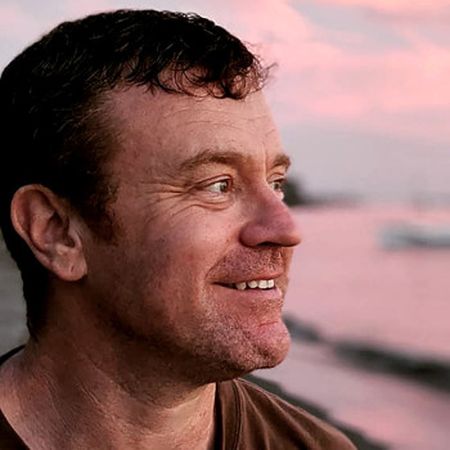
Glen Retief’s book, The Jack Bank: A Memoir of a South African Childhood, won a Lambda Literary Award. He teaches creative nonfiction at Susquehanna University and recently spent a year in South Africa as a Fulbright Scholar.
Comments
Scroll down to load comments...