




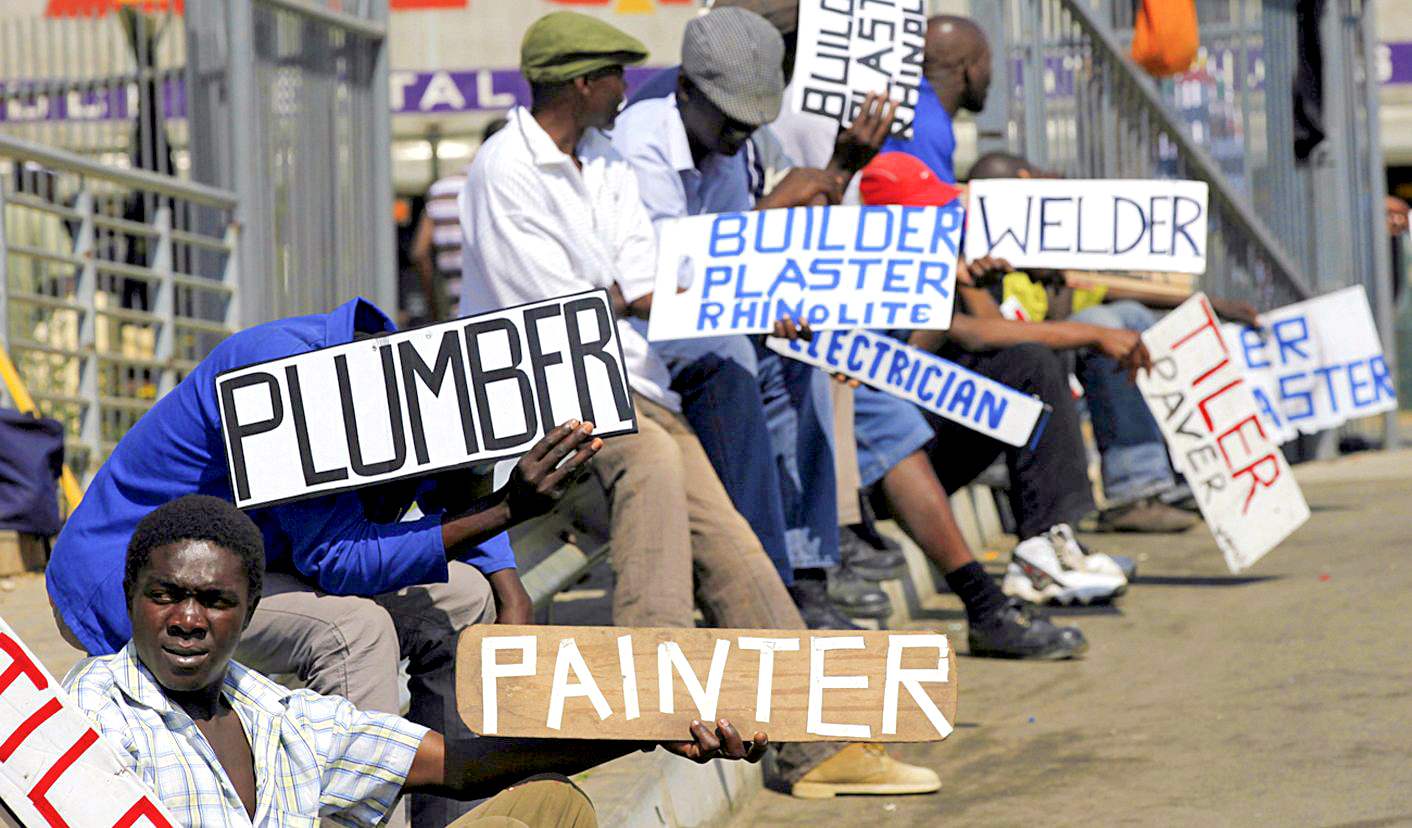
 Men hold placards offering temporary employment services in Glenvista, south of Johannesburg. (Photo:
Siphiwe Sibeko/Reuters)
Men hold placards offering temporary employment services in Glenvista, south of Johannesburg. (Photo:
Siphiwe Sibeko/Reuters)In June 1976, South Africa’s students ignited a fire that would burn down the apartheid system and change the country forever. The uprising was not because they believed change was imminent, but because they had decided that the world they had inherited was unacceptable and had to change.
The struggle today is fundamentally economic rather than political. But the stakes are just as real. Stats SA data for March shows the overall unemployment rate has risen to 32.7%, with youth unemployment even higher at 46% (that is 4.7 million people under the age of 35). Youth unemployment tends to be higher because young people without work experience are less able to compete for the jobs available.
Rising unemployment is the result of decades of economic failure. South Africa’s GDP growth rate from 2009 to 2026 was a miserable annual average of 1.1%. This is below the 1.3% annual population growth, meaning our GDP per capita has been declining by 0.2% per year for the past two decades.
Compare this with the sluggish Organisation for Economic Cooperation and Development (OECD) countries that grew annually by 1.5% per capita over the same period. Comparing South Africa with China, which grew more than 5.5% a year, gets depressing.
The employment intensity of growth also matters. Most countries depend on their small business and the informal sector to absorb the unemployed. In South Africa, however, we find 16 entrepreneurs per 100 people compared with 45 internationally.
The reason we have so few entrepreneurs is that South Africa is a country dominated by large businesses. Small businesses must navigate regulatory red tape and high taxes as if they are large businesses.
Additionally, apartheid excluded the vast majority from formal business experience for generations. Therefore, even though the National Development Plan in 2012 famously projected that 90% of the country’s new jobs by 2030 must come from small business, our regulatory environment keeps that door shut.
The rising unemployment also signals the failure of the taxpayer-funded education and skills development system. Internationally, according to OECD and World Economic Forum comparisons, South Africa is consistently both the highest spender and worst performer regarding educational outcomes.
And while we delay economic growth and skills reforms, the tsunami of AI is fast approaching our shores. AI is not a distant threat; it is already affecting entry-level work in auditing, financial services, logistics and administration. We can expect at least 40% of skills requirements to change by 2030.
Although many argue that AI will both destroy and create jobs, we must not be fooled. Those young South Africans who lose their admin and cashier jobs are not going to become AI engineers or AI ethics officers. Rather, we face an AI jobs bloodbath along the lines of the Covid job losses.
Even before AI, technology advances posed an external threat to a complacent South Africa. The automotive sector – one of South Africa’s most important manufacturing employers – faces structural disruption as Chinese vehicle brands are selling their offshore-produced, high-quality cars faster than those produced locally. This has implications for every plant, supplier and logistics operator in the Eastern Cape.
The calamitous unemployment data must not cause us to panic, however. Instead, the crisis must spur us to respond decisively.
What must a response look like?
First, as AI undermines youth employment, we must correspondingly introduce new rules that make it easier for companies to hire young people. As a country, we cannot win if half the team is not even on the field.
Therefore, our top priority is to ensure young people get their first work experience. The practical action is to amend labour regulations to make it much easier for employers to take a chance and hire someone without a track record. There needs to be a special employment dispensation for all work-seekers under the age of 25.
These new rules must extend to a revised dispensation to support the creation of small businesses, which will ultimately be the biggest employer of young people. Small businesses (meaning those generating less than R50-million a year in revenue) need to be given a reduced administrative burden and lower tax rate.
Second, youth job initiatives that have a proven track record and existing capacity must be scaled up immediately. In the Presidential Youth Employment Initiative, which includes Setas, technical and vocational education and training (TVET) colleges and other programmes, the Youth Employment Service (YES) accounts for 68% of all the demand-led youth jobs.
One way to scale up YES as the largest youth job creator is to cut red tape. For example, 40% of companies are blocked from participating in the YES programme because of a requirement that they first satisfy other B-BBEE criteria, like equity ownership, before they are allowed to sponsor youth jobs through YES.
Why stop thousands of companies from fully funding extra youth jobs? Indeed, the youth must be the first priority, not the last, of any true future-facing empowerment codes. Changing these priorities will boost YES to 200,000 youth jobs a year.
Public employment programmes also play a vital role. For every R1.65-billion of taxpayer funds, a further 100,000 young people can be mobilised and given valuable work experience while helping schools and clinics.
Third, we must radically reform taxpayer-funded education and training. South Africa spends R500-billion a year on education and skills development. The return on this investment is incredibly poor because the system focuses on certifications instead of employability. Indeed, barely 20% of students in TVET colleges are studying technical trades that the economy needs.
We do not need to spend more – we need to spend differently, with every economically relevant qualification tied to a guaranteed employment pathway, which can be co-funded by the government and private sector.
Training institutions that cannot demonstrate employability outcomes should be defunded and their taxpayer funds transferred to those that can. Merely redirecting 5% of our combined education and skills spending (about R25-billion a year), blended equally with employer co-funding, would fund 500,000 apprentice trades jobs a year. Young people who excel in the right courses will be guaranteed employment.
Finally, we will have to protect the jobs we already have from AI. We must regulate to ensure that AI cannot replace certain entry-level jobs. Just as South Africa regulated that petrol stations cannot move to self-service (which saved 40,000 jobs), we will have to do the same for endangered entry-level jobs such as cashiers, which are critical for youth employment.
If youth employment is indeed our top priority – as President Cyril Ramaphosa stressed in the 2026 State of the Nation Address – then we must see that in practice.
Accordingly, the state must review and progressively align all its laws, regulations and administrative measures to support employment creation in general and youth employment in particular.
Our economic transformation equation should be that transformation equals economic capacity. That is the real first prize: creating a virtuous circle in which our transformation efforts expand the country’s productive capacity. The more we strengthen our talent pipelines and unlock South Africa’s hidden youth potential, the more we accelerate the growth of future-facing sectors.
However, let us not be naive. The entire world is moving into an uncertain economic future. AI and new technologies are rampaging through labour markets. Indeed, as South Africa struggles to create an additional 10 million jobs by 2030, companies around the world are reducing their workforces. Globally, more can be produced with fewer workers.
As South Africa tries to solve youth employment, we will unavoidably be tackling a problem that is only deepening across the world. Future labour markets will inevitably require a combination of formal employment, self-employment, social support and “citizenship dividends” (that is, citizens having the right to universal income payments funded by corporate taxes).
Perhaps South Africa – which led the G20 in 2025 with the themes of solidarity, equality and sustainability – will introduce inclusive solutions to the growing gap between economic insiders and outsiders.
Indeed, if ever any time needed systems thinking and radical changes, it is now. On this 50th anniversary of the 1976 student uprising, we owe it to that generation, and to this one, to match their bravery.
South Africa’s youth deserve the same clarity of purpose from those of us who have the tools, the platforms and the responsibility to act. DM
Ravi Naidoo is the CEO of the Youth Employment Service and a member of the National Planning Commission.
This story first appeared in our weekly DM168 newspaper, available countrywide for R35.
/file/attachments/2993/DM-120626_491550.jpg)
Comments
Scroll down to load comments...