




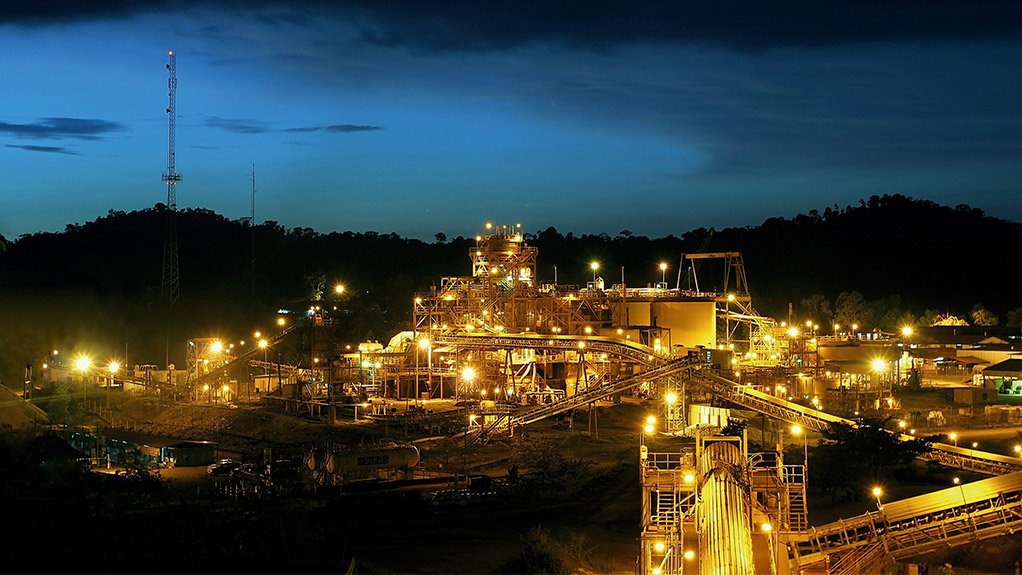
 Gold Fields is managing the transfer of the Damang mine (above) to the Ghanaian state after the government’s decision not to renew that operation’s lease. (Photo: Mining Weekly / Wikipedia)
For South African readers, the question may sound uncomfortably familiar.
When does legitimate economic transformation become something else?
When does a policy designed to increase local participation in the economy begin to look like a transfer of opportunity towards politically connected insiders?
Those questions increasingly surround Ghana’s mining sector, where a programme of resource nationalism championed by President John Mahama’s government is colliding with growing concerns from investors, mining executives and opposition politicians.
The debate followed Mahama all the way to London recently.
On a state visit, the Ghanaian leader met King Charles III and held talks with Prime Minister Sir Keir Starmer as part of a programme aimed at promoting his flagship “Reset Agenda” and attracting fresh international capital into the West African nation.
But the red carpets failed to draw attention from a series of disputes involving major mining assets, international investors and Engineers & Planners (E&P), the mining company owned by the president’s younger brother, Ibrahim Mahama.
Connected interests or resource nationalism?
Critics argue that strategic mining assets are increasingly gravitating towards politically connected interests under the banner of resource nationalism.
Supporters of the government argue that Ghana is simply doing what many resource-rich countries have long sought to do: ensure that a greater share of mineral wealth remains in local hands. Details of how local communities stand to benefit have yet to be provided.
“The argument that the dominance of E&P in the mining sector is tied to the political fortunes of Mr John Dramani Mahama is not only flawed, but undermines the business acumen of Ibrahim Mahama, the collective efforts of the board of directors, management and over 600 workers who have worked for close to 30 years to acquire and develop the technical and financial capacity for the company to operate,” a company spokesperson said.
The company also rejected suggestions that its emergence as the preferred bidder for the Damang mine was politically engineered.
“To suggest that E&P acquired Damang due to political influence belies the undisputed fact that E&P was given a No-Objection Letter by the previous NPP [National Patriotic Party] Government in March 2024 and that the acquisition was done through a bid process which was transparent and televised,” the spokesperson said.
On its dispute with Gold Fields, E&P argues that the matter is a straightforward commercial disagreement rather than evidence of political favouritism.
The distinction matters.
No serious observer disputes that Ghana should derive greater benefit from its gold resources. Nor do many investors oppose the principle of greater local participation.
State capture suspicions
However, the question increasingly being asked in boardrooms from Johannesburg to London is who is benefiting from the shake-up and is it a mere fig leaf for state capture, Ghana style.
At the centre of the controversy is London-based mining investor INIHC, the British subsidiary of Singapore investment group Ibaera Capital, which is locked in a dispute over the billion-dollar Black Volta gold project, one of Africa’s largest.
Wisdom Gomashie, co-head of the opposition NPP’s mining committee, described the government’s new mining framework as “an outright land grab”.
“It is nothing more than a smoke screen for appropriation,” he said. “There is no indication or clarity on how Ghanaians will benefit, nor transparency on how these policies are being carried out.”
The Mahama administration insists its reforms are designed to ensure Ghanaians receive a greater share of the benefits, but the debate threatened to derail Mahama’s London trip after he failed to address perceptions of a conflict of interest.
“There is a huge contrast between investor concerns and the government’s Reset Agenda,” said James Wallbank, a partner at Ibaera Capital. “There is no appetite to invest in Ghana at the moment.”
Gold Fields dispute
One of the most significant developments involves Gold Fields, a major investor in Ghana for more than three decades.
Gold Fields is currently attempting to renew the mining leases for Tarkwa, its largest operation in Ghana. At the same time, it is managing the transfer of the Damang mine to the Ghanaian state following the government’s decision not to renew that operation’s lease.
Complicating matters further is a legal battle with E&P. E&P has reportedly submitted two claims against Gold Fields worth a combined $740-million — $474.9-million relating to the Tarkwa mine and $264.7-million relating to the Damang mine.
Gold Fields has rejected the claims.
“Based on the opinion of our legal advisers, we believe that neither prospective claim has merit and intend to defend our position,” the company said.
While remaining confident that its Tarkwa lease renewal application complies with Ghanaian law, Gold Fields has acknowledged that broader reviews of mining and fiscal regulations have introduced “some complexity” to the process.
The company recently established a dedicated board subcommittee to oversee what outgoing chairman Yunus Suleman described as the “increasingly complex Ghana jurisdiction”.
Gold Fields sources argue that one of the central unanswered questions concerns whether Ghana is obtaining fair value from the transfer of strategic mining assets.
More quarrels
The controversy extends well beyond Gold Fields.
Reuters recently reported that Ghana’s Minerals Commission has instructed major international miners, including Newmont, AngloGold Ashanti and China’s Zijin Mining, to transition mining operations to local contractors by December 2026 or potentially face sanctions.
Government officials reject suggestions that these changes mean Ghana is becoming hostile to investors.
In a recent address to the Ghana Chamber of Mines, Lands and Natural Resources, Minister Emmanuel Armah-Kofi Buah said maintaining confidence, predictability and stability in the mining sector was “a strategic priority” for the government.
Buah argued that controversial cases such as Damang should be viewed as isolated matters rather than evidence of a broader shift in policy.
“These are isolated cases, handled in accordance with relevant legal and regulatory frameworks, and on a case-by-case basis,” he said.
The minister also stressed that the government remained committed to consultation and partnership with industry and announced the temporary suspension of a controversial directive requiring mining companies to move to contract-mining arrangements pending further legal review and discussions with industry stakeholders.
All this comes with gold prices near record highs, legal disputes multiplying and questions continuing to swirl around the future direction of Ghana’s mining sector. DM
Jonathan Clayton is a former Africa correspondent for The Times of London and Reuters. Over a reporting career spanning more than three decades, he covered many of Africa’s defining events, including the Rwandan genocide, the conflicts in Sierra Leone and Liberia and South Africa’s democratic transition. He now works as an independent journalist, editor and analyst, advising media organisations, international institutions and think tanks.
Comments
Scroll down to load comments...