




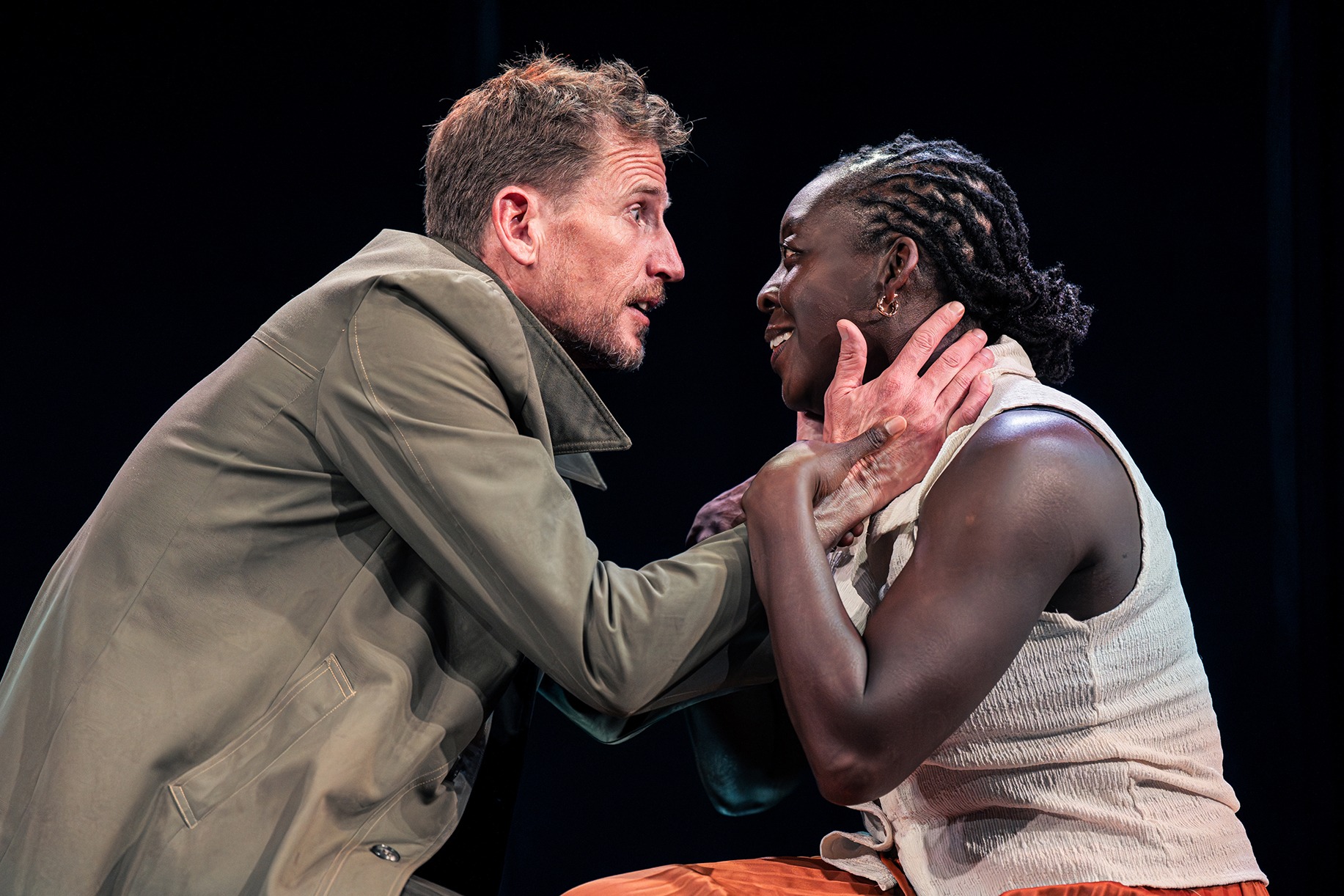
 Mark Elderkin and Mwenya Kabwe in Constellations. (Photo: Daniel Rutland Manners)
 Among the various descriptors used to market Nick Payne’s 2012 play Constellations, which is showing at the Baxter Studio in Cape Town, one word in particular caught my eye: “mindbending”.
Oh, please! It’s not.
Although the play is set in a vast constellation of possible realities and toys with the idea that whatever we’re seeing on stage at any given point might in fact be contradicted by the same scene currently happening in another universe, it is not so much “mindbending” as it is an unexpectedly tender, sometimes brittle exploration of the fragile bonds that link us to the other people in our lives.
Yes, it straddles both physical and metaphysical realities, but in essence, it’s simply a compendium of possible love stories, with all their ups, downs, highs and lows, and then one hell of a blow. In the end, the play wants to make you cry over its one chosen ending, but also leaves you wondering about the infinite alternative endings that might have been.
/file/attachments/orphans/Constellationsisacompendiumofpossiblelovestories_DanielRutlandManners_618258.jpg "Constellations is a compendium of possible love stories. (Photo: Daniel Rutland Manners)")
In the process, it doesn’t simplistically follow the chronological dynamics of an A-to-Z plotline. Instead, it’s a sometimes straightforward, sometimes muddled, sometimes chaotic love story that’s crafted as much to showcase the magic and mystery of the human heart as it is designed to provide insight into what might be called the calculus of love. Or maybe the mathematics of human emotions.
It is a play about two people, yes, but it is also about how these emotions of ours add up – and how, more often than not, they don’t.
In Payne’s imaginary universes, there are two people in particular – Roland and Marianne – and what we are led to understand is that the time they’re about to spend together is both finite and infinite. And that they will spend any of it knowing one another is entirely random.
That’s the crux of the play: every one of our relationships, our every interaction, and all of our multitudinous encounters with any of the infinite atoms in the universe – all of these moments, whether infinitesimally brief or eternal, are the result of some random set of variables.
And thus when these two individuals accidentally collide and Marianne opts to use being bumped into as an excuse to make conversation and show Roland what she can and cannot do with her tongue, an entire multiverse of endless possibilities is summoned into existence.
/file/attachments/orphans/MarkElderkinandMwenyaKabwesperformancesareperfectlycalibrated_DanielRutlandManners_225858.jpg "Mark Elderkin and Mwenya Kabwe’s performances are perfectly calibrated. (Photo: Daniel Rutland Manners)")
It very quickly becomes clear that we in the audience are watching not just one potential romance between Roland and Marianne, but one and then another and another, and on and on and on, and soon, because human minds are built that way, we’re editing together multiple strands of various possible stories, concocting endless possible scenarios and outcomes.
Some of those stories will make us laugh, some may end in tears, and some could very well fizzle out just as quickly as they were imagined into being.
Payne has some of these scenes play out again and again, each time with subtle and not-so-subtle deviations from the previous rendition, the idea being to give us a look at multiple iterations of a moment and how each flap of the proverbial butterfly’s wings might alter the future.
It’s a clever, beautifully low-key play, one that relies on the synergy and chemistry between the two actors – in this case Mwenya Kabwe and Mark Elderkin – to make the real sense of the play come alive. Both actors do a fine job of avoiding any clichéd emotional pitch, and this makes it all the more moving, the tenderness that much more believable because there’s such a lack of melodrama, even when some of the deepest, darkest torments of life and death, love and betrayal are being examined.
This minimalist approach, in the sense of having the actors stick to the emotional truth of their characters rather than leaning into unnecessary embellishment, has the additional effect of making the play feel somehow more raw – it’s as though director Jay Pather wants us to simmer in the truth of the play’s ideas, and trusts Payne’s text to make us feel what his characters must feel.
/file/attachments/orphans/Constellationsisabouttherelentlesspush-pullofrelationships_DanielRutlandManners_786159.jpg "Constellations is about the relentless push-pull of relationships. (Photo: Daniel Rutland Manners)")
Kabwe and Elderkin’s performances succeed admirably in solving the production’s complicated calculus; they’re so perfectly calibrated, I thought, that I could almost feel the tears welling up, as if on cue, at precisely those points in the play when the ultimate truths about life, the universe and everything were revealed in the most human way possible.
It’s impossible to escape the feeling that Constellations is also about the relentless push-pull of relationships and about the never-ending battle we humans have to find equanimity. Occasionally, I just wanted the characters to pull themselves together, to stop glitching in and out of the specific reality I wanted for them so that I could see them drop their defences and smother one another with love.
But, of course, that’s not how we humans are programmed; too frequently we say the opposite of what we mean, or we miss an opportunity to say the thing that might have changed everything. The point is, though, that the play made me believe in the existence of hope – one of those fundamentally human attributes that we could do with a lot more of.
The play is clever, for sure, but there’s comedy, too, mostly droll and slyly off-beat: elbows, the weird sex habits of bees, and the fact that an academic who is into space physics turns out to have a knack for existential philosophy – these are the kinds of subjects Payne muses with in order to make us laugh, or smile.
/file/attachments/orphans/Thesetdesigntransformsabstractspaceintorichvisualmetaphor_DanielRutlandManners_962210.jpg "The set design transforms abstract space into rich visual metaphor. (Photo: Daniel Rutland Manners)")
The deceptive simplicity of the drama is mirrored by a beguilingly simple set, designed by Wolf Britz, who knows how to transform abstract space into rich visual metaphor.
Apart from a trio of disco mirror balls and some backdrop screens onto which liminal imagery is projected, on stage are a pair of mobile reflective rostra that look perhaps like large, three-dimensional shards of shattered glass. These get pushed around, turned on their sides, sat on, lain on, fallen from.
Sometimes having the actors move these set components around works to simply create breathing space between the many brief scenes. But their movement also suggests that we’re witnessing a fractured environment, one that’s always in flux.
It’s both a kind of theatrical everywhere and an ambiguous nowhere: we’re in a land of ideas and words, a place where it’s the carefully crafted, exquisitely calculated dialogue that causes the vibrations between the actors, brings the characters to life and makes us yearn for them to live happily ever after.
It is, after all, a play about what a perfectly random and therefore utterly miraculous thing it is to be alive. Never mind the chances of falling in love with someone who possesses the power to alter our reality.
Perhaps it is, in fact, “mindbending”. I certainly can’t stop thinking about it. DM
Constellations is showing at the Baxter Studio in Cape Town until 20 June. It will transfer to Johannesburg’s Theatre on the Square on 23 June.