




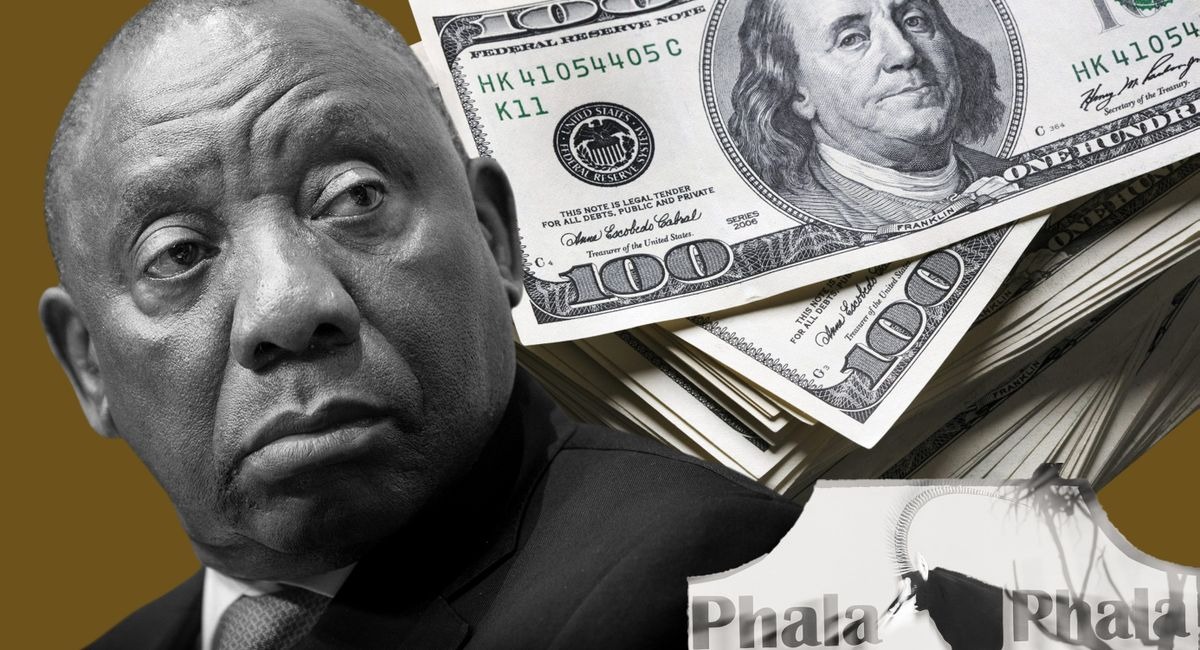
 Illustrative image: President Cyril Ramaphosa. (Photo: Jaco Marais / Gallo Images) | US dollars. (Photo: iStock) | President Cyril Ramaphosa’s Phala Phala farm in Limpopo. (Photo: Leon Sadiki)
Thirteen months into the trial over the theft of at least $580,000 from President Cyril Ramaphosa’s Phala Phala farm, lawyers of the three accused say they remain confident of being acquitted, arguing that the State has failed to produce direct evidence linking them to the burglary.
With both the State and defence having closed their cases, the prosecution has until Friday, 3 July, to file written heads of argument. The defence will then have 15 days to respond before oral arguments are heard in August.
At the heart of the defence’s case is the argument that prosecutors are relying on circumstantial evidence including cellphone records, financial transactions and witness testimony – rather than direct proof that any of the accused took part in the theft.
“The State’s case is weak. We are standing on our application for discharge simply because the State is relying on circumstantial evidence,” said Koena Matlala, who represents first accused Imanuwela David.
David, together with siblings Floriana and Ndilinasho Joseph, is accused of carrying out the burglary at the Limpopo game farm in February 2020.
The State alleges that Floriana Joseph, who was employed as a cleaner at the farm, discovered the wads of cash hidden inside a couch and alerted her brother, Ndilinasho, who then allegedly informed David, whom the State has described as the mastermind of the burglary.
The three Namibian nationals face charges of conspiracy to commit housebreaking with intent to steal and theft, as well as two counts of housebreaking with intent to steal and theft. David also faces a money laundering charge.
Following the money
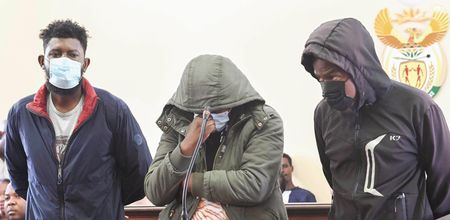
/file/attachments/orphans/ED_477844_614988.jpg "(From left) Imanuwela David (39) and Froliana Joseph (30) appear at Bela-Bela Magistrate’s Court on 7 November 2023 in connection with the robbery at President Cyril Ramaphosa's Phala Phala farm in 2020. Along with Joseph’s brother, Ndilinasho, they have been charged with theft, housebreaking with intent to steal, conspiracy to commit robbery, conspiracy to commit housebreaking with intent to steal. (Photo: Deaan Vivier / Beeld / Gallo Images)")
Throughout the trial, the State sought to build its case using cellphone evidence, financial records and witness testimony relating to David’s spending patterns after the burglary.
The court heard from a financial analyst, who testified that David’s bank account activity surged from about R126,000 in 2019 to more than R3-million in 2020, after the theft. That evidence supported what the State has maintained – that David’s lifestyle “dramatically” changed after the burglary.
During the State’s case, the court heard that David spent more than R5-million on a fleet of luxury vehicles, including one he bought for his “baby mama”.
Evidence presented in court also showed that he spent R250,000 on custom-made dental grills, R70,000 on adding diamonds to his Rolex watch, and R1-million on a property in Rustenburg, North West.
David has denied that any of the money originated from the Phala Phala burglary.
Instead, he testified that he operated several legitimate businesses, including a logistics company and a motor spares business that continued operating as an essential service during the Covid-19 lockdown. He also told the court that he sourced vehicles for clients in Malawi and earned substantial commissions from those transactions.
Defence attacks cellphone evidence
The State has relied heavily on testimony from a cellphone analyst, who placed the accused in the same general areas before and after the burglary and identified numerous calls between the phones linked to them.
Matlala argued that the evidence established little more than proximity.
According to the defence, cellphone tower records indicate only that a device was within the coverage area of a particular tower and do not place a person at a specific location.
He further argued that network congestion and technological limitations can result in phones connecting to towers outside their immediate vicinity.
David has also offered alternative explanations for his presence in the area around the time of the burglary.
He testified that he has family ties to a village near Phala Phala, owns a house in the area and had travelled there for personal reasons. He also claimed he intended attending a car show in Bela-Bela, Limpopo, and had been visiting relatives, including his mother in Rustenburg.
No case to answer – Joseph siblings
/file/dailymaverick/wp-content/uploads/2025/10/IMG_3128.jpg "(From left) Ndilinasho Joseph, Floriana Joseph and Imanuwela David in the dock. (Photo: Nonkululeko Njilo)")
For advocate Relleng Masipa, who represents the Joseph siblings, the State’s case is even weaker.
“From where we’re standing insofar as our clients are concerned, the State has not proven a case against our clients,” he said.
Masipa has maintained this position throughout the trial and previously made unsuccessful attempts to have the charges withdrawn.
Most recently, he joined a Section 174 application brought by the defence, arguing that the State had failed to present sufficient evidence to justify putting the accused on trial.
“We’re standing on the position that there is no case because after the Section 174 application there is no new evidence that changes that position,” he said.
State witnesses change their stories
Perhaps the biggest boost for the defence came from two witnesses who allegedly transported the accused before and after the burglary.
The State argued that the witnesses, who, as per court order, may not be named, helped move the accused between Limpopo and Gauteng during the period in which the theft was planned and ultimately carried out.
One of the witnesses initially told police that he had transported the accused and had been paid $30,000 for his services. However, when he testified in court, he dramatically changed his version.
He denied receiving $30,000 and instead claimed he had only been paid R7,000 to transport the group from Limpopo to Johannesburg.
He also told the court that he had been frightened when he made his original statement and suggested that parts of it were not true and that the investigating officer had threatened to send him to jail for a long time.
The State attempted to have him declared a hostile witness because of his contradictions, arguing that he was no longer supporting the version he had given the investigating officers.
The defence seized on the development, with one lawyer describing the State’s application as “a last kick of a dying horse”.
A second transport witness also created difficulties for the State.
While he acknowledged knowing the Joseph siblings, he attempted to distance himself from David, despite having previously told police that he knew him through their work in the security industry.
He also alleged that police had pressured him into signing his statement and threatened his life.
The defence argues that the contradictions and allegations made by both witnesses undermine the reliability of important parts of the State’s case.
NPA insists evidence is strong
Despite the setbacks, the National Prosecuting Authority (NPA) remains convinced it has made a compelling case before the court.
Limpopo NPA spokesperson Mashudu Malabi-Dzhangi said the cellphone evidence, viewed together with the broader body of evidence, points to coordination between the accused before and after the burglary.
“All the cellphones of the three accused were communicating days before the event happened. They were placed in the same area, including Bela-Bela. During the night of the incident, there were numerous conversations between them and afterwards the phones moved together to Gauteng,” Malabi-Dzhangi said.
“That is why the State has argued that accused two and three were also involved in the commission of the crime,” Malabi-Dzhangi added.
These developments comes against the backdrop of a probe by the police watchdog, the Independent Police Investigative Directorate, which found that the theft case was mishandled by members of the Presidential Protection Service and that an unlawful informal investigation was opened without first opening a criminal case or inquiry.
A criminal case was only formally opened in 2022, nearly two years after the theft.
Last week, Parliament’s Portfolio Committee on Police heard that key evidence, including the couch in which the cash was allegedly hidden, was never recovered. Police leadership nevertheless rejected allegations of wrongdoing.
The Modimolle Magistrate’s Court will ultimately have to decide whether the cellphone records, financial evidence and witness testimony are enough to prove the accused’s guilt beyond a reasonable doubt, or whether the defence is correct that the State’s case is largely circumstantial. DM
Comments
Scroll down to load comments...