




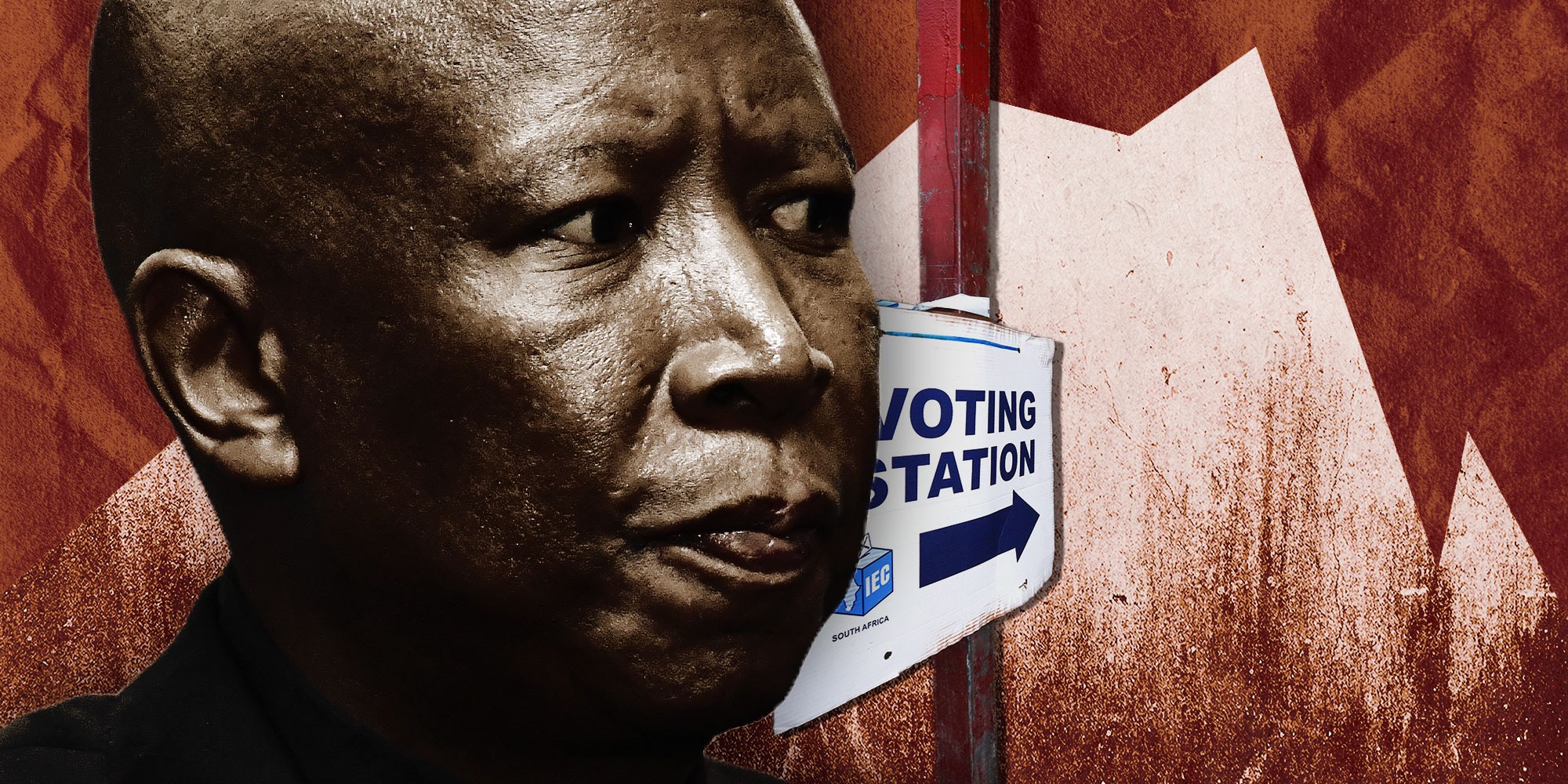
 Illustrative image: EFF lesder Julius Malema. (Photo: Gallo Images / Frennie Shivambu) | Voters at Sivuyiseni Primary School in Khayelitsha on 29 May 2024. (Photo: Shelley Christians) | (By Daniella Lee Ming Yesca)
 The latest evidence that EFF leader Julius Malema does not just benefit from alleged criminals but uses his political power to actively aid them makes the mountain he has to climb these local elections much steeper. His protestations that his relationship with deputy SAPS Crime Intelligence head Major-General Feroz Khan was simply that of old friends might fall on the deaf ears of increasingly cynical voters.
While Malema and the EFF burst onto the political scene in the 2014 elections with an agenda of radical change, that message has become increasingly obscured by the corruption claims against him.
The latest evidence, contained in an affidavit from the Madlanga Commission, that he used his power in Parliament to actively help a senior official in the SAPS commit corrupt acts may be impossible to explain away.
What innocent explanation can there be for causing then EFF MP Mbuyiseni Ndlozi to ask a question deliberately designed to lead to the removal of the then inspector-general of intelligence, Setlhomamaru Dintwe?
Or for Malema to request from Khan, and then receive, the details of the person who lodged criminal charges in the VBS scandal?
While Malema has not yet responded publicly and personally to these latest developments, the narrative may be just beginning. Khan is due to testify at the commission in three weeks.
If that goes ahead the pressure on Malema will grow. Khan may find it impossible to provide explanations for this communication.
The greatest victory he ever scored was being able to demand he be treated to a different standard from the way he treats everyone else.
In a worst-case scenario the commission’s investigators might even be able to get access to Malema’s phones. Or he may even have to testify himself.
And while certain EFF leaders have claimed on social media that there is nothing wrong with Malema being in communication with a senior police officer, how is it that this same officer was also actively plotting to use his power as a police officer to weaken a competitor of the cigarette smuggler who was funding Malema?
The same people who claim there could be an innocent explanation for all this will also not accept that there could be any kind of innocent explanation from President Cyril Ramaphosa for Phala Phala.
While Malema has undoubted political gifts, the greatest victory he ever scored was being able to demand he be treated to a different standard from the way he treats everyone else.
In the moments after the Constitutional Court ruling against Parliament on Phala Phala he claimed, with a straight face, that Ramaphosa was now facing the equivalent of criminal charges and thus should stand down.
If Geordin Hill-Lewis were to be found to have been in communication with a police officer about individuals or companies, Malema would be among the first to demand that he step down.
This hypocrisy has been able to lubricate his way through the evidence that he clearly benefited from the looting of VBS Bank, the fact he influences tenders in metros and has been profiting from politics for many years.
The EFF’s main problem, that it is totally reliant on Malema and his personality, has become even more entrenched.
While it is difficult to know why individual voters make the decisions they do, this behaviour must have had an impact on many people who might have voted for him.
The 2024 elections showed the EFF had lost momentum, as its share of the vote fell from 10.8% to 9.5%.
At the time it was difficult to know whether people seeking radical change had left the EFF in favour of the uMkhonto Wesizwe (MK) party. In MK’s heartland of KwaZulu-Natal, the EFF won just 2.26% in 2024, compared with 9.71% in 2019, suggesting this might have been the case. This means Malema’s task now is to win those people back.
This will be harder now than it was in the past, not just because there are more players in our politics, but because he does not appear to have the human resources he began the EFF with.
Both Ndlozi and Floyd Shivambu have left the party. And while there is a deputy leader in Godrich Gardee, he has not assumed a very public posture. This means that the EFF’s main problem, that it is totally reliant on Malema and his personality, has become even more entrenched.
His attempt to make a martyr of himself after being convicted of firing a semi-automatic gun above a crowd of people suggests this will not change. And any interview with any curious interviewer will surely end up concentrating on his relationship with Khan and these claims against him.
It is astonishing how important one week in 2023 has now become so important to the position in which Malema finds himself now.
In July that year the EFF hosted a gala dinner as part of its 10th anniversary celebrations. Khan attended, the first public sign of the relationship between him and Malema. If he had not gone to that dinner very few people would have known that they had some kind of connection. It is also unthinkable to imagine a police officer who holds such rank attending any other party’s event.
And if they had, the EFF would have been the first to complain.
At that same event Malema spoke about the person who gave him the money for the EFF’s first election deposit in 2014.
He said: “We are very proud of Adriano Mazzotti and are not ashamed to associate with him. We don’t know his business because he’s not our business partner. We don’t run an underworld, we are running an above world. Don’t be scared that we are part of anything that Mazzotti does”.
Malema’s real test will be to return to the days when he was able to set the national agenda.
The evidence in the Khan documents shows that, in fact, the EFF wanted to help Mazzotti’s cigarette company and weaken his rivals. And that he was using Khan’s police power to do it.
This gives his critics the ammunition they need; it reveals that his claim that we “don’t run an underworld” is not true.
Also at the dinner he spoke about the leadership of the EFF. He claimed to support democracy in the party but then said, in an apparent reference to Shivambu: “I am very ruthless against such people who organise things against me, so never try that with me. And he knows that because I have never lost a conference in my entire life.”
Thirteen months later Shivambu left the EFF and in a shock move joined MK (he then left MK and formed his own party).
Several days later the climax of the EFF’s celebrations was held at FNB Stadium, where Malema gave a speech that ended with him being raised on a crane platform.
After that event he claimed some members of the party who held elected positions in councils and legislatures and Parliament had not bused in enough people for the event and must be removed.
That amounted to 210 people, roughly one-sixth of the EFF’s elected public representatives at the time.
To lose such a high proportion of people, for such a small issue, might well have had an outsize impact on the party’s organisation ahead of 2024. It was also a warning to others who might have been attracted to the EFF: you can never rise to the top job and you will have to massage the leader’s ego.
All of this might suggest that Malema and the EFF are going to lose support in this election.
Of course, there will be different dynamics in different places. The EFF has tended to do slightly better in Tembisa and parts of Limpopo than anywhere else. Local elections reward charismatic candidates in certain wards (although the EFF has often battled to win local wards).
And people who supported MK in 2024 might well go back to the EFF.
But Malema’s real test will be to return to the days when he was able to set the national agenda.
The real source of Malema’s power in the past few years has been through coalitions and his willingness to manipulate them to his own ends.
The real damage of the Khan evidence might be that his ability to do this through the Ramaphosa impeachment process will now be severely limited.
While he might have been able to use that committee to portray himself as an anti-corruption crusader, any legitimacy to do this that he might once have had has disappeared.
It is even possible that while he is grandstanding at the committee he will receive a summons to appear at Madlanga, which might steal his thunder slightly. This may be the real damage – that he will have lost an ideal opportunity to capture the public narrative ahead of November.
But that does not mean his political power might be dramatically reduced if the EFF does lose support. The real source of Malema’s power in the past few years has been through coalitions and his willingness to manipulate them to his own ends.
He has made it clear that he can help people get into power and stay there. It is now even clearer what his price is – he wants to be able to use that power to influence tenders and receive a cut in return.
Absent a dramatic reversal, a strange turn of political events (where parties either find themselves able to survive without him or refuse to talk to him) or the National Prosecuting Authority formally charging him with corruption, he might retain this power after the elections.
Malema is in a difficult and possibly dangerous position. He will have to navigate the next few months very carefully, making sure political statements don’t hurt his legal position.
As a result, he might have to fight these elections with one hand behind his back at a time when he has to prove that his momentum has not finally run out. DM
Comments
Scroll down to load comments...